Nov 10, 2026
Are M12 connectors universal?
M12 connectors are not universal, although compatible interfaces may mate across brands. When I handle a replacement inquiry,…

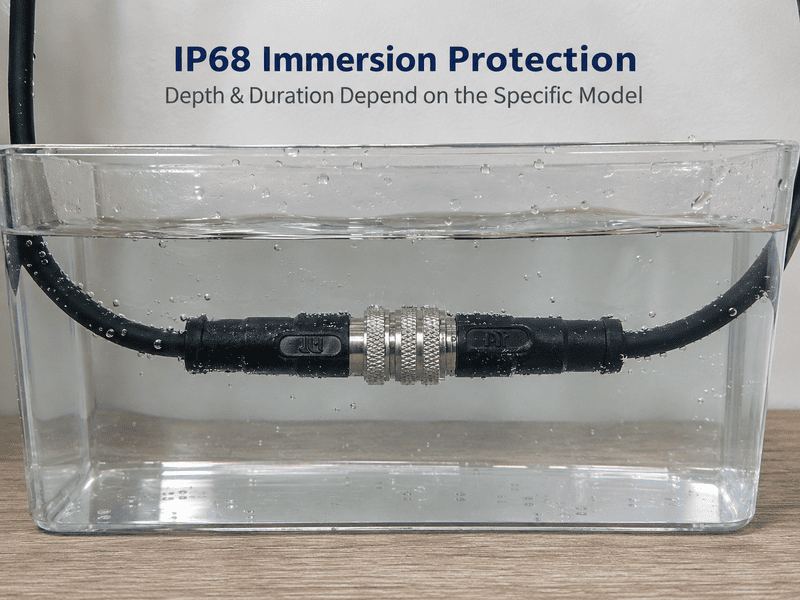
IP68 waterproof connectors are conditionally protected, not immune to water in every situation. When I discuss connector selection with buyers, I often find that “IP68” sounds like a complete answer, even though it does not specify one universal depth or duration. That misunderstanding can lead to a mismatch between a connector’s tested configuration and the conditions in an industrial installation.
IP68 means that a product is dust-tight and has protection against immersion under conditions specified by its manufacturer. The “6” indicates dust protection, and the “8” indicates immersion protection beyond the conditions associated with IPX7.1 The rating does not set one universal water depth or immersion time, and it does not promise permanent protection at any depth.2 Buyers need to check the exact model’s documented test conditions and installation requirements.
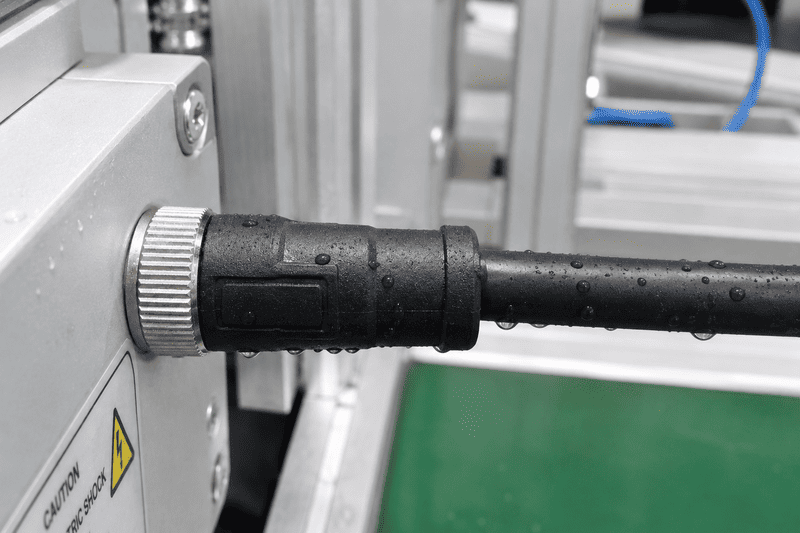
I approach the question by first asking what water exposure the equipment will face, and how the connector will be assembled when that exposure occurs. The answer depends on more than the rating printed on a product page. The mating component, cable entry, panel seal, installation method, and maintenance condition can all affect whether the installed connection is suitable.
The phrase “IP68 waterproof” can make a product sound protected in any wet environment. In industrial procurement, that interpretation is too broad. I treat IP68 as a rating that needs to be read alongside its test conditions, because the rating alone does not tell me whether a connector matches a machine’s actual water exposure.
IP ratings classify protection provided by an enclosure against access, solid objects, and water under defined test conditions. The first digit in IP68 is 6, which indicates dust-tight protection. The second digit is 8, which indicates protection against immersion under conditions specified by the product manufacturer. Those conditions are essential: the code alone does not promise protection at every depth, for every duration, or in every installation.
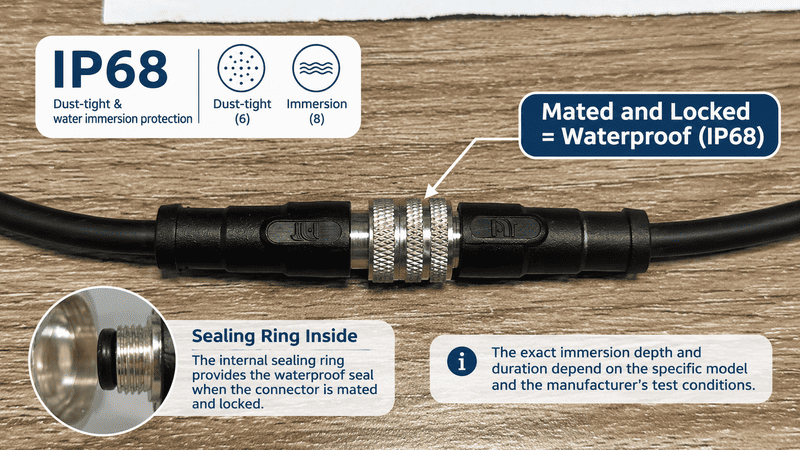
In a buyer inquiry, I may be asked simply, “Is this connector waterproof?” I cannot responsibly answer that question from the IP code alone. I first need to know what exact product the buyer means and whether the rating applies to the configuration being considered.
A product’s published rating may apply only when the connector is correctly assembled and mated with a specified counterpart. A bare connector body, a cable assembly, and a panel-mounted receptacle may have different sealing interfaces. If the catalog statement does not say which configuration was assessed, I ask for the relevant datasheet, installation instructions, or test documentation.
For procurement, the useful question is not just “Does it have IP68?” It is also:
I use manufacturer documents to establish the limits for the particular part number. A rating shown for one connector or product family should not be assumed to cover every variant, cable length, accessory, or customized assembly. Likewise, an example from another brand can show that test conditions vary, but it cannot establish the performance of a NITAI product or any other model.
The distinction matters because an enclosure can pass an immersion test in one configuration and still be unsuitable for a different exposure. A connector that is mated and locked during testing may not have the same protection when it is unplugged.3 A panel connector tested with a particular seal may not retain that protection if the panel cutout, mounting surface, or fastener arrangement differs.
When I help narrow a selection, I keep the claim within the evidence available for the exact model. If the buyer’s application needs a specific immersion duration or pressure, I look for documents that address those conditions. If the documents do not establish a fit, I recommend confirming the application with the manufacturer or a qualified professional rather than treating the IP code as a guarantee.
An IP68 label does not give buyers one standard water depth and duration to use for every product. This uncertainty can make a selection feel straightforward until a system integrator needs to compare a connector’s documented conditions with a particular installation. I therefore check the product-specific immersion limits before treating IP68 as relevant evidence.
For IP68, the manufacturer specifies the immersion conditions for the product. Buyers should verify the stated depth or pressure, the duration, the water or other test medium, and the tested assembly configuration in the documentation for the exact model. They should not infer a universal depth or time from the number “8.”
Water depth matters because deeper immersion produces greater pressure.4 Duration matters because an installation may face a short event or prolonged submersion. Temperature and the type of liquid can also affect whether a result applies to the buyer’s use case.5 The actual selection question is therefore whether the documented test conditions are relevant to the expected exposure, not whether the product has the right-looking code.
I ask buyers to describe the exposure in practical terms:
This information helps prevent an unsupported comparison. A published example for a different connector might list particular immersion conditions, but those figures apply to that product’s declared test, not to all IP68 connectors. I do not transfer another manufacturer’s depth or duration to a NITAI model. For NITAI products, buyers should confirm the claims in the documents available for the specific part number and configuration.
The same care applies when the order includes customization. A cable length, cable type, connector variant, or assembly change could affect what documentation is relevant. Buyers should request technical information that corresponds to the configuration they intend to purchase. A catalog entry for a standard assembly may not, by itself, demonstrate that a customized assembly has the same tested protection.
A product’s immersion rating also does not automatically establish long-term performance in a real machine.6 Wear, maintenance, cable movement, incorrect assembly, and damaged seals can change the condition of a connection over time. If a machine faces repeated immersion or a demanding operating environment, the buyer should include inspection and maintenance requirements in the evaluation.
Two connectors can both be marked IP68 and still have different sealing arrangements. Buyers who focus only on the connector body may miss a leak path at the mating face, cable entry, or panel mounting point. I check where the seals sit and which assembly conditions the product documents require before evaluating the protection of the complete connection.
Many connector products have an immersion rating only when they are correctly mated and locked. The rating may not apply when a connector is unplugged. Buyers should verify the exact model’s instructions and check whether a compatible protective cap is specified for an unmated condition.
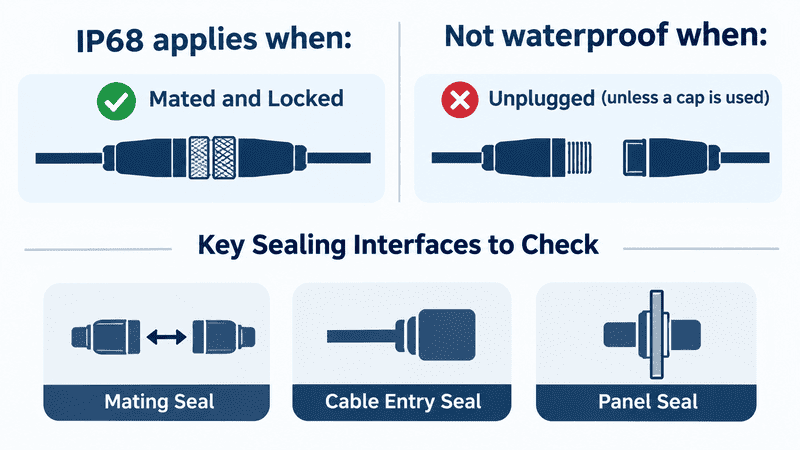
The required checks depend on the connector’s construction. I use the following distinctions when reviewing a proposed connection:
| Product configuration | Interfaces to verify |
|---|---|
| Pre-assembled cable connector | Mating interface, cable-to-connector seal, and the specified counterpart |
| Field-assembled connector | Seal components, supported cable diameter, assembly sequence, and tightening requirements |
| Panel receptacle | Mating interface, panel seal, mounting dimensions, and the stated coverage of the rating |
For a pre-assembled cable product, the cable entry and overmold or rear seal matter as much as the mating end. I check whether the cable assembly documentation identifies a compatible counterpart and the required locking method. A connector may not seal correctly if it is partially mated, cross-threaded, or fitted with an incompatible mating half.
For a field-assembled connector, installation can determine whether the sealing system works as intended. The cable diameter must fall within the stated range for the seal. The installer must fit the sealing components in the right order and apply the specified tightening method. If the seal is pinched, omitted, contaminated, or used with an unsuitable cable, the assembly may not match the manufacturer’s documented configuration.
For a panel receptacle, the front mating interface is only one part of the installation. The panel seal, cutout dimensions, surface condition, mounting hardware, and installation torque may also matter. A rating claim for the receptacle should not be assumed to cover any panel or enclosure without checking what the documentation includes.
I find a simple interface sketch useful when a team is comparing products. The sketch can mark the mating seal, cable-entry seal, and panel seal, then identify which parts are included in the tested configuration. It does not replace a datasheet or test report, but it helps buyers spot gaps in an assembly description.
When a connector is unplugged, I check whether the manufacturer documents protection in that state or specifies a cap. I do not assume that a connector rated when connected remains protected when open. The same principle applies to an assembled cable or equipment enclosure: one rated component does not automatically prove that every joint in the overall system has the same protection.
A product that meets an immersion condition may still be a poor choice for a washdown or corrosive environment. Buyers can overlook this distinction when they treat “waterproof” as a general term for all water contact. I separate immersion, water jets, and material exposure because each describes a different demand on the connector and its seals.
IPX8 concerns immersion under manufacturer-specified conditions. It does not automatically mean that a product also meets every water-jet protection requirement, such as those associated with IPX7 or other water-protection ratings. Buyers should check the product’s documented claims for the specific exposure instead of inferring them from IP68 alone.
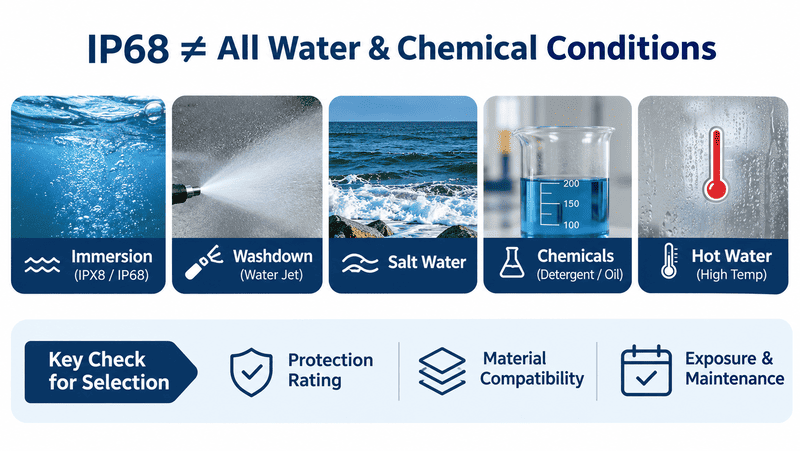
Rain, standing water, temporary immersion, high-pressure cleaning, hot-water washing, salt spray, and chemical cleaners are not interchangeable conditions. A connector selected for one may need additional verification for another. The pressure and temperature of cleaning equipment, for example, can differ substantially from the conditions used in an immersion test.
For procurement, I separate the assessment into two questions:
I then compare those answers with the ratings and material information for the exact product. An IP code addresses a defined form of enclosure protection. It does not, by itself, establish that the connector’s contacts, housing, seals, or cable jacket are compatible with a particular chemical or corrosive environment.7 For salt water or cleaning agents, I ask for material compatibility information that matches the actual exposure and concentration.
Repeated exposure also introduces maintenance questions. Seals can age, become damaged, collect debris, or lose their intended position during servicing.8 A connection that was assembled correctly may not remain in the same condition after repeated mating cycles or cable movement. Buyers should review inspection intervals and replacement requirements where the application depends on continued sealing.
I avoid treating a high-pressure cleaning process as equivalent to immersion simply because both involve water. The force and direction of a jet can challenge an enclosure differently. If the equipment will be cleaned with pressure or heat, the buyer should seek documentation for that use and confirm that the test conditions match the cleaning process.
This distinction is useful when comparing product offers. I look for explicit information about the protection type, tested state, and environmental compatibility. If a supplier’s document only lists IP68, I treat that as one part of the evaluation, not as proof of suitability for every outdoor, washdown, marine, or chemical application.
A short “IP68” line in a quotation may not answer the installation questions that determine fit. Procurement teams also need to compare mating parts, cable details, mounting conditions, and the evidence behind the claim. I use a consistent review sequence so the selected model can be checked against the real equipment configuration.
Before placing an order, buyers should confirm the exact model, compatible mating components, documented immersion conditions, and installation requirements. They should then compare those details with the planned cable, panel, assembly state, and water exposure. Product documentation or a test report should correspond as closely as possible to the actual configuration being purchased.
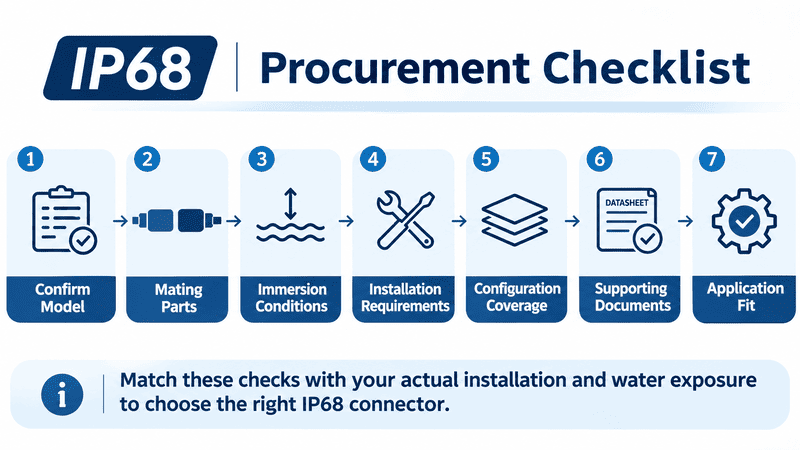
I start by asking how water will contact the connector, how long the exposure may last, and what the connection will look like at that time. Those answers help me avoid a broad request for “waterproof” products when the buyer really needs a defined immersion or washdown solution.
I then check the following items in order:
This sequence helps a buyer distinguish a supplier’s general product statement from evidence for a particular assembly. It also creates a practical comparison between vendors. One supplier may provide a clear part number, mating-part information, installation data, and a report for the relevant configuration. Another may provide only a broad rating claim. Those offers are not equally easy to evaluate, even if the headline rating looks the same.
When a configuration includes OEM or custom cable work, I would request the technical documents for that specific build rather than relying only on a standard product page. Buyers can also ask whether samples are available for fit checks and whether 2D, 3D, or CAD data can help validate the panel or equipment layout. A sample can help confirm dimensions and assembly fit, but it does not replace evidence for immersion performance.
I keep the final decision tied to verifiable information. If a required condition is missing from the datasheet, installation instructions, or test report, I ask for clarification before treating the connector as suitable. That approach supports a more defensible procurement decision and reduces the risk of confusing a component rating with protection for a complete machine.
No. IP68 indicates dust-tight protection and immersion protection under conditions specified by the manufacturer. It does not promise protection at every depth, for unlimited time, or in every installation. Buyers should check the exact model’s documentation and confirm that the tested configuration matches the intended use.
Not necessarily. Some products receive their immersion rating only when they are correctly mated and locked. The unmated condition may require a compatible protective cap, or it may not be rated. Buyers should check the product-specific instructions rather than assume the rating applies in both states.
Not by itself. Immersion and water-jet exposure are different conditions. A buyer planning pressure washing or hot-water cleaning should check the product’s documented water-jet protection, temperature limits, and installation requirements. The IP68 label alone does not establish suitability for a particular washdown process.
No. The rating of one connector does not automatically apply to its cable, mating component, panel installation, enclosure, or complete machine. Buyers should evaluate each relevant interface and confirm that the documentation covers the assembled configuration.
IP68 provides useful information, but it is a conditional protection rating rather than a promise of permanent or universal waterproofing. I verify the specific model, mating components, immersion conditions, installation requirements, and documents that cover the actual configuration. I also check separately for washing, salt water, chemicals, and maintenance needs. For industrial equipment, OEM cable assemblies, or control systems, buyers can share the required connection and exposure details with NITAI for a model and documentation review before requesting samples or a quotation.
"IP code", https://en.wikipedia.org/wiki/IP_code. IEC 60529 assigns the first characteristic numeral 6 to dust-tight enclosures and the second numeral 8 to protection against immersion under conditions agreed for the enclosure; the IPX8 conditions are more severe than those specified for IPX7. Evidence role: definition; source type: institution. Supports: An authoritative interpretation of IEC 60529 defining the first characteristic numeral 6 and the water-protection meaning of numeral 8, including how IPX8 conditions relate to IPX7.. Scope note: The standard's definition does not establish the immersion limits of any particular connector; those depend on the product's declared conditions. ↩
"IP code", https://en.wikipedia.org/wiki/IP_code. IEC 60529 defines IPX8 immersion protection by conditions specified for the enclosure, rather than by one universal depth and duration applicable to every product. Evidence role: definition; source type: institution. Supports: The standard's treatment of IPX8 as immersion under conditions specified or agreed for the product, rather than a single universal depth-and-duration threshold.. Scope note: This describes the rating scheme; a product's actual limits must be established from its own declaration and test documentation. ↩
"spacecraft electrical connector selection and application ...", https://ntrs.nasa.gov/api/citations/20130011503/downloads/20130011503.pdf. Studies of connector sealing distinguish the mated interface from an open connector, whose exposed contacts and sealing surfaces can create different ingress paths. Evidence role: mechanism; source type: research. Supports: Technical evidence that opening a sealed connector can expose a different ingress path and that protection in the unmated condition requires separate evaluation.. Scope note: This general mechanism does not establish whether a particular unmated connector is protected; that depends on its design and any specified cap. ↩
"The System Lime-Water at 210 C and High Pressures", https://nvlpubs.nist.gov/nistpubs/jres/54/jresv54n1p37_A1b.pdf. Hydrostatic pressure in a fluid increases with depth according to the fluid's density and gravitational acceleration, explaining why immersion depth is relevant to an enclosure's exposure. Evidence role: mechanism; source type: education. Supports: The hydrostatic-pressure relationship showing pressure increases with depth in a fluid.. Scope note: This physical relation does not establish a connector's allowable depth or test performance. ↩
"Chemical Compatibility Screening Results of Plastic ...", https://www.osti.gov/servlets/purl/149849. Research on elastomer and polymer seals documents that temperature and fluid chemistry can alter material properties and compatibility, so immersion results obtained under different conditions may not transfer directly to service. Evidence role: mechanism; source type: research. Supports: Materials research on how temperature and fluid chemistry can affect seal materials and thus the relevance of test conditions to service conditions.. Scope note: Effects depend on the specific material, fluid, concentration, temperature, and exposure duration; this evidence does not establish performance for an unspecified connector. ↩
"Synergistic Effects of Multiple Environmental Factors on ... - PMC", https://pmc.ncbi.nlm.nih.gov/articles/PMC10647683/. Research on sealing materials and enclosure reliability treats ingress testing as an evaluation under defined conditions, while long-term performance also depends on aging, wear, and subsequent service conditions. Evidence role: general_support; source type: research. Supports: Evidence distinguishing results of a defined ingress test from long-term durability under operational exposure, aging, and maintenance conditions.. Scope note: This distinction is general and does not predict the service life of a particular connector without product-specific durability data. ↩
"IP code", https://en.wikipedia.org/wiki/IP_code. Materials-compatibility research evaluates the response of polymers and metals to particular chemicals and corrosive media; an ingress-protection classification alone does not provide that compatibility assessment. Evidence role: general_support; source type: research. Supports: Evidence that ingress-protection classification evaluates enclosure protection against specified access, solids, and water conditions, while chemical compatibility is a separate materials question.. Scope note: Compatibility must be assessed for the specific material, chemical, concentration, temperature, and exposure duration. ↩
"Analysis of O-Ring Seal Failure under Static Conditions ... - PMC", https://pmc.ncbi.nlm.nih.gov/articles/PMC6723462/. Research on sealing systems identifies material aging, surface damage, contamination, and assembly disturbance as factors that can compromise sealing performance during service. Evidence role: mechanism; source type: research. Supports: Evidence describing aging, mechanical damage, contamination, or displacement as factors that can change seal performance over time.. Scope note: The rate and practical effect of degradation vary by seal material, design, exposure, and maintenance practice. ↩
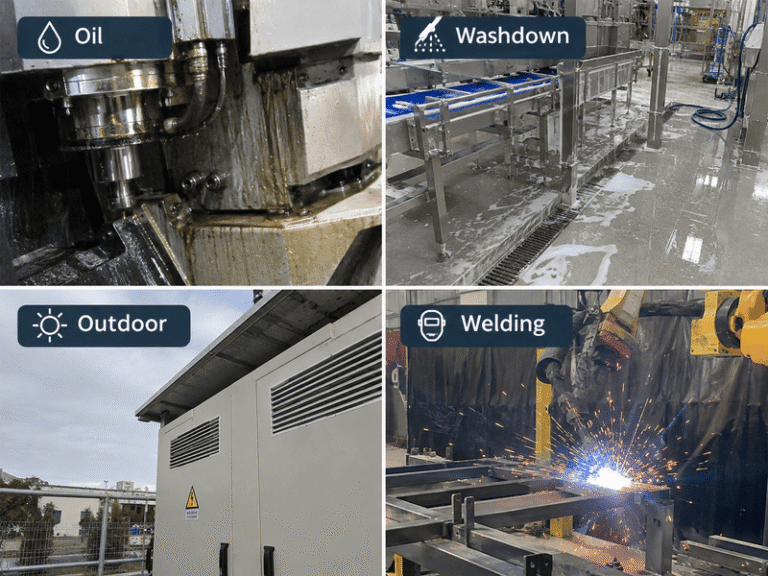
M12 connectors are not universal, although compatible interfaces may mate across brands. When I handle a replacement inquiry,…
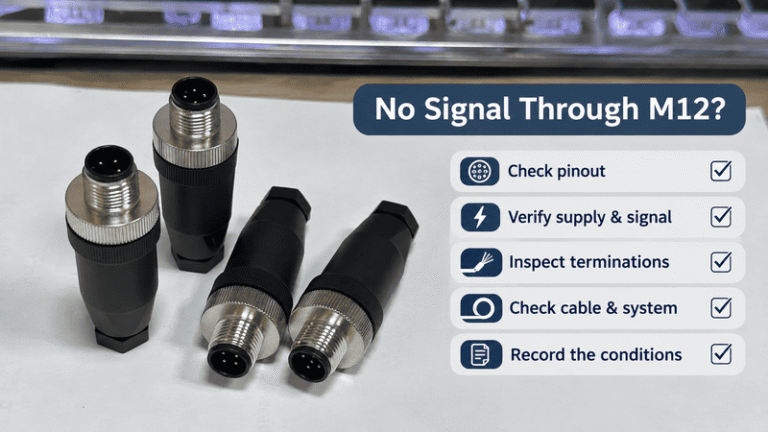
M12 problems can show up as a connector that will not mate, a device with no signal, intermittent…
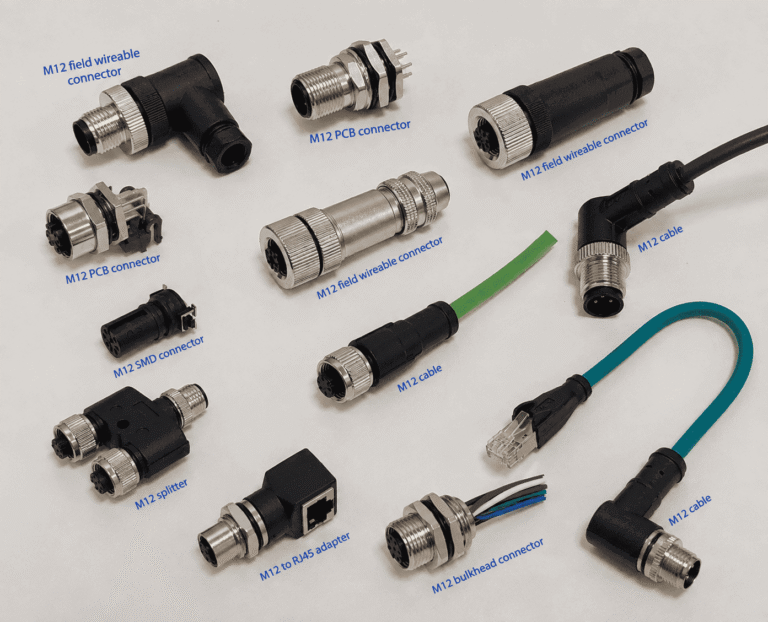
The standard for M12 connectors is a frequent question in the inquiries and orders I handle, and the…
NITAI manufactures terminal blocks, M8/M12 waterproof connectors and industrial distribution modules for global OEMs, distributors and automation customers.
Leave a Reply