Oct 17, 2026
How Do I Choose the Right M8 8 Pin Female Connector for My Equipment?
An M8 8 pin female connector can look like the right replacement on a purchasing list and still…

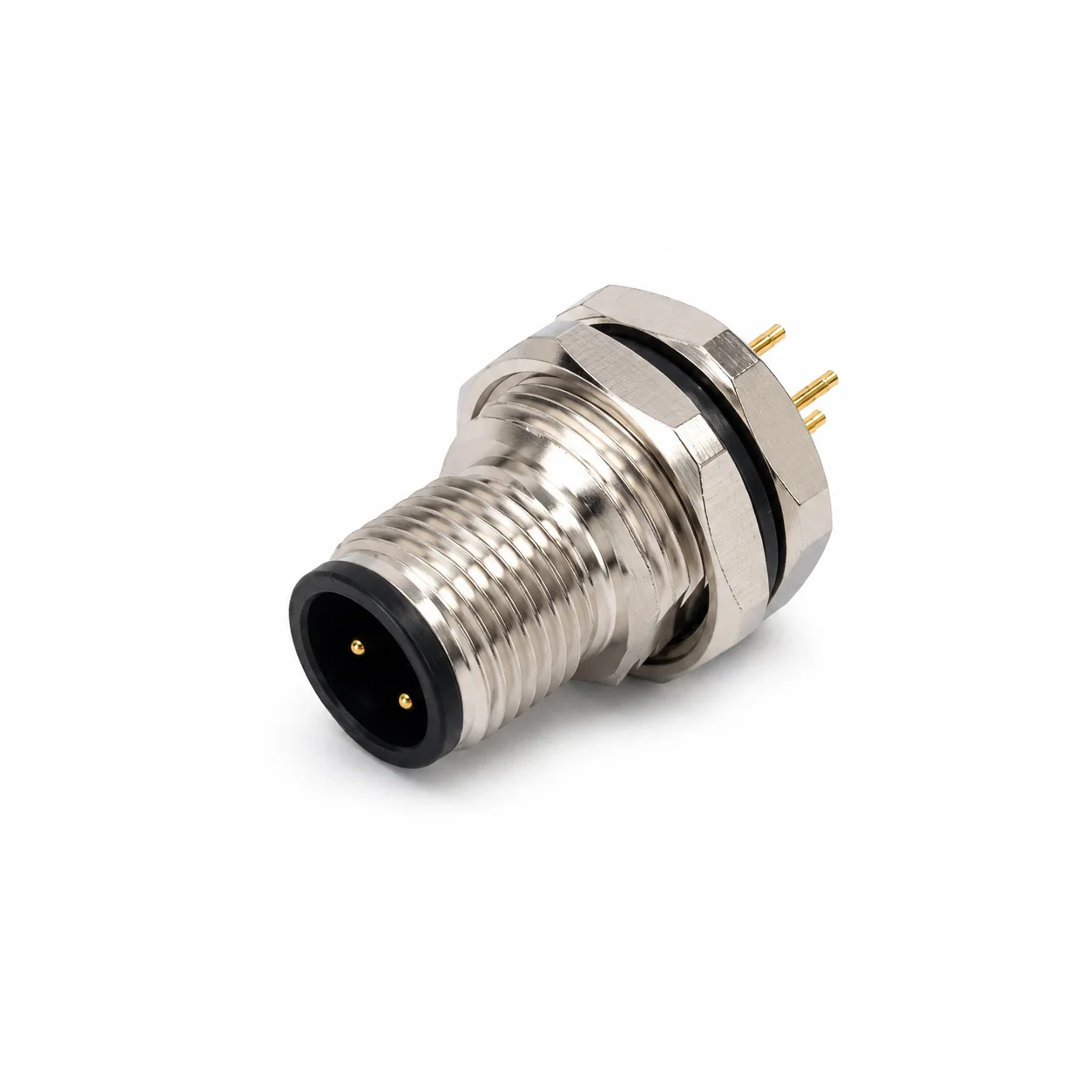
When someone first asks about a "C code M12 connector," it is easy to make the wrong choice and waste time or money on an incompatible part.
A “C code M12 connector” is an M12-sized circular connector with a specific C-coded keyway and contact arrangement. To choose the correct one, confirm the coding, pin count, gender, mating-face layout, electrical rating, and cable assembly requirements.
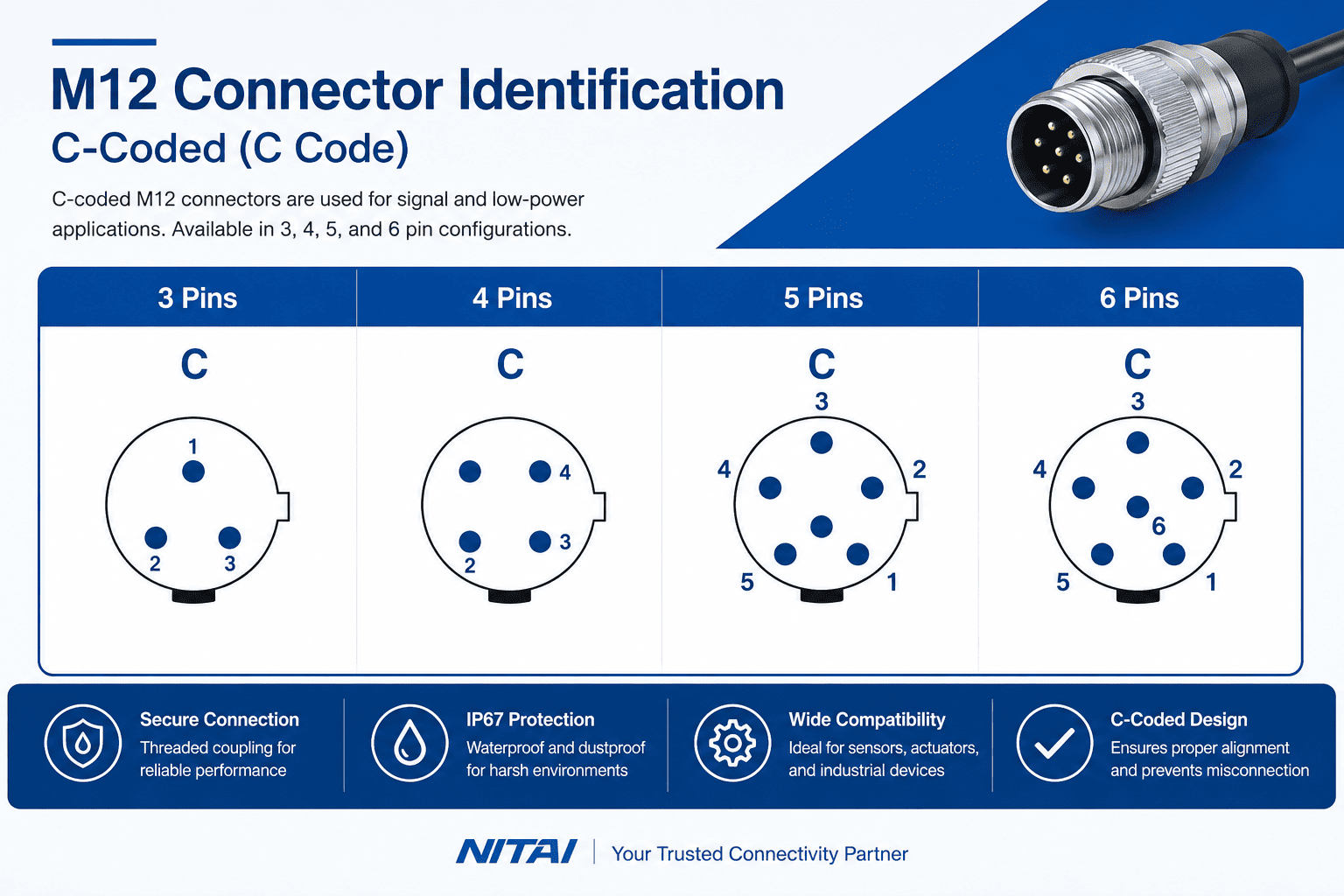
When customers ask us about an M12 connector, we do not start by identifying it only from the outside housing. We first confirm the coding, pin count, male or female contact type, device interface, and cable requirements. Two M12 connectors with the same outside size and contact count can still be incompatible if their coding or contact arrangement is different. A request for “M12, four pins” is therefore not enough to confirm the correct part.
Many people think “C code” is a brand or model number, but it is actually a coding designation used to distinguish one M12 mating interface from another.
A C-coded M12 connector uses a coding-specific keyway and contact arrangement. The letter “C” should not be interpreted as meaning that the keyway must literally look like the letter C. The reliable identification method is to compare the mating face with an approved product drawing.
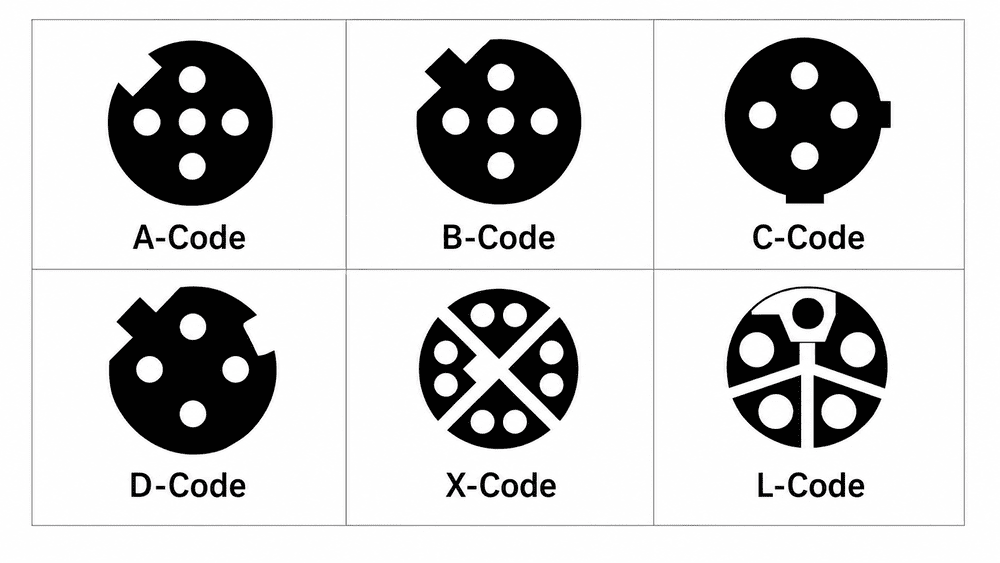
The M12 connector family includes several coding options, including A, B, C, D, X, S, T, K, and L. Each coding uses its own mechanical mating arrangement to reduce the risk of incorrect connection. IEC 61076-2-101 explains that differently coded male and female M12 connectors are not intended to mate1.
C-coded M12 connectors are used in certain industrial voltage-supply applications2. They are not interchangeable with A-coded connectors commonly used for sensors or D-coded connectors used for industrial Ethernet.
Here is a simplified comparison of common M12 coding types:
| M12 Coding | Keying Description | Common Contact Count | Typical Use | Interchangeable? |
|---|---|---|---|---|
| A-code | A-coded keyway | Multiple options | Sensors, actuators, and signals | No, coding must match |
| B-code | B-coded offset keyway | 4 or 5 | Fieldbus and PROFIBUS | No, coding must match |
| C-code | C-coded keyway | Product-specific | Certain voltage-supply and AC-powered device connections | No, coding must match |
| D-code | D-coded keyway | 4 | Industrial Ethernet up to 100 Mbps | No, coding must match |
| X-code | X-shaped internal divider | 8 | Category 6A industrial Ethernet up to 10 Gbps | No, coding must match |
Binder lists B-coded M12 connectors in both four- and five-contact versions for PROFIBUS and industrial data transmission3. TE Connectivity describes X-coded M12 connectors for Category 6A industrial Ethernet connections up to 10 Gbps4.
These sources are cited outside the table because some WordPress Markdown converters do not correctly process footnote references placed inside table cells.
If the coding is wrong, the connector may not mate with the equipment even if the housing size, pin count, and IP rating appear correct.
Customers sometimes assume that the pin count or an IP67 rating is enough to identify an M12 connector, but these details do not guarantee compatibility.
Knowing only the number of contacts or the ingress-protection rating will not confirm the coding, pin layout, gender, orientation, mounting structure, or locking method required by the equipment.
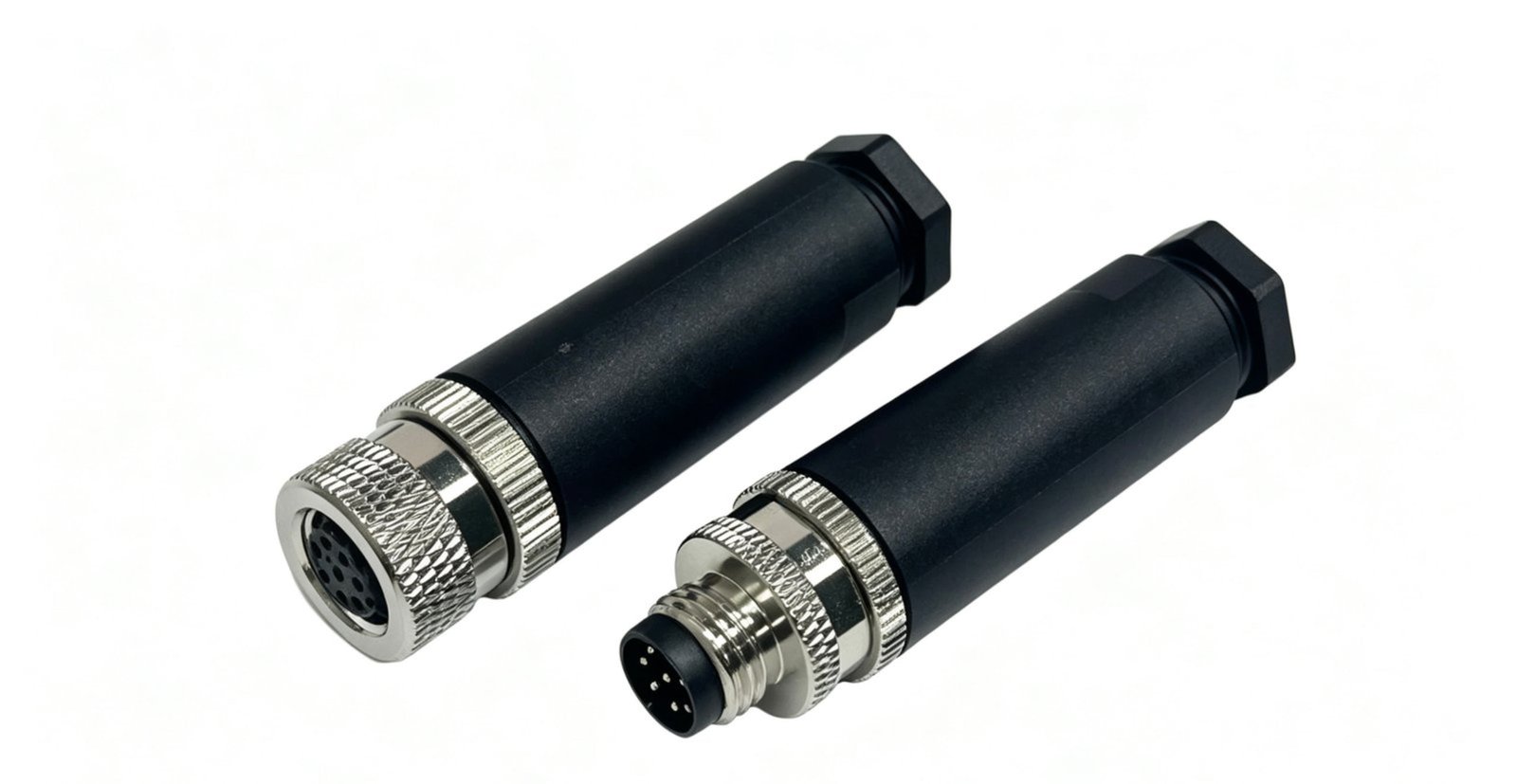
A request for a “four-pin M12, IP67” can still refer to several different products. The connector may be A-coded, B-coded, C-coded, or D-coded. It may also be straight, right-angle, male, female, cable-mounted, panel-mounted, or PCB-mounted.
Even when two connectors fit the same general M12 size, their pin assignments may be different. IP67 describes protection against dust and temporary water immersion under specified test conditions. It does not define the connector coding, mating arrangement, or electrical function.
When a customer sends us a product photograph, sample, or drawing, we check the mating face and ask for the corresponding equipment information. The following details should be confirmed:
The IEC M12 standard distinguishes fixed and free connectors as well as rewireable and non-rewireable constructions. The mounting and termination form must therefore be confirmed separately from the coding.
It is important to review every factor before confirming the part. Otherwise, the project may face repeated sample changes, installation delays, or an incompatible connector reaching the equipment.
A mechanically correct C-coded M12 connector may still be unsuitable if the voltage, current, cable size, wiring, or operating environment does not match the application.
Check the device voltage, current per contact, cable conductor size, cable length, pin assignment, and environmental conditions before ordering.
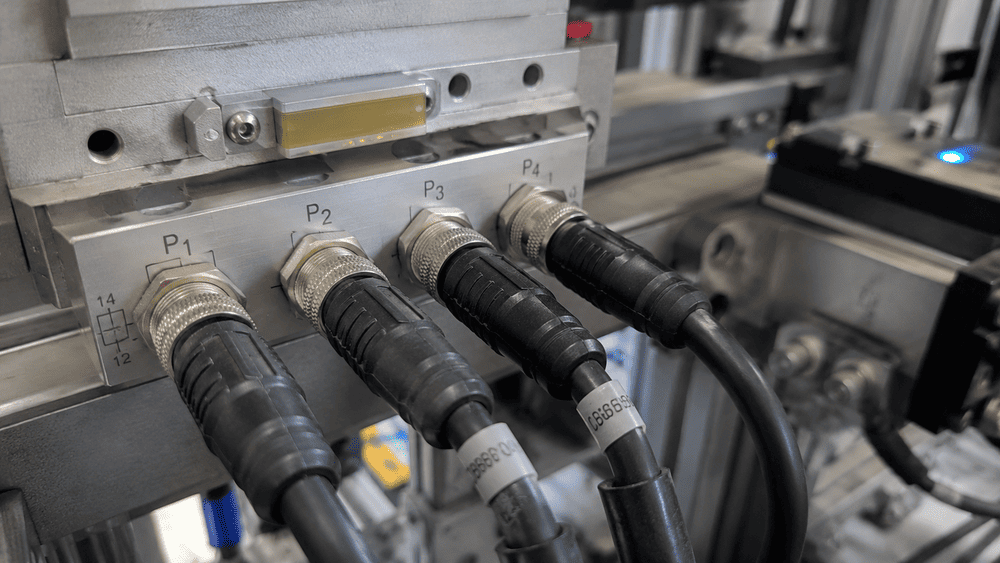
Specifications such as rated voltage, current per contact, conductor size, and cable construction must be confirmed from the selected product datasheet7.
For example, Molex part 1200130003 is a three-pole female C-coded cable assembly with 22 AWG conductors, a maximum voltage rating of 250 V AC/DC, and a maximum current rating of 4 A per contact. These values belong to that specific product and should not be treated as universal specifications for every C-coded M12 connector.
The cable must also have the correct number of conductors and sufficient conductor cross-section for the required load. Before quoting a cable assembly, we normally confirm:
Cable material should be selected according to the real environment. Phoenix Contact explains that its PUR cables can provide resistance to chemicals, oils, and lubricants and may be suitable for drag-chain applications, while cost-effective PVC cables can be used where mechanical stress is more moderate8.
This does not mean every PUR, PVC, or halogen-free cable has identical properties. The exact compound, temperature rating, flexibility, chemical resistance, and certification must be checked from the cable datasheet.
If the connector is correct but the cable assembly does not match the electrical or environmental requirements, the result may still be overheating, premature cable damage, equipment downtime, or failed installation.
Providing a device drawing, wiring diagram, existing part number, or physical sample helps the supplier confirm the correct assembly before production.
Not every automation device uses a C-coded M12 connector. Always check the device interface, electrical requirements, applicable standards, and future replacement availability before choosing it.
C-coded M12 connectors remain suitable when the equipment already specifies a matching C-coded interface. However, they should not be selected for a new project only because they are described as power or voltage-supply connectors.

For a replacement project, first confirm that the existing device port is actually C-coded. Do not replace it with another M12 coding simply because the alternative connector has a higher voltage or current rating.
For a new power-distribution design, compare the available M12 power coding systems. Phoenix Contact identifies S-, K-, and M-coded M12 connectors for AC power applications and T- and L-coded connectors for low-voltage DC power applications9.
This does not mean C-coded connectors are automatically obsolete. It means the correct interface depends on the equipment, power requirement, installation standard, and long-term supply plan.
Before selecting C-coded M12 for a new project:
Your connector supplier can help identify a product from a sample, drawing, or clear mating-face photograph, but all available technical information should be provided before the quotation is finalized.
This reduces the risk of purchasing a connector that looks similar but cannot mate with the equipment or meet the electrical requirements.
C-coded M12 connectors are one part of the wider M12 connector family. The coding identifies a specific mating interface, but it does not define one universal voltage, current, cable, or pin assignment.
Before ordering, verify:
Do not select a C-coded M12 connector from its outside appearance alone. Compare the equipment drawing, product datasheet, and physical mating face before approving the sample or releasing volume production.
"[IEC 61076-2-101:2024](https://webstore.iec.ch/en/publication/77773)." IEC defines the M12×1 screw-locking connector family, including fixed and free connectors with different contact counts and coding arrangements. Evidence role: standard definition; source type: standards organization. Supports: M12 coding is a mechanical compatibility system, and differently coded male and female connectors are prevented from mating. Scope note: The standard covers multiple M12 arrangements; the exact product rating must still be taken from the applicable connector datasheet. ↩
"[ifm ecolink Connection Technology — Coding Types](https://www.ifm.com/de/en/shared/products/ecolink/connection-technology)." ifm lists common applications for A-, B-, C-, D-, L-, T-, and X-coded connector systems. Evidence role: application reference; source type: industrial automation manufacturer. Supports: C-coded connectors are associated with voltage-supply applications, while A-coded connectors are commonly used for sensors and D-coded connectors for data connections. Scope note: The values shown by ifm describe its relevant product ranges and should not be treated as universal ratings for every manufacturer. ↩
"[Binder M12 B-Coded Connectors](https://www.binder-connector.com/en/products/automation-technology-speciality-connectors/m12-b)." Binder describes B-coded M12 products for PROFIBUS and industrial data transmission and lists both four- and five-contact versions. Evidence role: product-range verification; source type: major connector manufacturer. Supports: B-coded M12 connectors should not be described as exclusively five-contact products. Scope note: Available contact counts, shielding, termination, and ratings depend on the selected Binder product. ↩
"[TE Connectivity M12 X-Code Field-Installable Cable Plug](https://www.te.com/en/about-te/news-center/te-field-installable-cable-plug.html)." TE describes an IEC 61076-2-109-compliant X-coded M12 connector for IP67 Category 6A connections up to 10 Gbps. Evidence role: product and application reference; source type: major connector manufacturer. Supports: X-coded M12 is used for high-speed industrial Ethernet and should not be described only as a generic Gigabit connector. Scope note: Actual 10 Gbps performance depends on the complete connector, cable, shielding, termination, and equipment channel. ↩
"[IEC 61076-2-101:2024](https://webstore.iec.ch/en/publication/77773)." IEC distinguishes fixed and free M12 connectors and includes rewireable and non-rewireable constructions. Evidence role: connector-form definition; source type: standards organization. Supports: M12 connectors can use different cable, panel, and equipment-side constructions even when the mating interface belongs to the same general family. Scope note: Detailed panel cutouts, PCB footprints, and mounting dimensions remain product-specific. ↩
"[IEC 61076-2-010:2021](https://webstore.iec.ch/en/publication/29392)." IEC describes outer push-pull locking for M12 connectors and its relationship with correspondingly coded M12 screw-locking interfaces. Evidence role: locking-system definition; source type: standards organization. Supports: M12 interfaces can use standardized push-pull locking arrangements in addition to conventional screw locking. Scope note: A push-pull product must be checked for compliance and intermateability; not every proprietary quick-lock connector is automatically compatible. ↩
"[Molex Industrial Cable Assembly 1200130003](https://www.molex.com/en-us/products/part-detail/1200130003)." Molex lists a female three-pole C-coded M12 cable assembly with 22 AWG conductors, 250 V AC/DC maximum voltage, and 4 A maximum current per contact. Evidence role: product-level electrical example; source type: major connector manufacturer. Supports: A real C-coded commercial product may use these values and demonstrates the need to check a specific part number. Scope note: These specifications belong to this Molex product and must not be applied automatically to every C-coded connector. ↩
"[Phoenix Contact Signal and Power Cables](https://www.phoenixcontact.com/en-ae/products/cables-and-lines/signal-cables-and-power-cables)." Phoenix Contact describes its PUR cable products as resistant to chemicals, oils, and lubricants and suitable for drag-chain applications, while PVC products may be selected for more moderate mechanical stress. Evidence role: cable-material application reference; source type: major connector and cable manufacturer. Supports: Cable jacket selection should follow the mechanical and chemical environment rather than connector coding alone. Scope note: Cable performance depends on the specific compound, conductor construction, test method, and product series. ↩
"[Phoenix Contact M12 Power Coding Overview](https://www.phoenixcontact.com/en-ae/products/cables-and-lines/signal-cables-and-power-cables)." Phoenix Contact identifies S-, K-, and M-coded M12 systems for AC power and T- and L-coded systems for low-voltage DC power. Evidence role: current product-family comparison; source type: major connector manufacturer. Supports: New power projects should compare C-coded interfaces with current M12 power coding families before final selection. Scope note: The correct coding depends on the equipment interface, voltage, current, PE or FE requirements, and applicable product standard. ↩
"[IEC CISPR Guide 2024](https://assets.iec.ch/further_informations/1298/CISPR%20Guide%202024.pdf?0218T00)." IEC provides guidance on CISPR electromagnetic-compatibility publications and their relationship to equipment and market requirements. Evidence role: regulatory and EMC context; source type: standards organization. Supports: EMC and safety requirements should be confirmed according to the end equipment and destination market. Scope note: A connector component may be evaluated as part of the complete machine or electrical system rather than certified independently for every applicable regulation. ↩
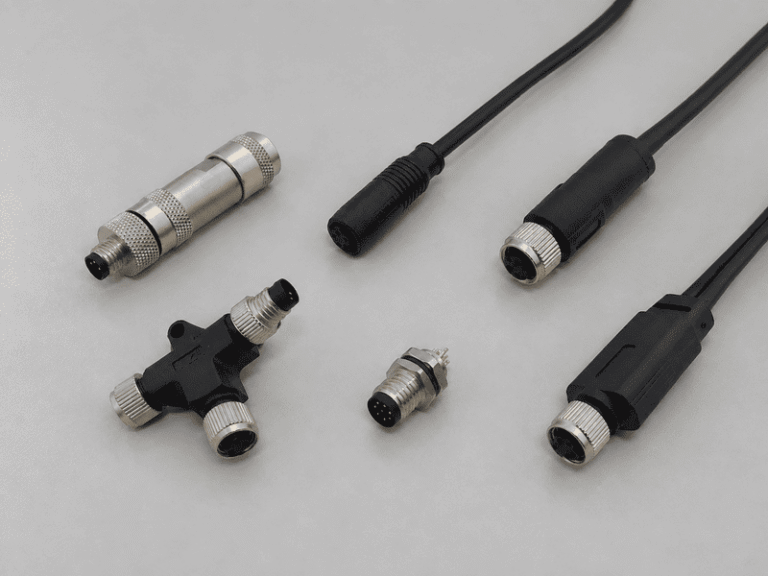
An M8 8 pin female connector can look like the right replacement on a purchasing list and still…
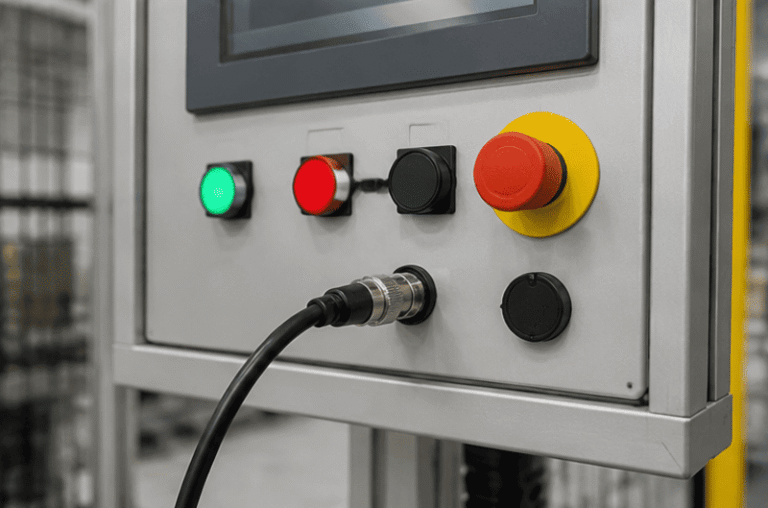
An M12 male connector 5-pin B-coded may look like a straightforward line item, but its name does not…
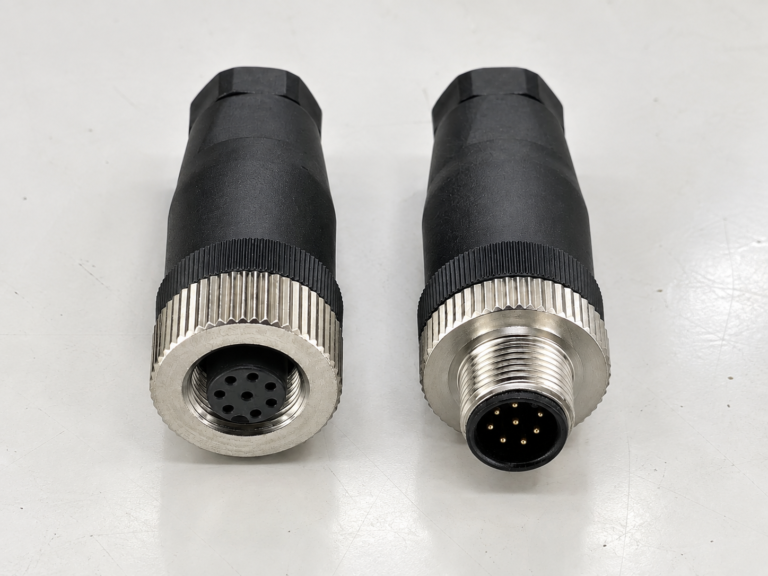
M12 connectors can carry different voltage ratings, so a buyer cannot choose one safely from the connector size…
NITAI manufactures terminal blocks, M8/M12 waterproof connectors and industrial distribution modules for global OEMs, distributors and automation customers.
Leave a Reply