Oct 17, 2026
How Do I Choose the Right M8 8 Pin Female Connector for My Equipment?
An M8 8 pin female connector can look like the right replacement on a purchasing list and still…

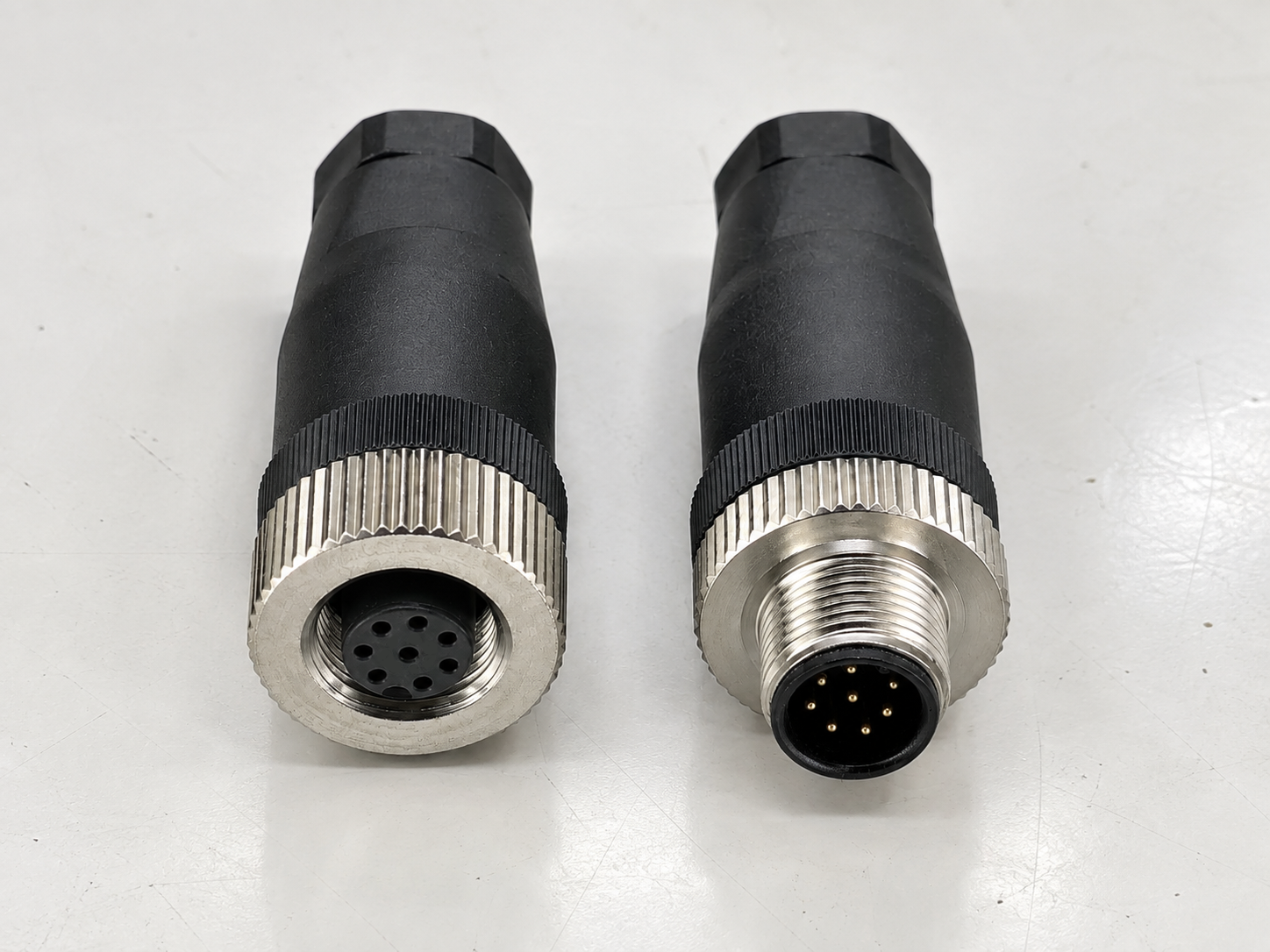
M12 connectors can carry different voltage ratings, so a buyer cannot choose one safely from the connector size alone. A customer once asked our NITAI team what voltage an M12 connector could handle. Our first questions were about coding and pin count. Without those details, a single-number answer could point the customer toward the wrong model.
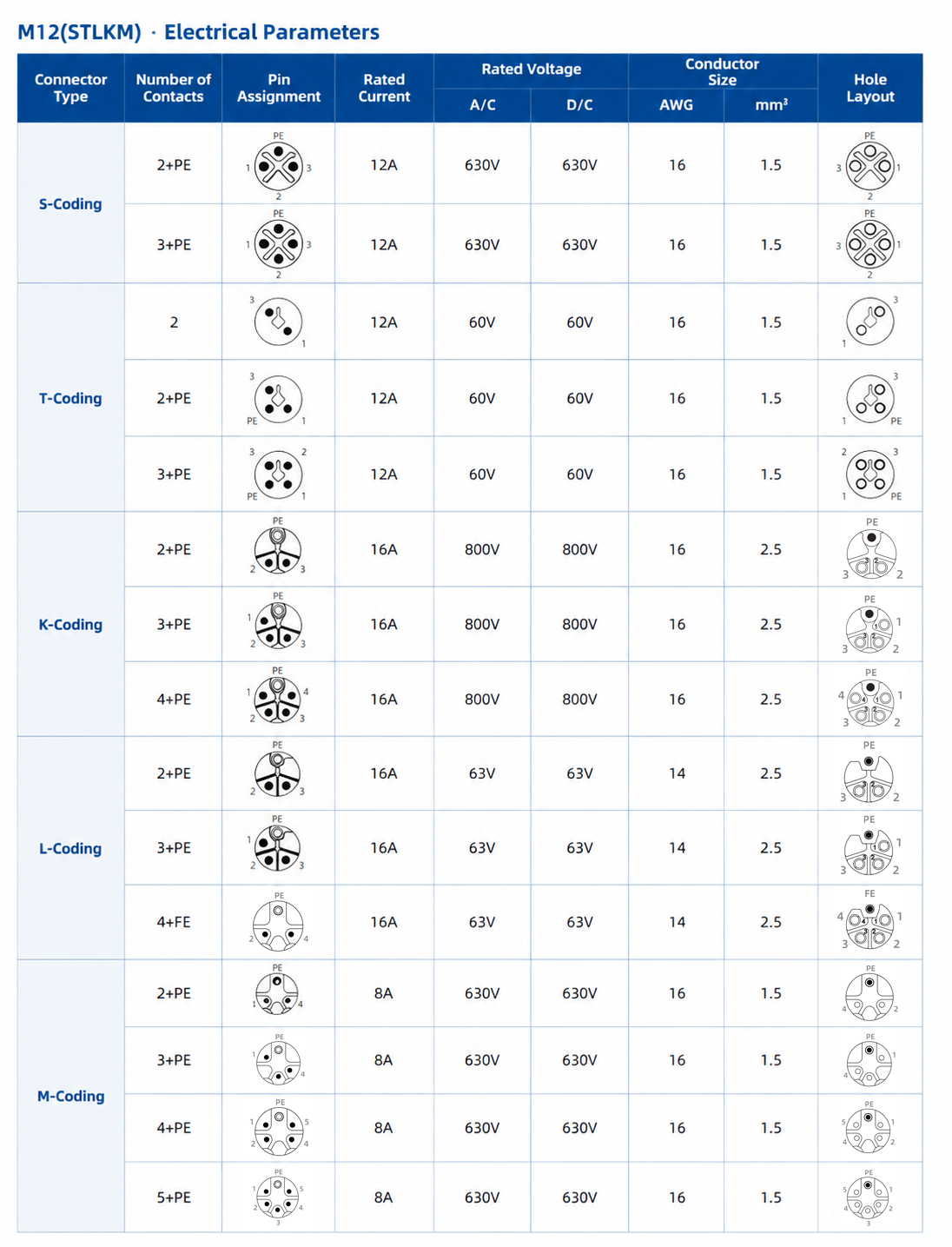
M12 connectors do not have one universal voltage rating.1 In the NITAI catalog information supplied for this article, listed configurations range from 30 V to 800 V. The correct rating depends on the exact model, including its coding, pin count, and separate AC and DC specifications. Buyers should confirm those details on the model-specific datasheet before selection.
That answer sounds simple, but the details matter when an automation OEM or control-cabinet builder has a fixed voltage requirement. Below, I explain why the question needs a model number, what the supplied catalog entries show, and what I would ask a supplier to document before approving a part.
An M12 connection may look familiar across several devices, which makes a quick voltage answer tempting. The problem is that a familiar connection does not identify one electrical specification. If I answer without the configuration, I may give a rating that belongs to a different product.
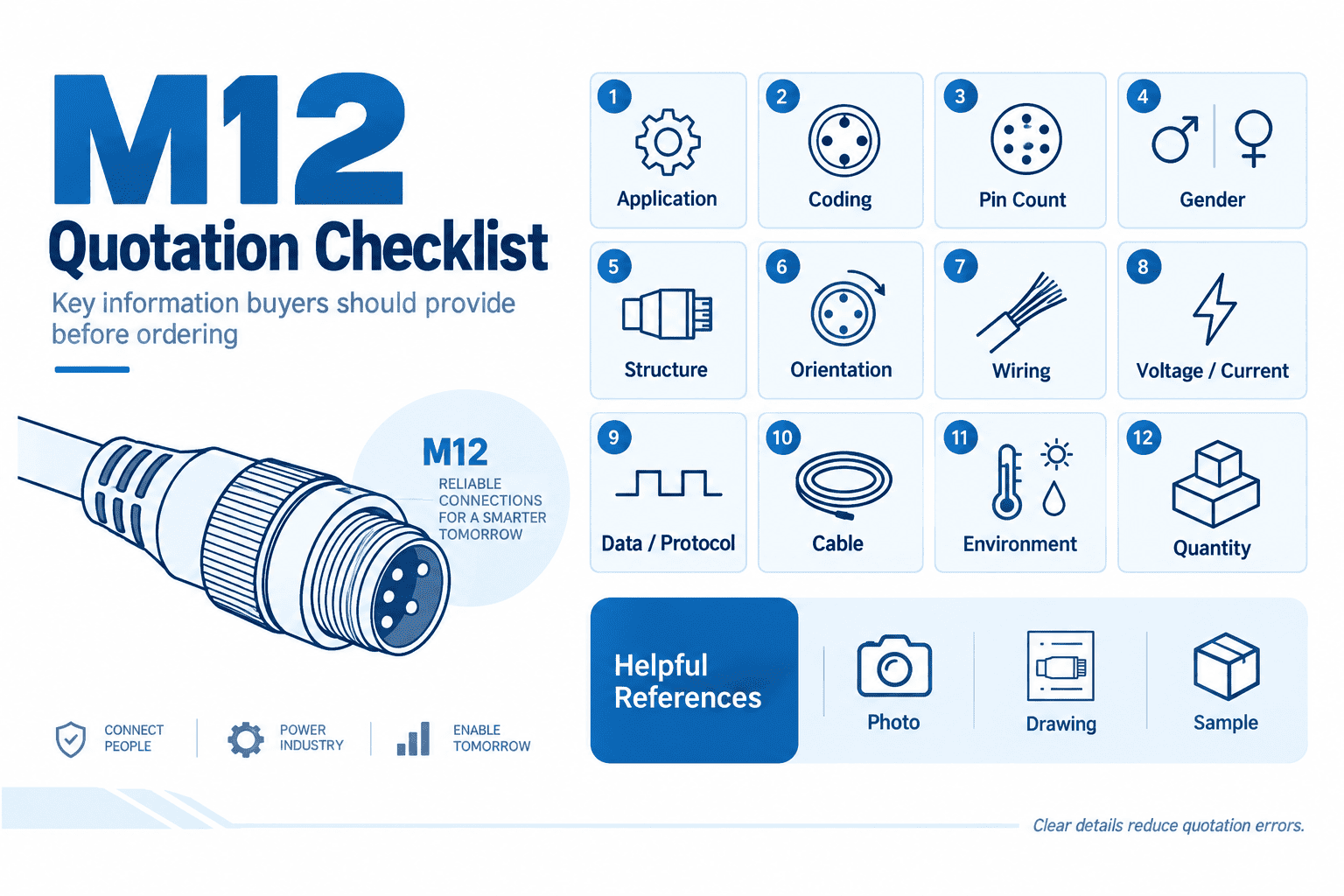
I treat “M12” as the starting point for a product search, not a complete specification. To find the applicable rated voltage, I need the exact connector model, its coding, its pin count2, and whether the requirement is AC or DC3. I then check the manufacturer’s documentation for that configuration.
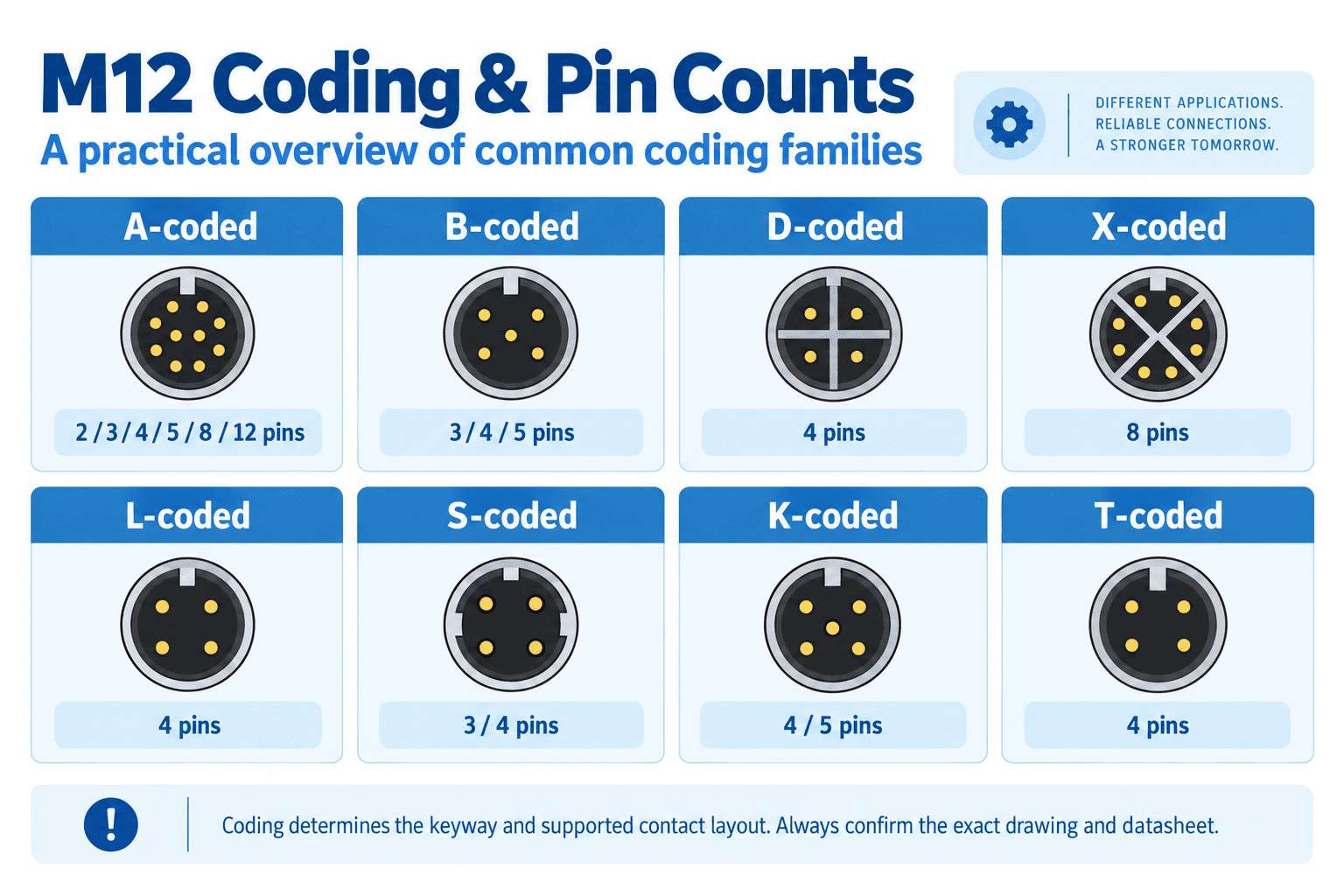
In an anonymized customer exchange, someone asked our team about M12 voltage. Our team asked for the coding and number of pins before answering. That exchange is useful because it shows the first diagnostic step. It is not a test result, and it does not establish a rating for any connector the customer had not identified.
I would use the same sequence in a procurement discussion:
This sequence also helps a purchasing team avoid mixing information from separate catalog pages. For example, a buyer might find a voltage beside one pin-count option and assume that it applies to another. The supplied NITAI entries show why that assumption is risky: even within the listed A/B/C/D configurations, the rating changes with pin count.4
I also keep [rated voltage separate from dielectric withstand voltage](https://www.iec.ch/corrigenda)%%%FOOTNOTE_REF_5%%%. They describe different specifications and should not be substituted for one another in a comparison. For an application-specific decision, I would have a qualified engineer review the complete datasheet and the equipment’s requirements.
A catalog range gives buyers a useful sense of variation, but it does not tell them which part to order. If I compress every entry into “M12 connectors handle up to 800 V,” I hide the lower-rated configurations. A compact comparison makes the differences easier to see.
The engineer-supplied NITAI catalog information lists 250 V AC/DC for specified 2–4-pin A/B/C/D entries, 60 V AC/DC for specified 5-pin entries, and 30 V AC/DC for specified 6-, 8-, 12-, and 17-pin entries. A separate 8X entry lists 50 V AC and 60 V DC.6 These are supplied catalog entries, not universal M12 ratings.
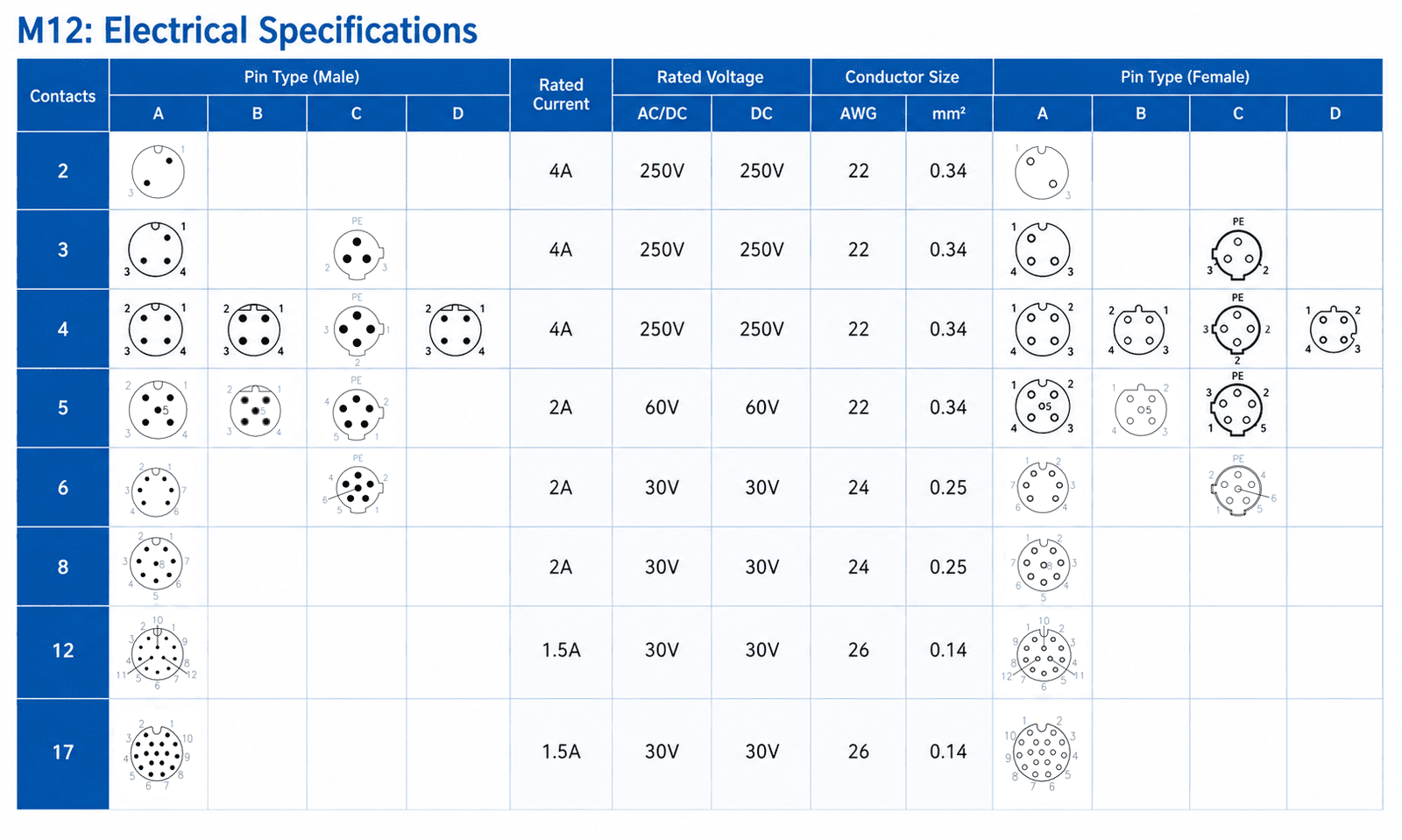
| Supplied NITAI catalog configuration | Listed AC rated voltage | Listed DC rated voltage | What I would verify before ordering |
|---|---|---|---|
| Listed A/B/C/D configurations, 2–4 pins | 250 V | 250 V | Exact model, coding, and available pin-count option |
| Listed A/B/C/D configurations, 5 pins | 60 V | 60 V | Exact model and 5-pin specification |
| Listed A/B/C/D configurations, 6/8/12/17 pins | 30 V | 30 V | Exact model and listed pin-count option |
| Supplied 8X entry | 50 V | 60 V | Exact model identifier and separate AC/DC entries |
Editorial verification note: These rows reflect the configuration information supplied for this article; they are not complete manufacturer part numbers. NITAI engineering should verify every row against its exact catalog model before publication. The supplied information also describes a catalog range extending to 800 V, but it does not identify the corresponding model here7. I cannot assign 800 V to a coding or pin count without that model-specific record.
I use this table to show how much the answer can change, not to replace a datasheet. In the supplied A/B/C/D entries, moving from a listed 2–4-pin configuration to a listed 5-pin configuration changes the stated rating from 250 V to 60 V. The listed 6-, 8-, 12-, and 17-pin entries show 30 V. Those differences are substantial for a buyer screening parts against an equipment specification.
The table does not establish that every combination of A, B, C, or D coding and every pin count shown is available8. It also does not establish ratings for other manufacturers’ products. I would ask for the exact part number and its current drawing or datasheet before treating any row as a purchase specification.
For procurement, I would record the decision in a comparison sheet with separate fields for part number, coding, pin count, AC rating, DC rating, document revision, and supplier confirmation. That record gives engineering and purchasing the same reference point. It also makes a later substitution easier to evaluate: the replacement must be checked against the required specification, not merely against the description “M12 connector.”
A buyer may see matching AC and DC figures in several entries and expect them to match everywhere. That shortcut fails for the supplied 8X entry. If the equipment requirement changes from DC to AC, the relevant figure changes too, even when the connector designation stays the same.
No, I do not assume an M12 model has identical AC and DC ratings. In the supplied NITAI information, the 8X entry is listed at 50 V AC and 60 V DC. I would compare the equipment requirement with the rating for its actual supply type, then confirm the exact model documentation.
When I review a connector shortlist, I write the requirement in a way that prevents an AC/DC mix-up. “60 V” by itself leaves a question open. “60 V DC requirement,” for example, tells the supplier which published rating I need to see. The same discipline matters when a purchasing document, drawing, and datasheet pass between different teams.
A practical comparison can stay short:
| Buyer’s question | Document detail I would request |
|---|---|
| Is the equipment requirement AC or DC? | The electrical requirement from the equipment design team |
| Which rating is being quoted? | The AC and DC rated-voltage entries for the exact model |
| Is this the proposed production part? | The full part number and current product drawing |
| Has a configuration changed? | A revised specification for the replacement configuration |
I would not use the 8X figures to predict the rating of a different M12 product. I also would not use the higher of its two figures as a general-purpose value. The useful lesson is narrower: check AC and DC as separate specifications whenever both matter to the purchase.
Voltage is only one part of a complete connector review. The equipment designer may also need to evaluate other electrical, mechanical, and environmental requirements9 in the manufacturer’s documentation. My role as a supplier is to provide the correct product information and answer configuration questions. A qualified professional should determine whether the selected part is appropriate for the specific equipment and application.
A promising catalog entry can still leave a buyer with open questions about the part they will receive. A missing drawing revision, an unclear variant, or an undocumented substitution can slow approval. I find it more useful to qualify the proposed product and the supplier’s documentation together.
I would request an exact part number, a current datasheet or drawing, and written confirmation of coding, pin count, and AC/DC rated voltage. I would also ask about samples, production lead time, and change control when they affect the buying decision. The equipment’s qualified engineering team should make the final application-specific assessment.
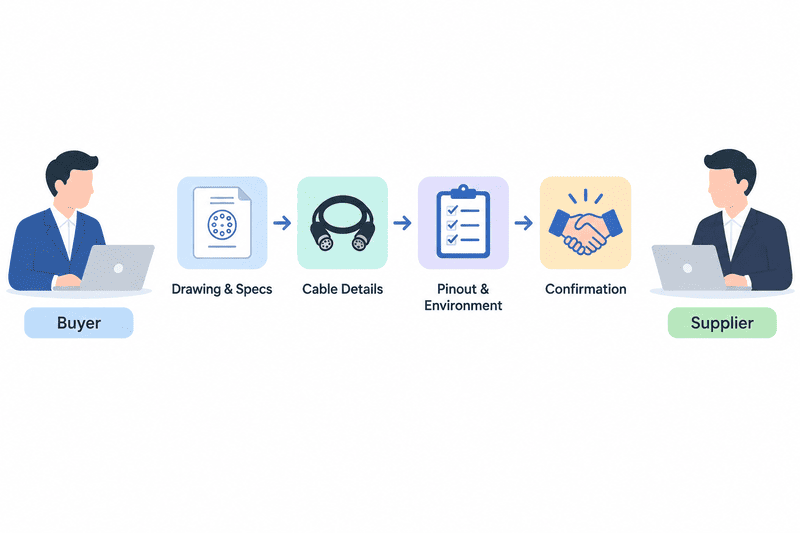
I start an inquiry with the details that help a supplier identify the correct item:
At NITAI, we can support discussions about industrial connectors, custom assemblies, engineering files, sample development, and volume supply. I would still evaluate each proposed M12 item on its own documented specifications. A broad product range or a supplier’s ability to customize does not turn one catalog entry into a rating for every variant.
I apply the same care to certification claims. If a project requires a particular certificate or compliance document, I ask for the document that applies to the exact proposed product and have the buyer verify its relevance. I do not treat a general supplier statement as proof that every configuration meets a project requirement.
This process gives procurement a clearer basis for comparison. A low price or fast lead time matters only after the proposed model is identified and engineering can review its specifications. Once those checks are complete, the buyer can compare commercial terms without losing track of which connector each quotation describes.
No. I need the exact model and its published electrical specifications. Coding, pin count, and the AC or DC rating can change the answer. The supplied NITAI entries include ratings from 30 V upward, so I would not quote one voltage for every M12 connector.
I would not state that as a universal rule. The supplied NITAI A/B/C/D entries show lower ratings for the listed higher-pin-count configurations, but that observation belongs to those catalog entries. I would check each manufacturer’s exact model rather than extrapolate from the pattern.
No. Some supplied entries list the same figure for AC and DC, but the supplied 8X entry lists 50 V AC and 60 V DC. I would use the rating that matches the equipment requirement and verify it on the exact model’s documentation.
I cannot make that determination from the maximum alone. The information supplied for this article does not identify the corresponding 800 V model. I would ask NITAI engineering for its exact part number and current specification before including it in a comparison or quotation.
No. I treat them as different specifications and would not substitute one figure for the other. If either matters to a project review, I would request the exact model’s documentation and ask a qualified professional to evaluate it against the application requirements.
The answer to “What voltages can M12 connectors handle?” depends on which M12 connector the buyer means. The supplied NITAI catalog information shows meaningful differences by configuration, including 30 V, 60 V, and 250 V A/B/C/D entries and separate 50 V AC and 60 V DC figures for 8X. A stated catalog maximum cannot replace an exact model specification. Send NITAI your required voltage type, coding, pin count, and proposed part number, and our team can help identify the relevant product documents for your engineering review.
"TECHNICAL SPECIFICATION", https://ocp-api.iec.ch/api/publications/101814/view?hasAccess=false&language=en&previewLanguage=en&media=PDF. IEC documentation treats electrical characteristics as specifications of defined connector configurations; the M12 designation alone does not establish a rated voltage. Evidence role: general_support; source type: institution. Supports: M12 describes a connector interface while electrical ratings are specified for particular configurations.. Scope note: The standard provides context and does not verify any NITAI catalog rating. ↩
"IEC 61076-2-101:2012", https://webstore.iec.ch/en/publication/4418. IEC connector specifications distinguish M12 interfaces by coding and contact arrangement, supporting their use in identifying the intended configuration. Evidence role: definition; source type: institution. Supports: M12 connector specifications distinguish coded interfaces and contact arrangements.. Scope note: Those identifiers do not, by themselves, establish the voltage rating of a particular product. ↩
"insulation coordination of ultra high voltage ac system", https://www.academia.edu/26970917/INSULATION_COORDINATION_OF_ULTRA_HIGH_VOLTAGE_AC_SYSTEM. Connector and insulation-coordination guidance distinguishes the characteristics of applied AC and DC voltage, supporting separate comparison where a product specifies separate ratings. Evidence role: mechanism; source type: institution. Supports: Electrical rating and insulation assessments account for the type of applied voltage.. Scope note: This guidance does not establish that every connector has different AC and DC ratings. ↩
"A-coded M12 connector", https://www.binder-usa.com/us-en/products/automation-technology/m12-a?srsltid=AU7gw4Ux3_NXzk7PY7yDGzxSXLHmDKeoxonqQTNAMyTdadDMfDa8CoGX. The cited NITAI model datasheets list rated voltages for the identified pin-count configurations, documenting the comparison within those products. Evidence role: case_reference; source type: other. Supports: Model-specific NITAI documentation lists the ratings for each pin-count configuration being compared.. Scope note: The comparison applies only to the documented models and revisions, not to all A-, B-, C-, or D-coded M12 connectors. ↩
"Technical Corrigenda", https://www.iec.ch/corrigenda. IEC connector terminology distinguishes rated voltage from dielectric withstand testing; a withstand-test value is not an operating-voltage rating. Evidence role: definition; source type: institution. Supports: Rated voltage describes an assigned operating characteristic, whereas dielectric withstand voltage relates to an insulation test.. ↩
"DC Connectors & AC Connectors - Seamless Integration", https://www.binder-usa.com/us-en/news/ac-and-dc-connectors?srsltid=AU7gw4UPm2P__1kfUVbwh998BU2u4Yzkhi1wGa0J-OPfFaNoTXrYmeTQ. The cited NITAI 8X specification states separate rated voltages of 50 V AC and 60 V DC for the identified model. Evidence role: case_reference; source type: other. Supports: A model-specific NITAI record states separate 50 V AC and 60 V DC ratings for the 8X entry.. Scope note: The designation must be tied to a full part number and current document revision; the figures cannot be generalized to other 8-contact M12 products. ↩
"Product data sheet M12-A female cable connector, Contacts", https://docs.rs-online.com/9dd4/0900766b812ce344.pdf. The cited NITAI specification assigns an 800 V rating to the identified catalog model under its stated conditions. Evidence role: case_reference; source type: other. Supports: An identifiable NITAI model-specific document states an 800 V rated voltage and its applicable conditions.. Scope note: Until the model, voltage type, and document revision are identified, the 800 V figure does not support a rating for any connector discussed in the table. ↩
"Apache Tomcat 9 (9.0.123) - Changelog", https://kfsinvd.is.colostate.edu/docs/changelog.html. IEC M12 interface specifications describe defined coding and contact arrangements, so a grouped voltage table does not establish the availability of every possible combination. Evidence role: general_support; source type: institution. Supports: M12 interface specifications define particular coding and contact arrangements rather than an unrestricted combination of options.. Scope note: A standard does not establish which combinations NITAI currently sells. ↩
"IEC 60512-1:1976", https://webstore.iec.ch/en/publication/16409. IEC connector requirements and test methods address mechanical, climatic, and electrical characteristics, indicating that rated voltage is only one part of application assessment. Evidence role: expert_consensus; source type: institution. Supports: Connector standards address mechanical and environmental performance alongside electrical characteristics.. Scope note: The applicable tests and acceptance criteria depend on the equipment and connector configuration. ↩
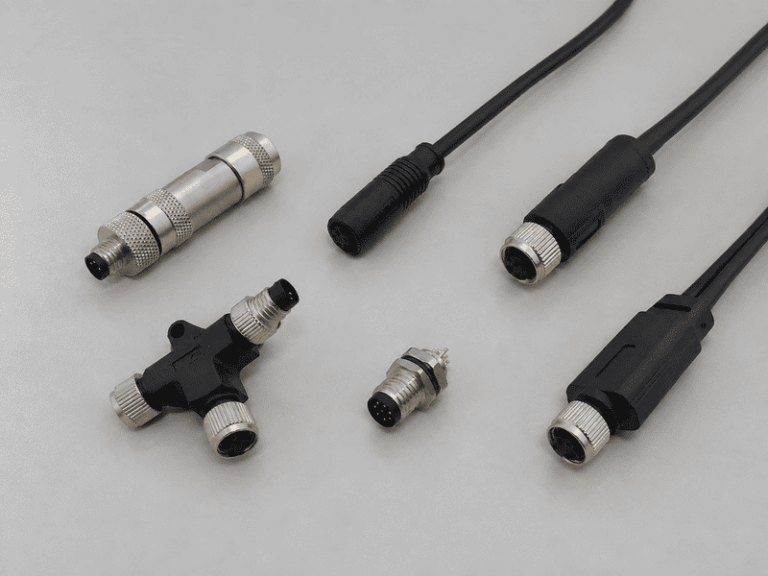
An M8 8 pin female connector can look like the right replacement on a purchasing list and still…
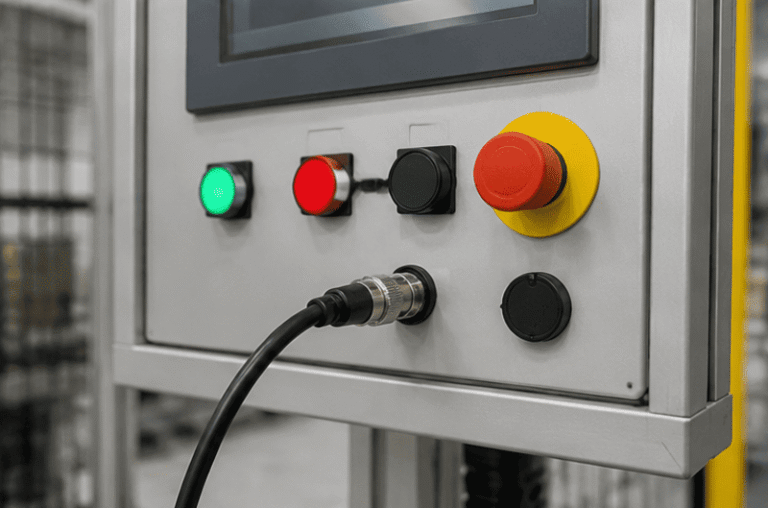
An M12 male connector 5-pin B-coded may look like a straightforward line item, but its name does not…
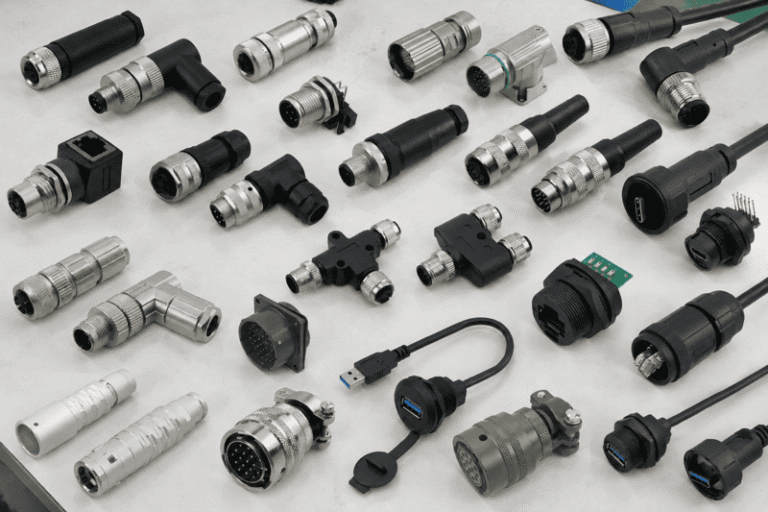
Connector types can look interchangeable in a catalog, but a familiar shape does not tell me whether two…
NITAI manufactures terminal blocks, M8/M12 waterproof connectors and industrial distribution modules for global OEMs, distributors and automation customers.
Leave a Reply