Oct 17, 2026
How Do I Choose the Right M8 8 Pin Female Connector for My Equipment?
An M8 8 pin female connector can look like the right replacement on a purchasing list and still…

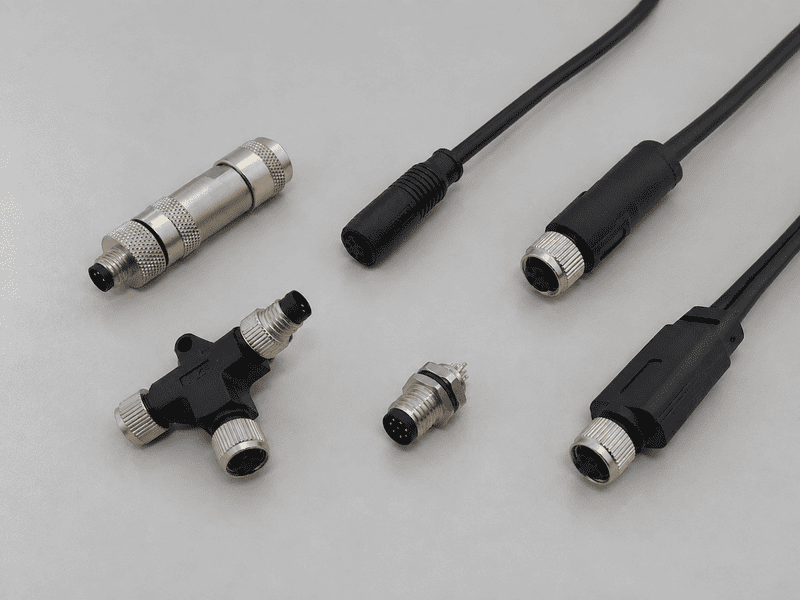
M8 connectors can look almost identical, but that surface similarity creates real purchasing risk. I often see buyers assume the same thread size or pin count means safe replacement. That mistake can lead to wiring errors, field rework, or downtime. The better solution is to compare the full connector specification before buying.
No, all M8 connectors are not the same. “M8” mainly describes a compact circular connector interface size, not a universal part number.1 Buyers should verify coding, pin count, gender, pinout, mounting style, cable structure, shielding, IP rating, material, and application conditions before selecting or replacing an M8 connector.2
The important question is not only, “Does it fit?” The better question is, “Will it match my device, wiring definition, environment, and procurement requirements?” I will break down the checks I use when helping customers review M8 connector inquiries.
M8 connectors often create confusion because the outer shape looks simple. A buyer may see a small circular connector, count the pins, and expect it to work. However, hidden differences can affect electrical connection, installation, and long-term reliability.
M8 connectors are not automatically interchangeable because the same size can have different coding, pin arrangements, male or female contacts, cable wiring, shielding, mounting styles, and material choices. Two connectors may mate mechanically but still fail electrically if the pinout or wiring definition does not match the device.3
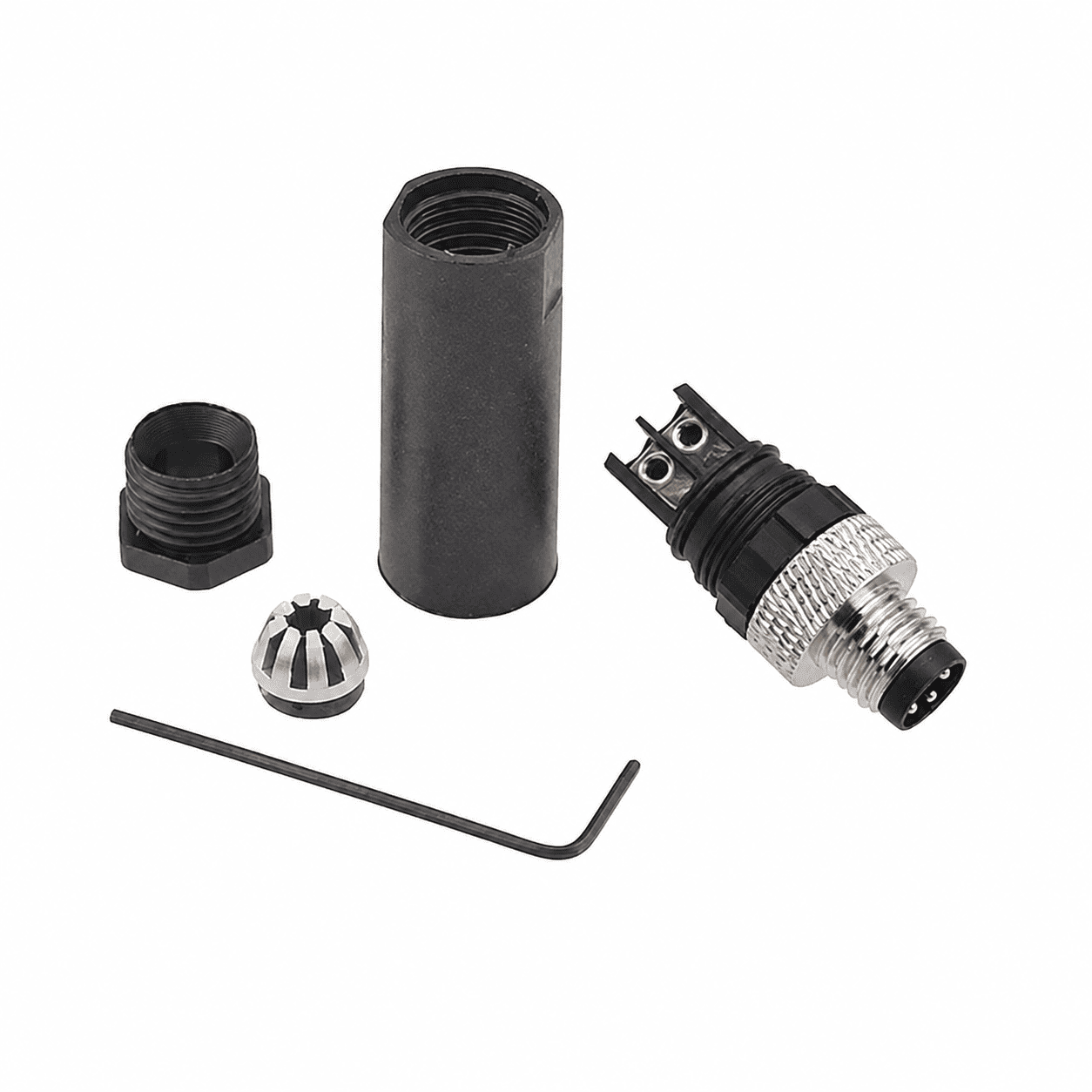
In customer inquiries, I often see buyers ask whether one M8 connector can replace another because both are “M8 4 pin” or “M8 male.” I understand why this happens. In procurement work, short descriptions are common. But for industrial connectors, a short description is rarely enough.
“M8” usually refers to the thread/interface size of the circular connector family. It does not fully define the product. A complete M8 connector specification may include:
A connector can match in one area and fail in another. For example, a replacement may have the same 4-pin layout but a different wire color assignment.4 It may plug into the device, yet the sensor signal or power line may connect to the wrong circuit.
I always tell buyers that appearance is a starting point, not proof of compatibility. Industrial buyers should avoid approving a connector only from a photo unless the photo is supported by a drawing, wiring diagram, or datasheet.
| Surface detail | Hidden detail that must be checked | Possible risk |
|---|---|---|
| Same M8 thread | Different coding or contact arrangement | Cannot mate correctly or damages contact |
| Same pin count | Different pinout or wire color | Device does not work or wiring is reversed |
| Same cable length | Different conductor size | Voltage drop or current mismatch |
| Same black cable | Different jacket material | Oil, abrasion, or temperature failure |
| Same IP rating claim | Different test conditions | Water ingress in real use |
| Same low price | Different molding or quality control | Higher field failure risk |
For a new quotation or replacement inquiry, I prefer to review at least one of these documents:
This does not mean every project requires complex engineering. Many M8 connectors are standard and straightforward. But a clear confirmation step prevents avoidable mistakes. A mature supplier should help buyers identify the unknowns before mass production, not after shipment.
Replacing M8 connectors can be easy when the original specification is clear. The problem starts when the buyer has only a photo, a pin count, or a short label. In that situation, the replacement may look correct but still create device failure.
Before replacing M8 connectors, buyers should verify coding, pin count, gender, pinout, wire color definition, mounting style, cable length, conductor size, jacket material, shielding, IP rating, temperature range, and any drawing or certification requirements. A sample check is often safer before bulk orders.
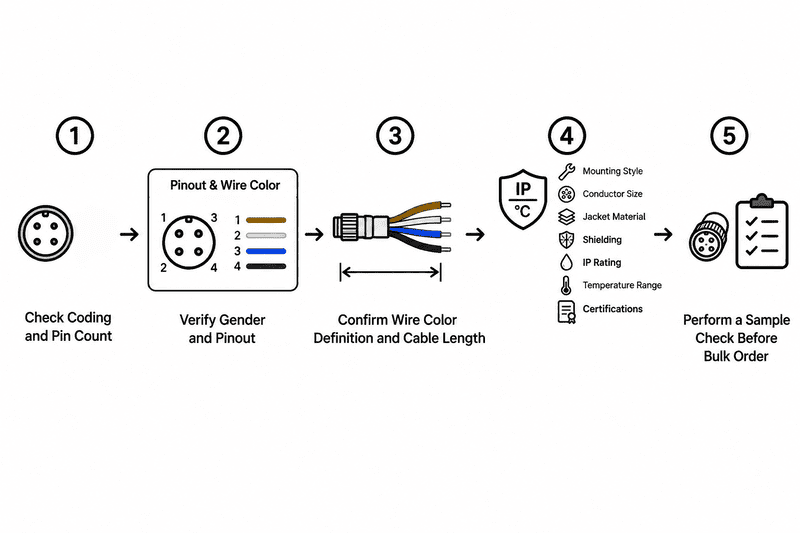
When I receive an M8 replacement request, I try to move from the most visible items to the most hidden items. This method helps buyers avoid missing small but important details.
| Check item | What to confirm | Why it matters |
|---|---|---|
| Connector type | Male or female, plug or socket | Prevents wrong mating interface |
| Pin count | 3, 4, 5, 6, 8 pins, etc. | Defines contact quantity, not full wiring |
| Coding | A-coded or required project coding | Prevents mismatch with device interface |
| Pinout | Function of each pin | Protects power, signal, and grounding |
| Wire color | Brown, blue, black, white, etc. | Supports installation and maintenance |
| Cable length | Standard or custom length | Affects routing and installation cost |
| Conductor size | Example: 0.25 mm², 0.34 mm² | Affects current and voltage drop |
| Jacket material | PVC, PUR, special cable | Affects flexibility and chemical resistance |
| Shielding | Shielded or unshielded | Important for noise-sensitive signals |
| Mounting | Cable-end, panel mount, PCB | Affects assembly method |
| Environment | Oil, water, UV, vibration, temperature | Affects service life |
| Documentation | Datasheet, drawing, test report, certificates | Supports buyer approval process |
A common risky request sounds like this: “I need an M8 4-pin connector. Please quote.” I can quote a general item, but I cannot responsibly confirm the best match without more information.
A 4-pin connector may be used for many purposes:
Each use may have a different pin definition. For example, pin 1 may carry positive voltage in one device, but another device may use a different assignment. If the buyer replaces only by pin count, the connector may physically fit but electrically fail.
Many buyers focus on the connector head and forget the cable. However, the cable is often where long-term problems appear.
For example:
I do not treat these as universal rules. The right choice depends on the project. If a buyer has a drawing, equipment manual, or end-customer requirement, I recommend using that document as the approval basis.
For uncertain replacement projects, I usually suggest a sample before volume purchase. A sample allows the buyer to check:
This step is especially useful for distributors, importers, and system integrators. A small sample cost is usually much lower than the cost of field rework.
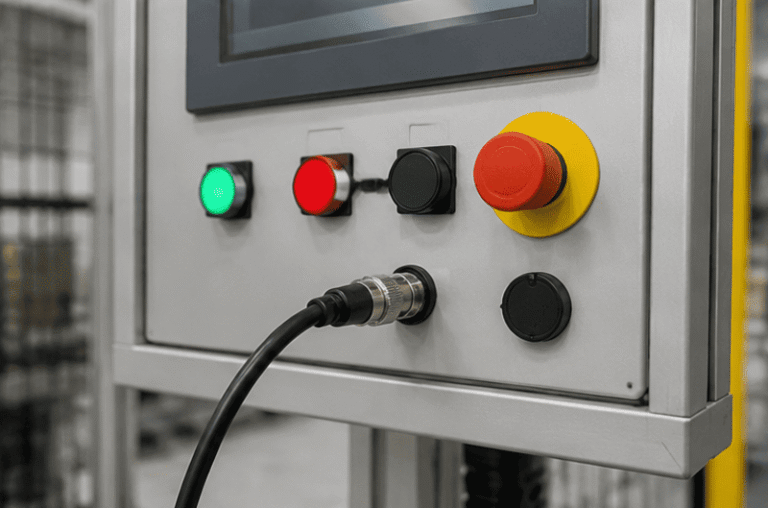
M8 connectors are used across many automation systems, but each application creates different priorities. A sensor cable, a robot harness, and a control cabinet panel connector may all use the M8 format, yet the selection logic can be very different.
Applications change the right M8 connectors because sensors, actuators, PLC I/O, industrial Ethernet, robotics, AGVs, and equipment wiring may require different pinouts, shielding, cable materials, bending performance, IP protection, temperature range, and approval documents. The application should guide the connector selection.
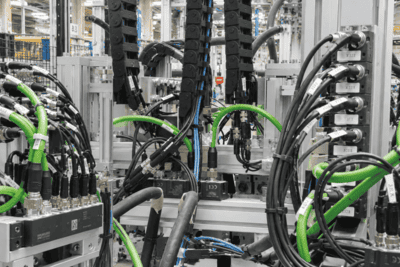
For many automation projects, M8 connectors are used with sensors and actuators. These applications often need compact size, fast installation, and reliable signal transmission. In many cases, buyers care about standard pin definitions, cable length, and stable molded construction.
Typical selection questions include:
Control cabinet builders often use connectors to simplify wiring and maintenance. In this case, installation layout becomes important. A right-angle connector may save space. A panel mount connector may provide a clean interface between the cabinet and machine wiring.
For PLC-related projects, I recommend checking:
As a manufacturer of terminal blocks, PLC interface modules, distribution modules, relay modules, and circular connector assemblies, I see many projects where the connector is only one part of the whole wiring system. The connector must match the broader cabinet design.
Some compact industrial network devices may use small circular connectors. In network or communication-related projects, buyers should be more careful with shielding, cable structure, impedance requirements, and supplier documentation. I avoid making assumptions here because communication performance depends on the full design.
A buyer should verify:
If a project references an IEC standard, customer drawing, or certification requirement, the buyer should verify the exact document version and supplier support materials. I can provide drawings and product information for review, but project approval should follow the buyer’s technical process.
Robots and AGVs create higher mechanical stress than fixed sensor wiring.5 Movement, bending, vibration, and abrasion can shorten cable life if the cable is not selected correctly.6
For moving equipment, I would pay attention to:
The table below shows how application priorities can differ.
| Application | Main concern | Common specification focus |
|---|---|---|
| Sensor wiring | Reliable signal and easy replacement | Pinout, length, molded cable, IP rating |
| Actuator wiring | Power and control stability | Current rating, conductor size, pin definition |
| PLC I/O | Cabinet organization and maintenance | Panel mount, wiring diagram, labeling |
| Industrial network | Signal quality | Shielding, cable structure, documentation |
| Robot/AGV | Motion durability | Flexible cable, strain relief, jacket material |
| Outdoor equipment | Weather exposure | IP rating, UV resistance, temperature range |
The connector name alone cannot answer these application questions. I prefer to ask how and where the connector will be used before recommending a final structure.
IP ratings and price are important, but they do not tell the full story. I see many buyers ask first for IP67 and the lowest unit price. That is understandable in procurement, but it can miss the real operating conditions.
IP ratings and low prices are not enough when buying M8 connectors. Buyers should also check temperature range, oil exposure, UV exposure, vibration, cable movement, material quality, test conditions, certification documents, MOQ, delivery time, sample support, and OEM or private-label requirements.
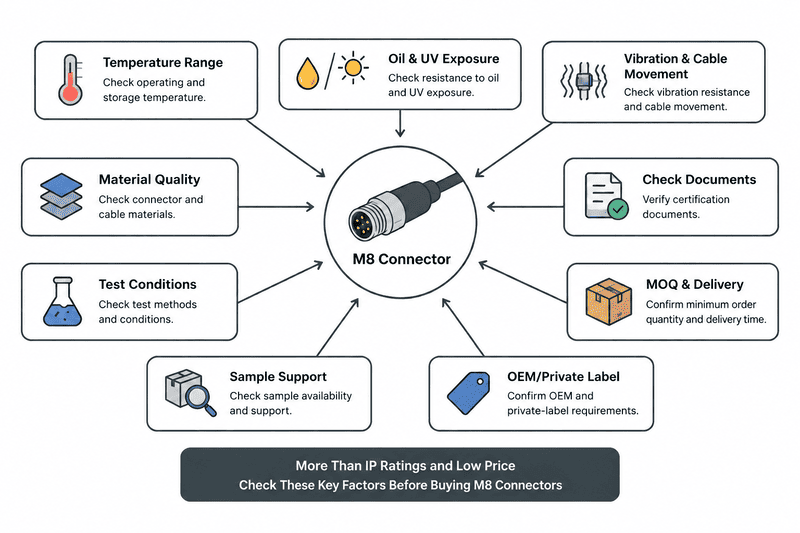
An IP rating can be useful, but buyers should understand what it does and does not prove. For example, IP67 usually relates to dust protection and temporary water immersion under defined test conditions.7 It does not automatically mean the connector is suitable for every washdown, outdoor, chemical, or long-term submerged environment.8
Before relying on an IP rating, buyers should ask:
I recommend treating IP rating as one filter, not the final decision. The final choice should match the actual installation environment.
A lower price may be acceptable when the specification is simple and the application risk is low. However, price comparison only makes sense when buyers compare the same structure and documentation level.
For example, two quotations for M8 connectors may differ because of:
If one quote includes PUR cable and another includes standard PVC cable, the lower price may not be a better value. It may simply be a different product.
For global OEM buyers and importers, documents matter. Some projects require RoHS, REACH, CE-related declarations, UL-related files, IEC reference standards, or customer-specific compliance documents.9 I treat these as documents buyers should verify, not as assumptions.
A responsible buying process may include:
At NITAI, I can support buyers with engineering materials such as drawings, CAD information, sample development, and product customization where available. However, the buyer should still confirm whether the documents meet the end project, local market, and customer approval requirements.
Industrial buyers do not evaluate only technical details. They also need stable supply. A connector that is technically suitable but unavailable for repeated orders may create production risk.
For purchasing teams, I suggest checking:
These checks are especially important for OEM/ODM manufacturers, electrical distributors, and automation equipment builders. A good supplier should help balance technical fit, price, and delivery reliability.
Confirming M8 connectors with a supplier should be a structured process. If the discussion stays at “same as photo” or “same pin count,” both sides may misunderstand the requirement. A clear confirmation file saves time and prevents repeated revisions.
Buyers should confirm M8 connectors by sending drawings, photos, device specifications, pinout requirements, cable details, application environment, target quantity, certification needs, and delivery expectations. A good supplier should review technical compatibility, provide samples when needed, and confirm details before production.
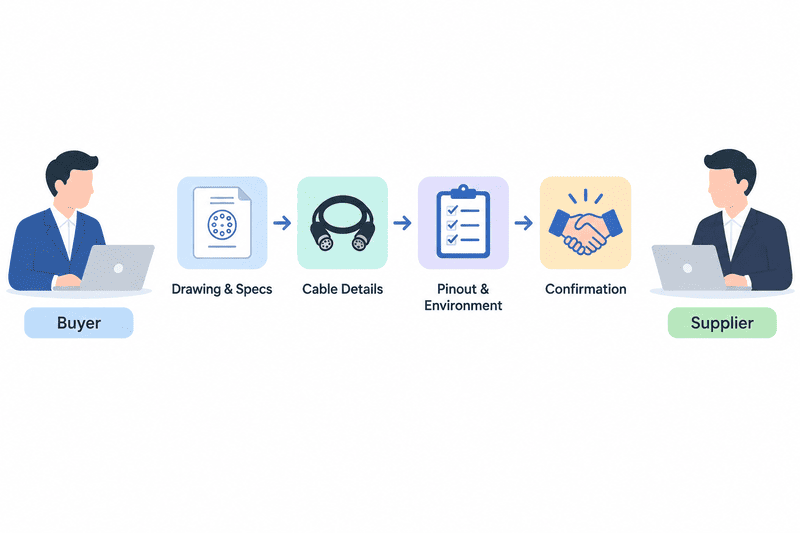
When a buyer asks for a quotation, I try to collect enough information to avoid a vague offer. A fast quote is useful, but a correct quote is better.
The most helpful information includes:
If the buyer does not have all the details, photos can still help. I prefer front view, side view, cable marking, device socket, and old label photos. These photos do not replace a drawing, but they help narrow the selection.
Buyers can use the table below when requesting M8 connectors from a factory or trading partner.
| Information | Buyer input |
|---|---|
| Application | Sensor / actuator / PLC / robot / AGV / other |
| Connector type | Male / female / panel / cable-end |
| Pin count | 3 / 4 / 5 / 6 / 8 / other |
| Coding | A-coded / other / unknown |
| Shape | Straight / right-angle |
| Cable | PVC / PUR / shielded / custom |
| Length | Standard or custom |
| Pinout | Drawing or wire color definition |
| Environment | Indoor / outdoor / oil / vibration / moving |
| Documents | Datasheet / drawing / compliance files |
| Quantity | Sample and mass order volume |
| Delivery | Required lead time |
Custom connector assemblies are useful when a standard item does not fully match the project. Customization may include cable length, wire color, jacket material, labeling, packaging, harness branching, or private branding.
I usually see custom needs in:
However, customization should be controlled. Too much unnecessary customization can increase MOQ, cost, and lead time. I usually recommend standard structures when they meet the requirement, and custom structures when they reduce installation time, improve reliability, or match the end customer’s drawing.
A supplier’s technical communication is part of product quality. If a supplier does not ask about pinout, cable, environment, or documents, the buyer may receive a fast price but not a safe match.
A mature supplier should be able to:
This is the approach I try to follow at NITAI. I want buyers to receive a connector that fits the project, not only a connector that matches a short product name.
No, the same pin count does not guarantee compatibility. You should verify coding, gender, pinout, wire color, cable structure, and mounting style. A 4-pin connector, for example, may have different wiring definitions depending on the device or application.
The most common mistake is buying by appearance or short description only. Buyers may send a photo and request “same M8 connector,” but the hidden details matter. Pinout, cable material, shielding, conductor size, and environment should be confirmed before approval.
No. Different products may have different IP ratings, and the rating may depend on the mating condition, cable type, assembly method, and test conditions. Buyers should verify the supplier’s datasheet and confirm whether the rating matches the real installation environment.
PVC is common and cost-effective for many fixed industrial applications. PUR is often preferred for higher abrasion resistance, flexibility, or harsher environments. The best choice depends on oil exposure, movement, temperature, installation method, and project requirements.
You should send drawings, photos, pinout, cable length, cable material, connector gender, pin count, coding, application environment, quantity, document requirements, and delivery expectations. If you are replacing an old part, photos of the connector face, cable marking, and label are helpful.
M8 connectors are not all the same, even when they share the same compact circular format. A correct selection depends on coding, pin count, gender, pinout, cable construction, mounting style, environment, documents, and supply requirements. I recommend treating each inquiry as a specification match, not a visual match. If you need support for selection, replacement, OEM/ODM customization, or industrial cable assembly development, you can send NITAI your drawing, photos, or application requirements for review.
"IEC metric screw sized connectors", https://en.wikipedia.org/wiki/IEC_metric_screw_sized_connectors. IEC 61076-2-104 treats M8 connectors as a standardized circular connector interface with specified dimensional and performance requirements, supporting the point that “M8” identifies an interface family rather than a complete replacement specification. Evidence role: definition; source type: institution. Supports: A standards source should show that M8 is treated as a circular connector interface category with defined mechanical and electrical variants, not as a single universal part number.. Scope note: The standard defines the interface category and variants, but it does not evaluate every manufacturer-specific part or custom assembly. ↩
"IEC metric screw sized connectors", https://en.wikipedia.org/wiki/IEC_metric_screw_sized_connectors. Connector standards such as IEC 61076 specify circular connectors through multiple attributes, including contact arrangements, coding, termination style, and performance requirements, providing contextual support for verifying the full specification before replacement. Evidence role: general_support; source type: institution. Supports: A standards or institutional source should support that connector specifications include coding, contact arrangement, termination, environmental rating, and related parameters.. Scope note: This supports the engineering rationale for a multi-attribute check, but it does not prove that every listed parameter is required in every M8 purchase. ↩
"IEC 60320", https://en.wikipedia.org/wiki/IEC_60320. Electrical interconnection references describe connector pinouts as the mapping between physical contacts and circuit functions, which supports the mechanism by which mechanically mating connectors can still be electrically incompatible when pin assignments differ. Evidence role: mechanism; source type: education. Supports: A technical education or standards source should explain that connector pins carry assigned electrical functions and that mismatched pinouts can connect circuits incorrectly.. Scope note: The source would explain the general mechanism; it would not document a specific M8 failure case unless a case study is used. ↩
"Sensor Actuator wiring standards when using M12/8 ...", https://www.reddit.com/r/PLC/comments/1jixqhm/sensor_actuator_wiring_standards_when_using_m128/. Industrial sensor interface standards and wiring conventions define contact functions and conductor colors separately from the number of contacts, supporting the point that a four-pin connector description alone does not fully specify the wiring. Evidence role: general_support; source type: institution. Supports: A standards source should show that industrial sensor wiring commonly maps specific contact numbers to functions and conductor colors, illustrating why pin count alone is incomplete.. Scope note: The evidence is contextual because wire colors may vary by product family, market, or customer-specific harness design. ↩
"Measurement of a Vibration on a Robotic Vehicle - PMC", https://pmc.ncbi.nlm.nih.gov/articles/PMC9695174/. Research on robotic cable and harness reliability identifies repeated bending, torsion, vibration, and abrasion as characteristic stresses in moving automation systems, providing contextual support for distinguishing robot or AGV wiring from fixed sensor wiring. Evidence role: general_support; source type: paper. Supports: A robotics or cable-reliability paper should support that moving automation systems expose cables to repeated bending, torsion, vibration, or abrasion.. Scope note: The magnitude of stress depends on robot geometry, cable routing, duty cycle, strain relief, and operating environment. ↩
"Bending Fatigue Response of Grouted Stay Cables (0-1401-1)", https://library.ctr.utexas.edu/ctr-publications/0-1401-1.pdf. Cable reliability studies describe repeated flexing, vibration, and abrasion as mechanisms that can damage conductors, insulation, or jacket materials over time, supporting the claim that inappropriate cable selection can shorten service life in moving applications. Evidence role: mechanism; source type: paper. Supports: A research paper should explain how repeated bending, vibration, and abrasion contribute to conductor, insulation, or jacket fatigue and reduced cable life.. Scope note: The evidence supports the failure mechanisms generally; predicted life requires cable-specific flex testing and application-specific duty-cycle data. ↩
"IP67 Testing: Dust Test and Temporary Immersion IEC 60529", https://www.ingressprotectiontest.com/?l=test-ip67-protection-against-dust-ip6x-immersion-ipx7-cei-en-iec-60529. IEC 60529 defines IP67 as dust-tight protection with protection against the effects of temporary immersion in water under specified test conditions, supporting the article’s explanation of the rating. Evidence role: definition; source type: institution. Supports: A standards source should define the first digit 6 as dust-tight protection and the second digit 7 as protection against temporary immersion under standard conditions.. ↩
"IP code", https://en.wikipedia.org/wiki/IP_code. Ingress protection standards define IP ratings by specified dust and water tests, while institutional guidance notes that such ratings do not independently establish resistance to corrosion, chemicals, sunlight, washdown conditions, or permanent immersion. Evidence role: expert_consensus; source type: institution. Supports: A standards or institutional source should clarify that IP codes describe specific ingress tests and do not automatically cover chemical compatibility, corrosion, sunlight exposure, washdown severity, or indefinite immersion.. Scope note: This supports the limitation of IP ratings generally; suitability for a particular connector still requires product-specific testing and installation review. ↩
"List of IEC standards", https://en.wikipedia.org/wiki/List_of_IEC_standards. Official European regulatory materials identify RoHS, REACH, and CE marking as compliance frameworks relevant to many electrical and electronic products, supporting the article’s statement that connector projects may require formal declarations or standards documentation. Evidence role: historical_context; source type: government. Supports: Official regulatory sources should show that RoHS, REACH, and CE marking obligations can apply to electrical and electronic products in relevant markets, while UL and IEC documents may be used for conformity or customer approval.. Scope note: Applicability depends on the product’s function, market, supply-chain role, and jurisdiction; the cited regulations do not by themselves determine requirements for every M8 connector assembly. ↩
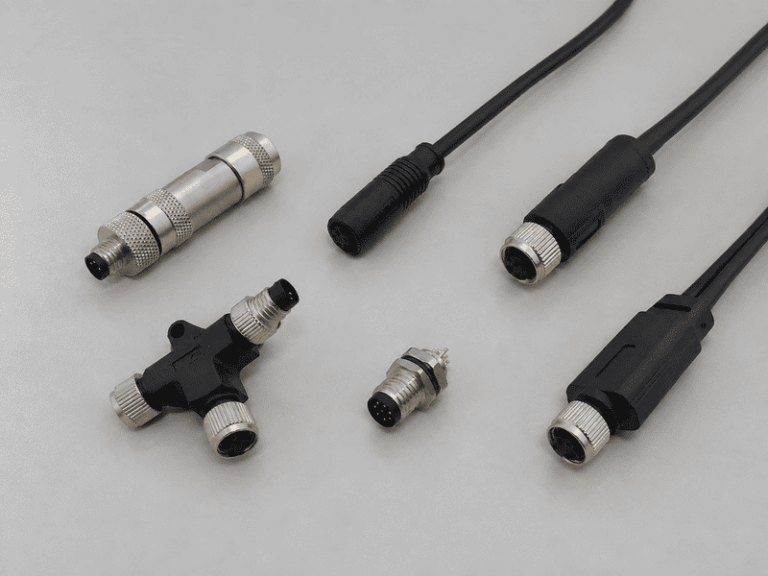
An M8 8 pin female connector can look like the right replacement on a purchasing list and still…
An M12 male connector 5-pin B-coded may look like a straightforward line item, but its name does not…
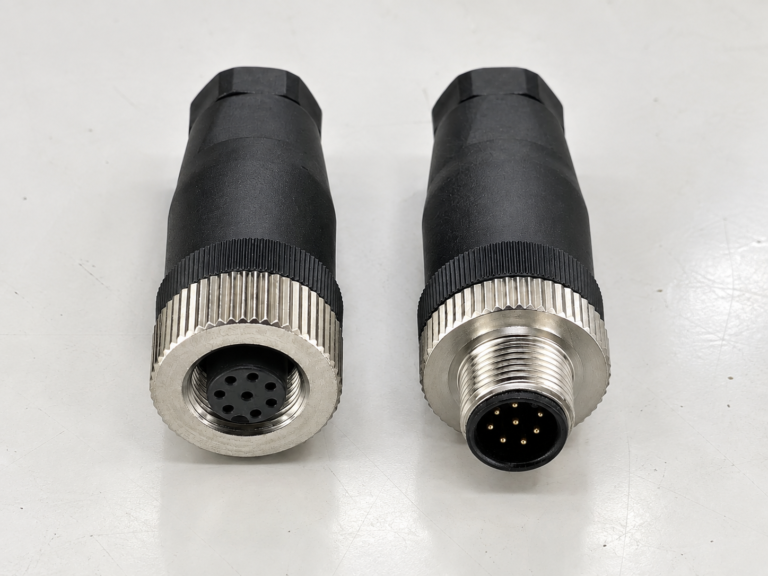
M12 connectors can carry different voltage ratings, so a buyer cannot choose one safely from the connector size…
NITAI manufactures terminal blocks, M8/M12 waterproof connectors and industrial distribution modules for global OEMs, distributors and automation customers.
Leave a Reply