Oct 17, 2026
How Do I Choose the Right M8 8 Pin Female Connector for My Equipment?
An M8 8 pin female connector can look like the right replacement on a purchasing list and still…

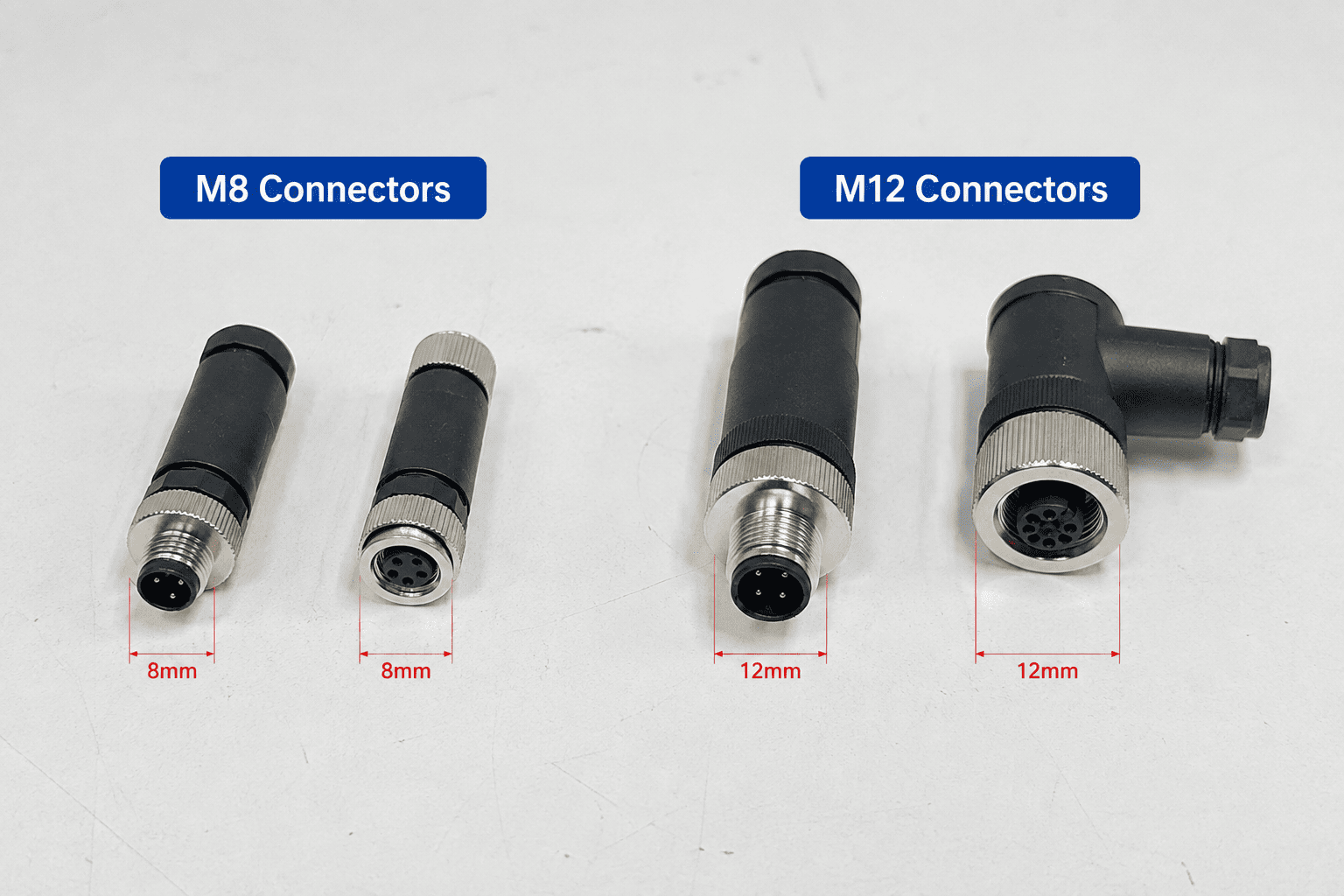
M8 vs M12 connectors can look interchangeable in a product photo, but ordering by appearance can leave you with the wrong interface or a cable that will not fit the installation. I start with the device documentation, not a preferred connector size. Then I check electrical requirements and available space before requesting a quote.
For an existing device, choose M8 or M12 by matching its documented connector interface, including thread, gender, coding, contacts, and pinout. For a new design, first identify connector options that meet the required circuits and communication specifications. Then compare port spacing, cable routing, and coupling access. Size alone does not establish suitability.
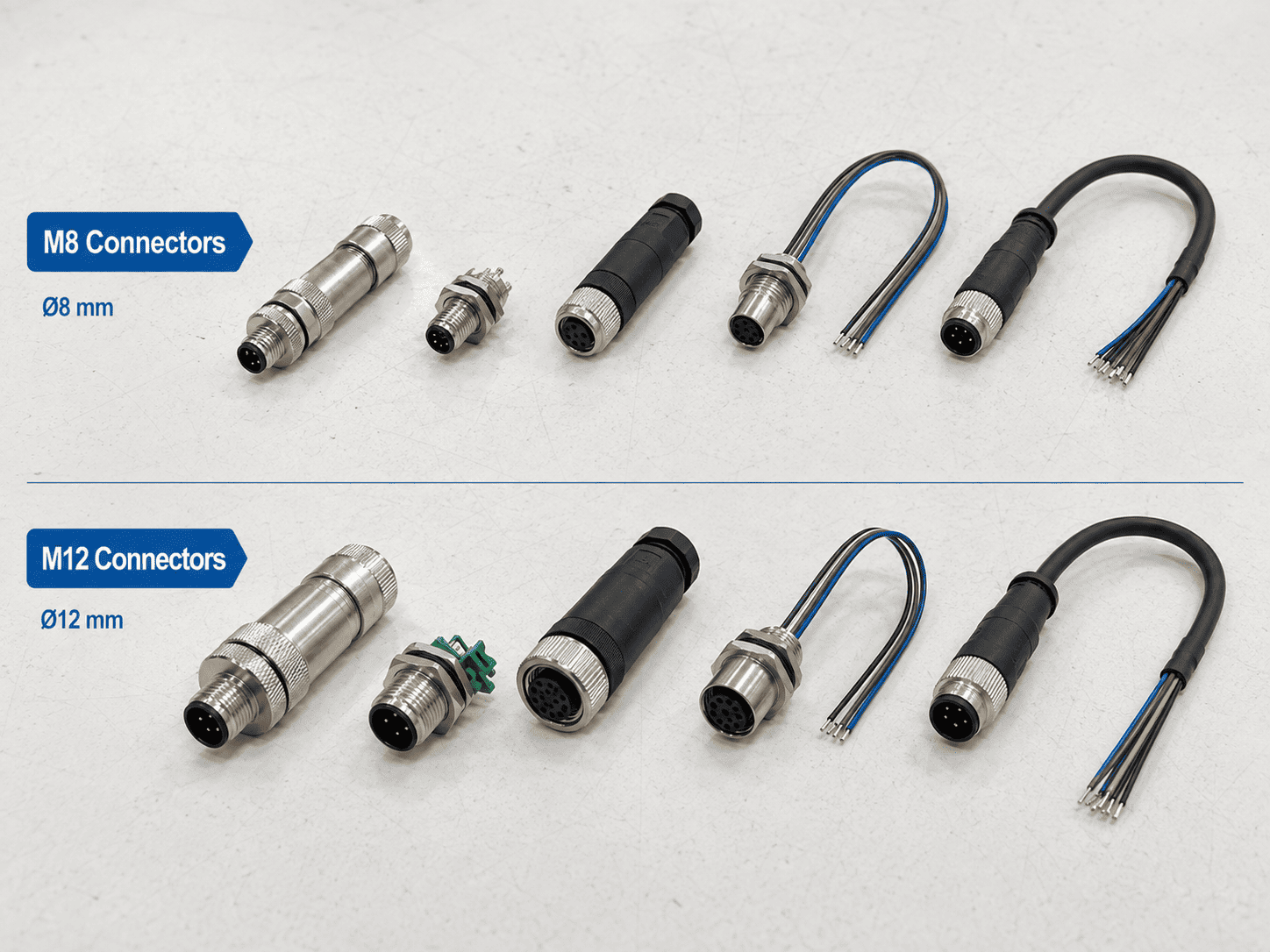
That sequence matters because a correct-looking connector can still have the wrong pin assignment, rating, or cable construction. I use the checks below to turn a device specification into a purchase-ready connector or cable assembly requirement. They also show when a question needs an engineering answer rather than a sales assumption.
A device photo often shows the connector location but not the details needed to identify it. If I guess the size, I may send a sample that cannot mate with the device. The choice changes as soon as the equipment interface is fixed: at that point, I match the documented interface instead of choosing a size.
I confirm the nominal thread size, mating configuration, coding, contact count, and pinout from the device datasheet, drawing, label, or manufacturer documentation. M8 refers to a nominal 8 mm thread diameter; M12 refers to a nominal 12 mm thread diameter.1 An unscaled photograph is not enough to identify either one confidently.
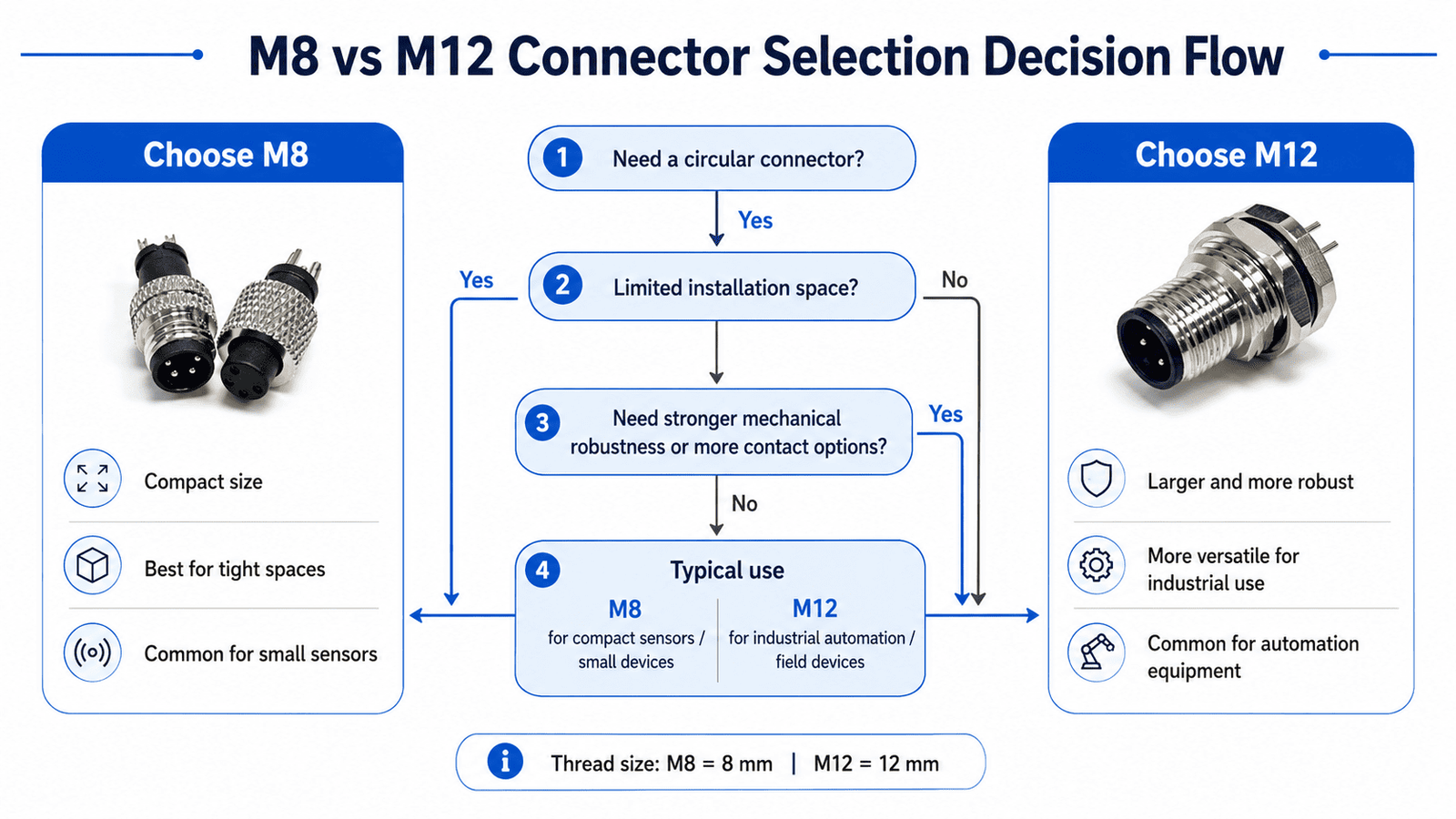
I have handled a photo-only M8/M12 inquiry by asking for dimensions or documentation before identifying the model. That extra information made the interface identifiable. It did not, by itself, validate how the connector would perform in the customer’s application.
For an existing device, I ask the buyer for:
I use “male” and “female” carefully because a buyer may describe the contacts while a catalog describes the coupling end. A mating drawing helps both sides confirm what will connect.
| Check | What I verify next | Why it can change the order |
|---|---|---|
| Thread | Documented M8 or M12 interface | The connector must mate mechanically with the device port. |
| Gender and form | Mating drawing and coupling arrangement | The proposed cable end must connect to the installed port. |
| Coding | Device and connector documentation | Similar-looking circular connectors may use different keyed interfaces.2 |
| Contact count | Device circuit requirements | The selected configuration must provide the required contacts. |
| Pinout | Both ends of the connection | Matching contact counts do not establish matching functions.3 |
For a new device design, the process is different. I can compare more than one interface, but I still start with the circuits and communication requirements. I then narrow the options to documented, compatible configurations. Only after that do I compare their physical footprints. If the device maker has already selected a port, procurement has less freedom: the matching interface becomes a requirement, not a preference.
A small sensor or actuator does not automatically need M8. The connector must fit not only the device body but also the space needed to attach and route its cable. I check installation geometry when a new design can support more than one interface, or when a replacement cable has limited room around an existing port.
I compare adjacent-port spacing, connector body dimensions, coupling access, cable exit direction, and bend clearance using product drawings and the equipment layout. If either size meets the documented interface and electrical needs, these dimensions can decide the choice. If the interface is fixed, they help me choose a suitable cable-end form instead.
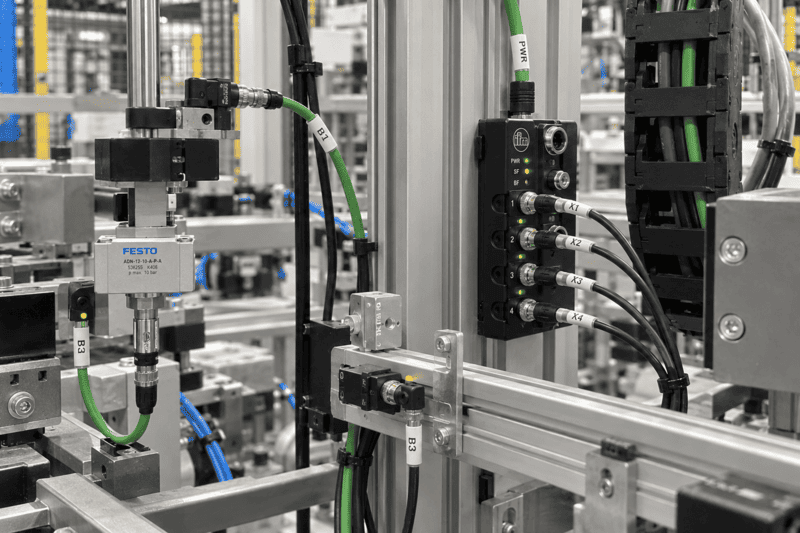
The nominal thread size does not describe the full installed assembly. A connector body, coupling nut, overmold, and cable can take up more room than the port itself. A panel drawing that shows only hole locations may therefore be insufficient for cable selection.
For a dense device layout, I ask several practical questions:
These questions can change a selection even when two candidate products have the same nominal thread size. They can also reveal that the device layout needs review. I would not assume that switching to a smaller connector solves a cramped installation if the device interface, mating dimensions, or cable exit still conflicts with the equipment.
Space also affects the temptation to pick a connector by appearance alone. I do not choose a 3-, 4-, or 5-contact version because “more pins” seems safer. I match the required circuits and assigned contact positions in the device documentation.
For example, a drawing may call for a particular contact count and identify which positions carry supply, return, signals, or other functions. I use that drawing rather than assuming an unused contact makes another configuration interchangeable. The next verification is the proposed connector’s mating drawing and pin-numbering view, followed by a check of the complete cable assembly. That approach makes the purchase specification clearer for the supplier and the engineer reviewing the design.
Mechanical fit is necessary, but it does not establish electrical or environmental suitability. This distinction matters when a buyer asks whether M8 is “for signals” or M12 is “for power.” I avoid either shortcut. The choice changes only when the specific device and connector specifications show that an option meets the application.
After confirming the mating interface, I check the proposed product’s documented current and voltage ratings, communication support where relevant, IP-rating conditions, and cable materials. I also compare those specifications with the device requirements and installation conditions. I leave application-specific performance validation to a qualified engineering review.

An M12 label alone does not tell me whether a product suits a power circuit or an industrial communication link. M12 connectors are available in different coded configurations for different purposes.5 The same caution applies to M8 options: I need the exact product documentation, not a general statement about connector size.
I ask buyers to separate two approvals:
| Approval question | Evidence I request |
|---|---|
| Will these parts mate correctly? | Device-port drawing and proposed connector mating drawing |
| Will the connection suit the application? | Device requirements, connector and cable datasheets, and engineering review where needed |
That separation keeps a mechanically compatible sample from being treated as a completed technical approval.
For environmental requirements, I check how the manufacturer states the IP rating6, including any conditions for a fully mated and correctly assembled connection. I also ask about the cable jacket and installation environment rather than treating a waterproof connector description as approval for every wet location. The cable, termination, and installation all belong in the review.
If a buyer needs evidence of a certification or compliance claim, I request the current document for the exact product or assembly and ask the buyer to verify its scope. I do not treat a catalog badge or a certification held by a different product as proof for the quoted item.
My purchasing rule is simple: I confirm what connects first, then verify what that exact connection is rated to do.
Application names help me ask questions, but they do not identify a connector on their own. “Sensor,” “IO-Link,” and “industrial Ethernet” can each describe equipment with different interfaces. In these illustrative walkthroughs, I start with the device specification and use the application to identify what needs verification next.
I select the mating interface stated for each device, then check its pin assignment and applicable electrical or communication requirements. For a new design, I compare documented interface options only after confirming those requirements. I do not infer a connector’s protocol support from its diameter, contact count, or similar appearance.7
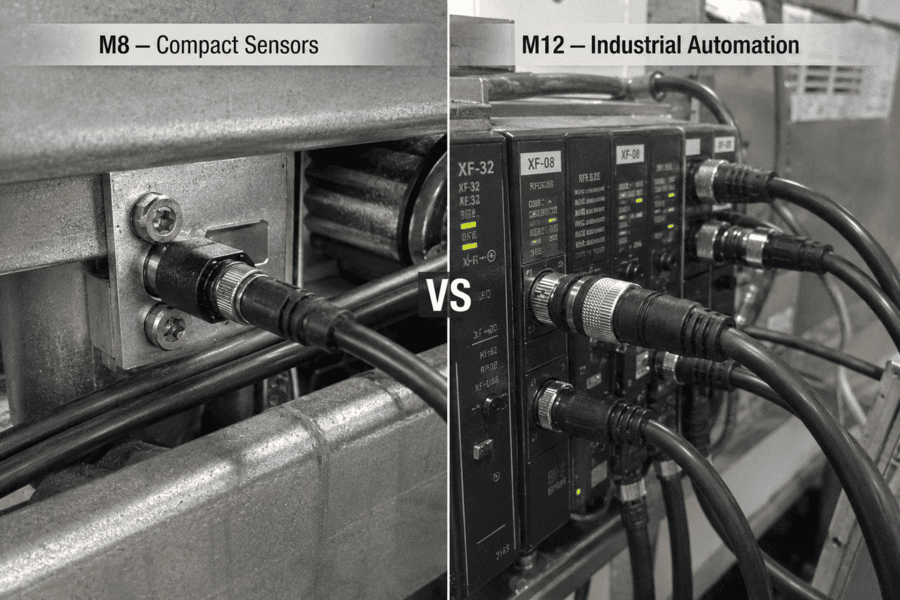
For a sensor, I would request the sensor model number and connection diagram. Those documents should identify the port or cable connection and show the assigned contacts. If the sensor has an existing M8 or M12 port, I match that interface. I then check the supply and output requirements against the proposed connector and cable documentation.
If the sensor sits beside several others, I also examine port spacing and cable exit. That installation check may change my recommendation from one cable-end form to another. It does not justify changing a fixed device port to a different nominal size.
For an IO-Link connection, I would obtain documentation for the device port and the master port8. I would verify their specified interfaces, contact assignments, and applicable cable requirements before quoting an assembly. If the documents leave a compatibility question unresolved, I would send it to the equipment manufacturer or a qualified engineer rather than assume that a connector with the right number of contacts will work.
This is also where a cable drawing earns its place in the purchasing file. It can state both ends, their pin mapping, and the requested length so that the supplier and buyer review the same proposed connection.
For industrial Ethernet equipment, I would first identify the device’s specified connector interface and communication requirements. I would then compare the proposed connector and cable assembly with the relevant product documentation, including coding and cable construction. If shielding is required by the equipment specification, I would include that requirement in the cable inquiry and seek engineering confirmation of the complete connection.
These are selection walkthroughs, not claims about a particular customer project. In each case, the next action is the same: collect the exact datasheets and drawings, resolve any discrepancy, and have the responsible engineer validate application-specific performance.
An incomplete inquiry can produce a price for the wrong item. “M12 cable, two meters” does not tell a supplier enough about mating ends, pin mapping, or installation form. I make the quote request more specific once I have checked the equipment documentation; that saves both sides from treating assumptions as approved specifications.
I send the device and mating-interface details, required circuits, cable construction requirements, length, connector forms, and quantity. When two pieces of equipment use different interfaces, I ask whether a documented cable assembly can cover both ends. I still require electrical and protocol compatibility checks; customization cannot create compatibility where it does not exist.
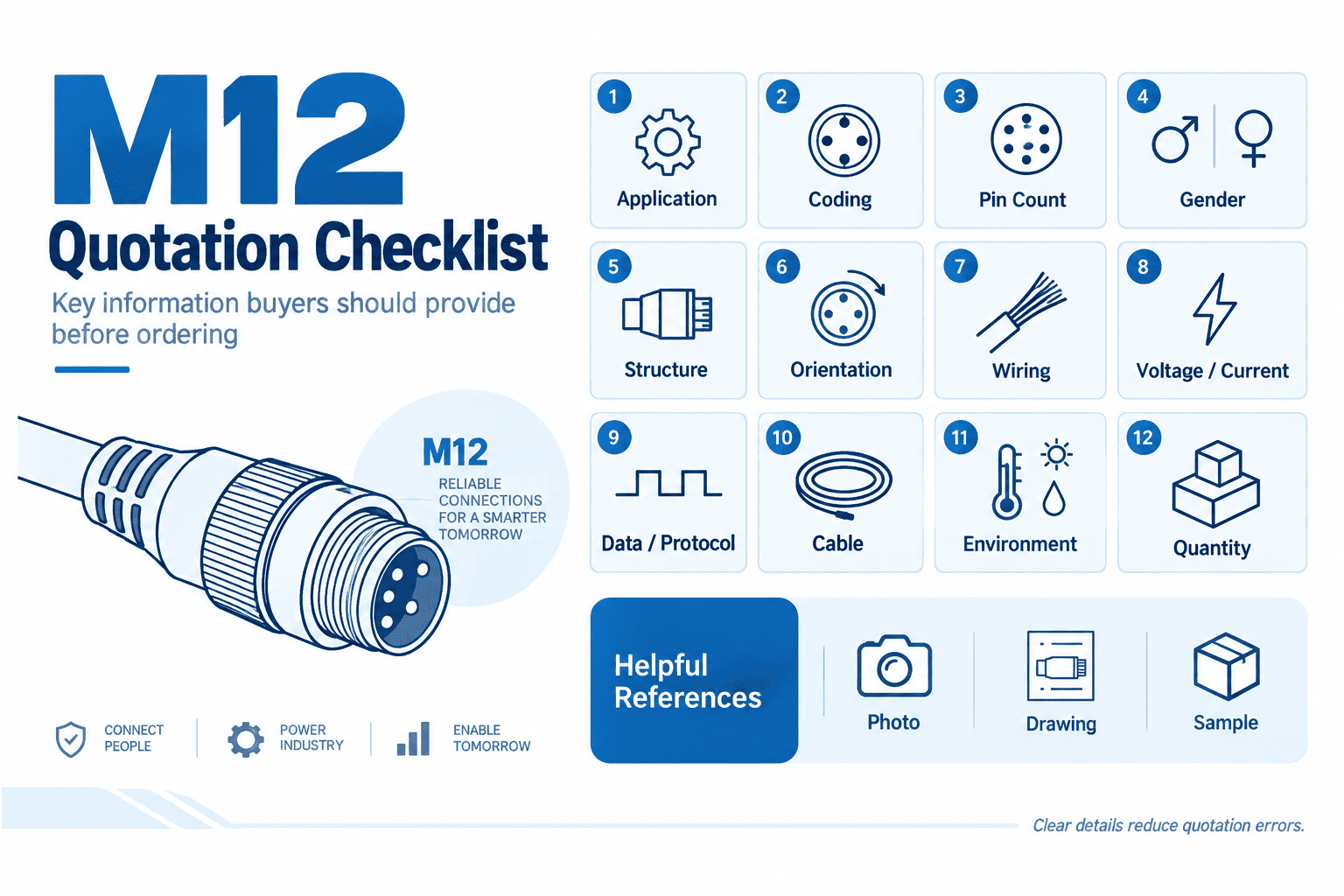
I find that a short, complete inquiry is more useful than a long description of the application without drawings. For a standard connector or custom cable assembly, I include:
If a machine interface and a control-cabinet interface differ, I can discuss an assembly designed around both documented ends. I ask for a drawing that shows the connectors, cable, and pin-to-pin mapping before treating it as a substitute for a standard part. An adapter or custom cable may solve a physical connection and routing problem. It does not, on its own, resolve a mismatch in voltage, assigned functions, or communication requirements.
At NITAI, we support connector and industrial cable-assembly inquiries with customization, samples, and engineering documents such as 2D, 3D, and CAD files. I use those materials to help buyers and their engineers compare a proposed assembly with the equipment specification. I would still ask the responsible engineering team to approve the final application-specific choice before bulk purchasing.
I would not identify the size confidently from an unscaled photograph. I ask for the device model, a datasheet or mating drawing, or dimensions that show the thread and connector face. A photo can help me frame the follow-up questions, but it should not be the sole basis for an order.
No. I verify thread size, gender, coding, mating geometry, and pinout as separate items. I then check the electrical requirements. Two connectors can show the same contact count while assigning those contacts different functions, so I request drawings for both sides before recommending an assembly.
No. I check the ratings and IP conditions of the specific connector and complete assembly against the equipment requirements. I also review the cable material and installation conditions. I do not use nominal size as a substitute for datasheet review or qualified engineering evaluation.
A custom assembly can be specified with different documented connector ends, a defined pin map, length, and cable construction. I would first confirm that the equipment interfaces and circuit requirements permit the intended connection. The custom cable alone does not correct an electrical or protocol incompatibility.
I choose between M8 vs M12 connectors by matching the documented device interface first. For a new design, I identify options that meet the circuit and communication requirements before comparing installation space. I then verify the exact product ratings, cable requirements, and pin mapping instead of relying on connector size or appearance. If you are sourcing connectors or a cable assembly, send NITAI your device models, drawings, and installation requirements. We can help prepare a quote and samples for your team’s technical review.
"IEC metric screw sized connectors", https://en.wikipedia.org/wiki/IEC_metric_screw_sized_connectors. IEC circular-connector specifications identify M8 and M12 screw-locking interfaces by nominal metric thread size; the designation does not describe the connector’s complete outside dimensions. Evidence role: definition; source type: institution. Supports: Connector standards identify M8 and M12 circular interfaces by their nominal metric screw-locking thread sizes.. Scope note: Nominal thread size does not establish the dimensions of a particular connector body or cable assembly. ↩
"IEC metric screw sized connectors", https://en.wikipedia.org/wiki/IEC_metric_screw_sized_connectors. IEC circular-connector specifications define coded mating interfaces with distinct keying arrangements, so an apparently similar circular face does not by itself establish mating compatibility. Evidence role: mechanism; source type: institution. Supports: Circular-connector specifications distinguish coded mating interfaces by their keying geometry.. ↩
"IO-Link", https://en.wikipedia.org/wiki/IO-Link. Industrial interface specifications assign functions to numbered contacts; the presence of the same number of contacts therefore does not demonstrate that two ports use the same pin assignment. Evidence role: mechanism; source type: institution. Supports: Published connection specifications assign functions to numbered contacts separately from the number of contacts.. Scope note: A general pin-assignment specification cannot establish the wiring of the particular devices being purchased. ↩
"NVD-CVE-2026-60228 - NIST", https://nvd.nist.gov/vuln/detail/CVE-2026-60228. Electrical installation guidance addresses minimum cable bend radius to avoid damage during routing; the applicable limit must be taken from the specification for the cable being installed. Evidence role: mechanism; source type: government. Supports: Cable installation guidance treats excessive bending as a potential source of cable damage and calls for observing applicable limits.. Scope note: General installation guidance does not supply a bend-radius value for the proposed assembly. ↩
"IEC metric screw sized connectors", https://en.wikipedia.org/wiki/IEC_metric_screw_sized_connectors. IEC 61076-2 connector specifications define multiple M12 coded interfaces, including variants specified for different connection applications; the M12 thread designation alone does not identify the coding. Evidence role: definition; source type: institution. Supports: IEC connector specifications define multiple M12 mating-interface codings, including configurations used for different connection requirements.. Scope note: The appropriate coding and performance rating still depend on the exact device and component specifications. ↩
"Ingress Protection (IP) ratings", https://www.iec.ch/ip-ratings. IEC 60529 defines IP classifications through specified tests of an enclosure; a connector’s claimed protection should therefore be read together with the manufacturer’s stated mating and assembly conditions. Evidence role: definition; source type: institution. Supports: IP classifications describe protection under specified test conditions, making the rated configuration relevant.. Scope note: An IP classification does not establish suitability for every wet-location exposure or installation. ↩
"Ethernet physical layer", https://en.wikipedia.org/wiki/Ethernet_physical_layer. Industrial communication and physical-layer specifications define connection requirements beyond contact count and external dimensions; visual similarity alone cannot establish that a connector-and-cable assembly supports a given link. Evidence role: mechanism; source type: institution. Supports: Communication specifications include physical-layer and cabling requirements beyond a connector’s visible geometry.. Scope note: This principle does not determine whether any specific assembly meets a particular protocol specification. ↩
"IO-Link", https://en.wikipedia.org/wiki/IO-Link. IEC 61131-9 describes IO-Link as an interface between a master and a device, with defined port connections; reviewing documentation for both ports is therefore necessary to check a proposed cable’s assignments. Evidence role: mechanism; source type: institution. Supports: IO-Link specifies communication between a master port and a device port and defines relevant interface connections.. Scope note: The standard does not verify compatibility between the particular equipment models in an inquiry. ↩
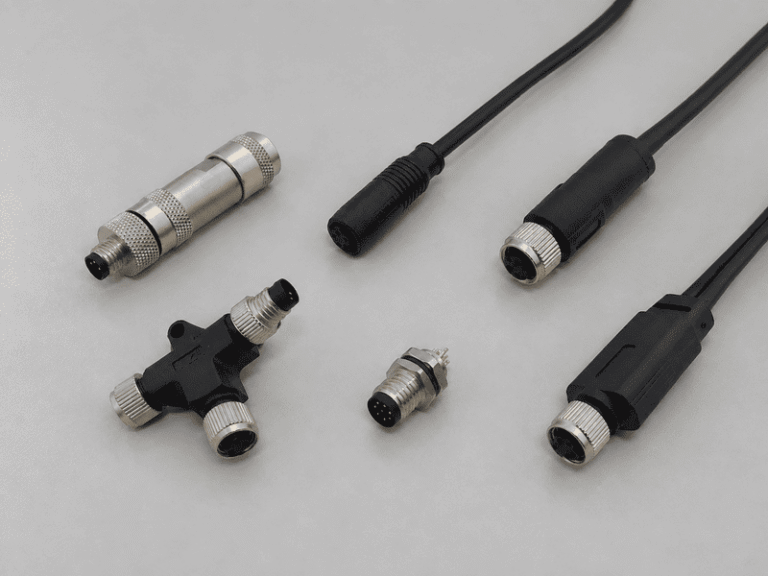
An M8 8 pin female connector can look like the right replacement on a purchasing list and still…

An M12 male connector 5-pin B-coded may look like a straightforward line item, but its name does not…
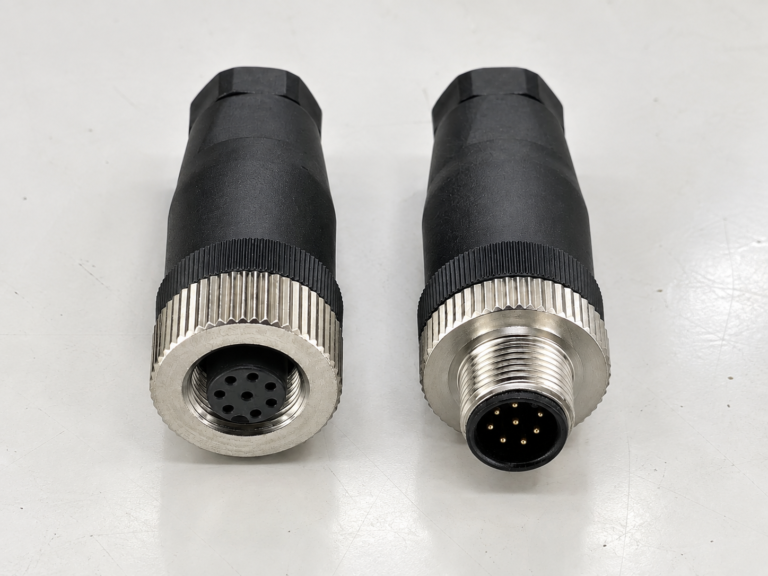
M12 connectors can carry different voltage ratings, so a buyer cannot choose one safely from the connector size…
NITAI manufactures terminal blocks, M8/M12 waterproof connectors and industrial distribution modules for global OEMs, distributors and automation customers.
Leave a Reply