Oct 16, 2026
What Is an M12 Male Connector 5-Pin B-Coded?
An M12 male connector 5-pin B-coded may look like a straightforward line item, but its name does not…

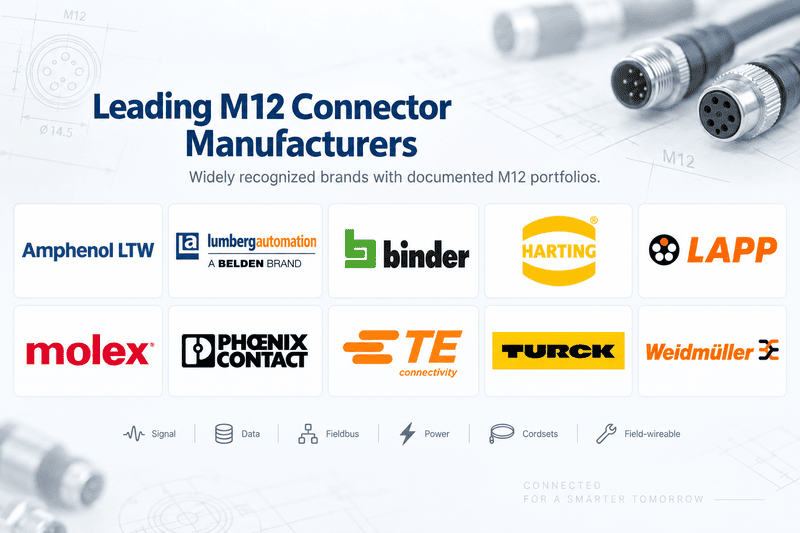
M12 connector manufacturers serve very different purchasing needs, even when their products share the same connector size. A familiar brand name does not tell me whether a supplier can provide the coding, cable construction, drawings, or order quantities my project needs. This comparison helps buyers narrow the field before requesting samples and technical documents.
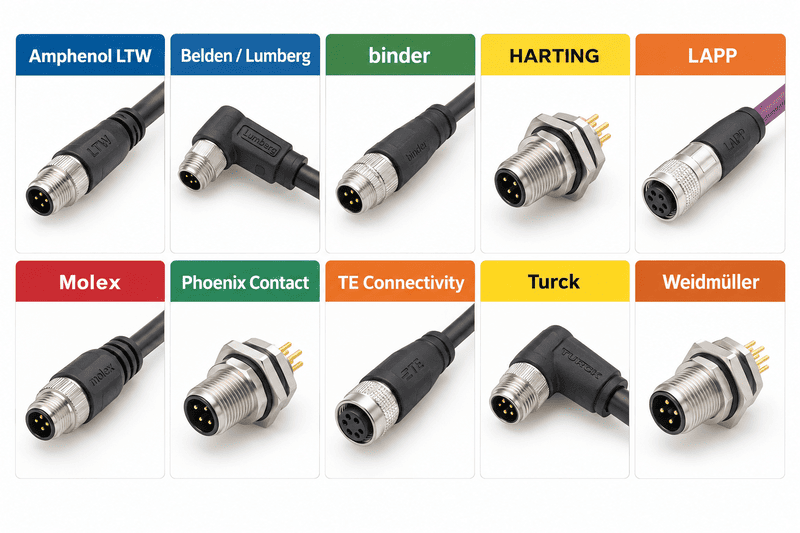
The 10 brands compared here are Amphenol LTW, Lumberg Automation, binder, HARTING, LAPP, Molex, Phoenix Contact, TE Connectivity, Turck, and Weidmüller. I would shortlist them by application and product format, not by an unsupported “best manufacturer” ranking. Buyers seeking a specified original-brand part should follow that brand’s documentation; buyers needing a custom cable assembly should also evaluate an OEM supplier.
The useful question is not simply “Who makes M12 connectors?” It is “Which supplier offers the right coding, termination format, documentation, and purchasing route for this project?” I will compare those points first, then look at each brand and explain where an OEM manufacturer such as NITAI may fit.
A brand list can start a search, but it can also create false confidence. Two catalogs may both contain M12 connectors while emphasizing different products, such as sensor cords, field-wireable plugs, or panel receptacles. I use the table below to decide which catalogs deserve a closer look.
The table groups each manufacturer by a practical starting point rather than a quality or price ranking. Product availability varies by region and part number. Before selecting a component, I would check the manufacturer’s current datasheet, drawing, mating information, and distributor listing for the exact configuration under consideration.
| Manufacturer | Product focus to investigate | Projects where I would start looking | First selection check |
|---|---|---|---|
| Amphenol LTW | M-series circular connectors and cable assemblies | Equipment exposed to demanding environments | Check the exact sealing conditions and cable options |
| Lumberg Automation | Sensor and actuator connectivity | Factory automation and machine wiring | Check cordset configuration and mating details |
| binder | M12 connectors in established circular-connector series | Device connections and compact machine interfaces | Check series-specific coding and termination options |
| HARTING | M12 connectivity for industrial devices and networks | Automation and industrial data links | Check coding against the network specification |
| LAPP | EPIC-branded connectivity and cable solutions | Projects sourcing connectors alongside industrial cable | Check the connector-and-cable combination |
| Molex | Brad industrial connectivity, including Micro-Change M12 products | Sensor wiring and cable assemblies | Check the precise cordset and pin arrangement |
| Phoenix Contact | Sensor/actuator cabling, device connectors, and installation components | Control cabinets and distributed machine wiring | Check installation format and product documentation |
| TE Connectivity | M12 circular connector and cable-assembly options | Device design and industrial equipment | Check drawings, termination, and part-number variants |
| Turck | eurofast M12 connectivity and cordsets | Sensors, actuators, and distributed I/O | Check cordset ends, length, and I/O compatibility |
| Weidmüller | SAI connectivity and industrial installation products | Machine wiring and I/O distribution | Check connector-to-module compatibility |
I start with the interface, not the logo. “M12” describes a threaded connection size; it does not establish that two parts have the same coding, contact count, pin assignment, electrical rating, or intended application.1 A buyer comparing signal, data, and power connections should ask for the full part number and its matching drawing.
I then check how the connection will be installed:
Finally, I look at the purchasing route. A catalog part may be convenient when an approved manufacturer and part number already exist. A custom assembly may be more appropriate when a machine builder needs a fixed cable length, a mixed connector end, or a defined wire sequence at production volume. Neither route removes the need for application-specific engineering review.
I also treat environmental and compliance statements as part-number-specific evidence. A stated IP rating may depend on proper mating and installation.2 Certifications and declarations should be requested and checked for the exact product, rather than assumed from a brand’s wider portfolio.3
The 10 M12 connector manufacturers below are not arranged from best to worst. I would use each subsection as a catalog-search starting point, then confirm the proposed part with current manufacturer documentation. Series names help narrow a search, but they are not substitutes for a verified drawing or quotation.
Product series: I would begin with Amphenol LTW’s M-series circular connectivity offerings and narrow the search to M12 products. Its range provides a useful starting point when a device builder is considering a connector alongside a finished cable assembly.
M12 features: I would compare connector coding, contact configuration, mounting style, and cable construction at the individual part-number level. A broad M-series label alone does not identify those details.
Typical applications: I would investigate Amphenol LTW for industrial equipment where the connector and its environmental documentation are important procurement inputs. For an exposed installation, I would ask how the stated protection rating applies to the assembled and mated connection.
Selection caution: Buyers should not transfer a rating from one M-series product to another. I would request the exact drawing, cable specification, mating-part guidance, and applicable test or compliance documents before approving a sample.
Product series: I would search Lumberg Automation’s sensor and actuator connectivity range for the required M12 cordset or connector. The brand is a relevant starting point when machine wiring is the main purchasing task.
M12 features: Its M12 choices should be compared by cable length, connector orientation, number of contacts, coding, and the configuration at the opposite cable end. Those details often determine whether a cordset is useful on a real machine.
Typical applications: I would look here for sensor-to-I/O and actuator wiring on automation equipment, especially when a buyer wants a catalog cable rather than a drawing-led custom build.
Selection caution: “M12 sensor cable” is too broad for a purchase order. I would confirm the complete ordering code and wiring diagram, including whether the second end is open, fitted with another connector, or specified in another way. The chosen cable also needs to suit its intended routing and operating conditions.
Product series: I would investigate binder’s M12 products through its circular-connector series, including the relevant Series 713 and Series 763 offerings. I would use the series page to find candidate parts, then work from individual datasheets.
M12 features: binder is worth examining when a project needs to compare device-side connectors, cable-side connectors, and termination methods within a circular-connector catalog. The available variants depend on the series and part number.
Typical applications: I would start here for machine and device interfaces where enclosure integration matters as much as the external cable.
Selection caution: Similar-looking circular connectors are not necessarily mating alternatives.4 I would check the interface drawing, coding, contact layout, panel cutout, and recommended mating part. For a new device, I would also ask the design team to review assembly and service requirements before locking the connector into the enclosure design.
Product series: I would look through HARTING’s M12 industrial connectivity range, using the application’s required coding and installation format to narrow the catalog.
M12 features: The relevant comparison is not simply a HARTING M12 connector versus another M12 connector. I would distinguish a connector intended for sensor or actuator signals from one specified for an industrial data connection, then check the associated cable and mating components.
Typical applications: HARTING is a sensible catalog starting point for automation equipment and industrial network connections where project documentation calls for a defined connector interface.
Selection caution: A data application requires more than a familiar coding label.5 I would verify the complete channel requirements with a qualified engineer, including connector, cable, termination, and the specified network. I would also confirm that the quoted part is the same one shown in the approved drawing.
Product series: I would search LAPP’s EPIC connectivity offerings alongside its industrial cable range. This is particularly useful when procurement needs to assess the connector and cable together.
M12 features: An M12 part can be suitable at the interface but unsuitable as a complete assembly if the cable construction does not match the installation.6 I would compare available connector formats with the cable jacket, conductor, and handling requirements in the project specification.
Typical applications: I would consider LAPP for machine-building purchases where cable selection, routing, and connector selection are handled in one sourcing exercise.
Selection caution: Buyers should verify the specific combination being purchased. A cable family’s properties do not automatically apply to every finished assembly, and a connector’s rating does not establish the performance of an unspecified cable.7 I would ask for assembly-level documentation or an approved bill of materials where those distinctions matter.
Product series: I would begin with Molex Brad Micro-Change M12 products when searching for industrial cordsets and related connectivity.
M12 features: A Molex M12 cable assembly search should quickly move from the family name to the exact end configurations. I would check whether each end is straight or angled, male or female, and fitted with the specified coding and contact arrangement.
Typical applications: I would investigate these assemblies for repeatable sensor and actuator wiring on production machines, where a published ordering code can simplify replenishment.
Selection caution: Buyers often compare assemblies by length and connector appearance alone. I would also verify the wiring diagram, cable construction, environmental rating conditions, and mating interface. For a replacement purchase, I would compare drawings against the installed part rather than infer interchangeability from the Micro-Change name.
Product series: I would search Phoenix Contact’s SAC sensor/actuator cabling and related device-connection products when building a shortlist. Its catalog can be useful when one project needs cordsets as well as installation components.
M12 features: A Phoenix Contact M12 connector search may lead to a ready-made cable, a connector for field termination, or a device-side connection. I would identify the required format before filtering by coding and contact count.
Typical applications: I would consider these products for control-cabinet connections, distributed machine wiring, and device integration where published selection data supports an approved bill of materials.
Selection caution: Catalog breadth makes accurate filtering important. I would compare the manufacturer’s part-number-specific drawing, pin assignment, mounting details, and mating guidance. Where an assembly combines components, I would confirm the documented specification for the assembly rather than treating each component’s claims as interchangeable.
Product series: I would use TE Connectivity’s M12 circular connector catalog as the starting point and filter by the device or cable interface the design requires.
M12 features: A TE Connectivity M12 connector may be evaluated for its coding, contact arrangement, termination, and mounting style. These characteristics need to match the equipment drawing and the intended cable or mating connector.
Typical applications: I would investigate TE for industrial device designs and equipment builds where engineering teams need defined product drawings and a repeatable catalog part number.
Selection caution: I would not accept “TE M12” as a complete substitute description on a quotation. The buyer needs the exact ordering code and revision-relevant documentation. If a proposed alternative comes from another supplier, a qualified engineer should assess fit, electrical requirements, installation, and applicable approvals before purchasing it as a replacement.
Product series: I would begin with Turck’s eurofast M12 connectivity range, including relevant cordsets for sensors, actuators, and distributed I/O.
M12 features: A Turck M12 cable search should account for both the connector and the wiring path. I would compare cable length, end configuration, contact count, coding, and any published wiring diagram.
Typical applications: I would consider Turck when a machine design uses distributed I/O and needs cataloged connections between field devices and modules.
Selection caution: Compatibility with an I/O module is not established by the M12 thread alone.8 I would check the module’s port documentation and the cable assembly’s pinout side by side. Where the installation includes movement, washdown, or other demanding conditions, I would ask for the exact assembly’s relevant cable and environmental specifications.
Product series: I would investigate Weidmüller’s SAI sensor/actuator connectivity range when evaluating M12 components alongside I/O and installation products.
M12 features: I would separate device connectors, cables, and distribution components in the selection process. Each serves a different point in the machine-wiring layout, even when multiple items use M12 interfaces.
Typical applications: I would start here for machine automation projects where a buyer wants to compare field connections and distribution hardware within a coordinated purchasing list.
Selection caution: A connector should be checked against the exact distribution-module port and field-device pin assignment. I would request the relevant datasheets and drawings for each item in the connection path. That review matters most when a project combines products from several manufacturers or modifies a proven machine design.
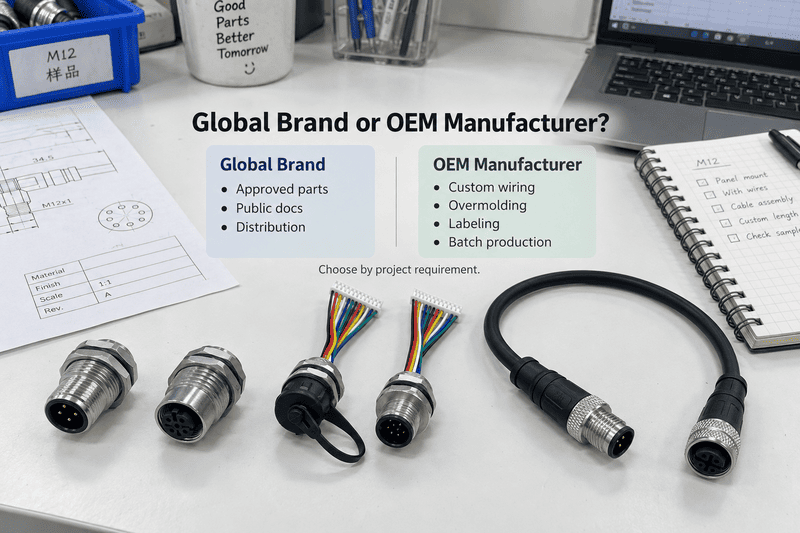
A well-known brand may be written into an approved equipment design. Replacing it solely to change the purchase route can create extra engineering work and approval risk.9 Yet a catalog part can be an awkward fit when the project needs a nonstandard cable length, wire sequence, or connector combination.
I would buy the specified original-brand part when the project requires its exact part number, documented performance, established approval, or direct access to that manufacturer’s product support. I would evaluate an OEM custom assembly when engineering controls the specification and needs a configuration that standard cordsets do not conveniently provide.
| Purchasing question | Original-brand catalog part | OEM custom M12 assembly |
|---|---|---|
| Is a specific part number mandated? | Usually the direct route | Requires formal engineering review and approval |
| Is the cable configuration standard? | Check available catalog assemblies | Useful if catalog choices do not fit |
| Is a special length or mixed connector end needed? | Ask about available variants | Discuss a drawing-led custom build |
| Who supplies selection evidence? | Obtain the brand’s current datasheet and drawing | Obtain the OEM’s drawing, materials specification, and sample documentation |
| Can I assume equivalence? | Only to the approved specification | No. Validate the proposed design against project requirements |
I find that a clear RFQ prevents more delays than a long list of loosely described “equivalent” products. A useful request identifies the complete assembly and the evidence needed to approve it:
A proposed OEM assembly should be evaluated on its own documented specification.10 I would never infer that it carries another manufacturer’s approvals or that it is interchangeable because it looks similar. Qualified engineering and compliance staff should make application-specific decisions, particularly for regulated or demanding installations.
Some readers will leave this comparison needing an original-brand datasheet or an authorized purchasing channel. Others will have a different problem: a standard cordset almost fits, but its length, pin assignment, or second connector does not. That is the point where I would discuss a custom build.
At NITAI (Dongguan Nitai Electronics Co., Ltd.), we manufacture industrial connectors and cable assemblies and support OEM/ODM requests. Our stated services include custom cable lengths, connector combinations, pin arrangements, overmolding, engineering drawings, samples, and volume production. We would assess a proposed M12 assembly against the buyer’s drawing and requirements; we do not claim authorization, partnership, or certification equivalence with any brand listed above.
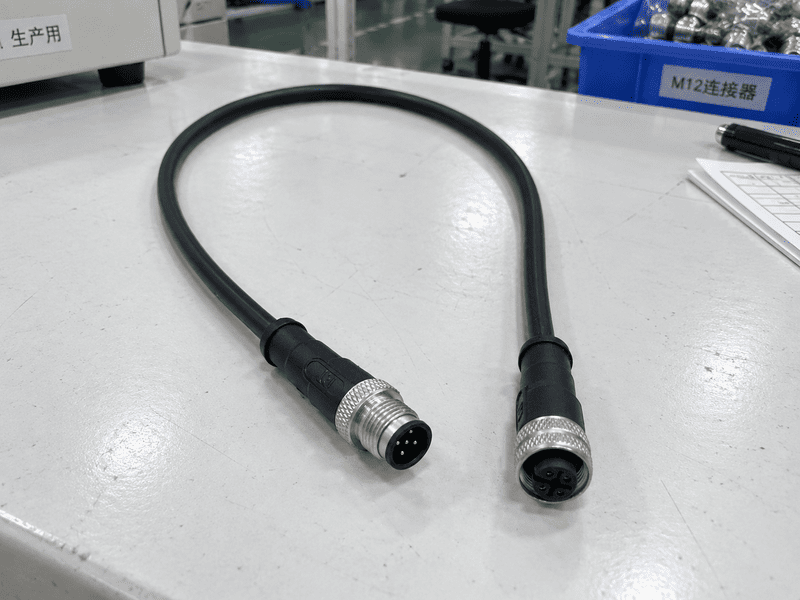
I would send the existing drawing if one is available. If the project is still at an early stage, I would send a short specification covering the M12 interface, cable, wiring, second end, installation conditions, target quantity, and documents required for approval. That gives our engineering team a concrete basis for discussing feasibility and preparing a sample.
I would also separate must-have requirements from preferences. For example, a mandated mating interface and pinout may be fixed, while cable length or packaging may be adjustable. That distinction helps both sides avoid a quotation for a technically plausible assembly that the customer cannot approve.
Before placing a production order, I would ask the project team to review the sample against its drawing and test plan. Buyers should check dimensional fit, wiring, materials, marking, and any required environmental or compliance evidence. A sample approval process is particularly important when the finished cable connects equipment from multiple suppliers.11
Readers who are still defining the interface can find NITAI’s M12 product information, look for the M12 pinout guide, check the M12 coding guide, or review M12 waterproof guidance. These are site-targeted searches so readers can locate the current pages without relying on an unverified deep link. For a project discussion, buyers can start at NITAI’s website and share their RFQ through its current contact channel.
I would not assume so. Two products can share an M12 thread but differ in coding, contacts, pinout, mounting dimensions, ratings, or installation requirements. I would compare the exact drawings and datasheets, then ask a qualified engineer to approve any proposed substitution.
I would start with the equipment and network specification, not a general coding rule. The required interface depends on the application and the device ports. I would verify the connector coding, cable, pin assignment, and complete link requirements before requesting quotes.
Neither format is always better. I would compare installation labor, required cable length, service needs, and the documented performance of the finished connection. A pre-molded assembly may simplify repeat builds, while a field-wireable option may suit work where termination takes place on site.12
I would treat “equivalent” as an engineering question, not a sales label. NITAI can discuss an assembly built to the buyer’s stated requirements, but buyers must validate its drawings, materials, tests, and approvals independently. I would not represent it as an authorized or automatically interchangeable brand product.
I would review impressions and clicks alongside on-page engagement and qualified RFQs. A visitor searching for a brand may only need an official datasheet or CAD file. I would prioritize brand-related keywords using Google Search Console and keyword-tool data, then assess whether those visits lead to relevant project conversations.
The best use of a list of M12 connector manufacturers is to build a defensible shortlist, not declare a winner without comparable price, lead-time, or quality data. I would match each brand’s current products to the required coding, connection format, application, and documentation. I would then decide whether the project calls for an exact original-brand part or a drawing-led custom assembly. If your team needs a tailored cable length, pin arrangement, mixed connector end, or production run, contact NITAI with your specification for an OEM M12 assembly review.
"IEC metric screw sized connectors", https://en.wikipedia.org/wiki/IEC_metric_screw_sized_connectors. IEC specifications for M12 circular connectors distinguish interface and contact arrangements; the M12 thread designation alone does not establish compatibility between two specified parts. Evidence role: definition; source type: institution. Supports: M12 connector specifications distinguish mating interfaces and contact arrangements beyond the thread designation.. Scope note: The applicable standard and edition must still be checked for the particular connector types being compared. ↩
"Ingress Protection (IP) ratings", https://www.iec.ch/ip-ratings. IEC 60529 defines ingress-protection classifications through specified tests; a published connector rating should therefore be read alongside the manufacturer’s stated assembly and mating conditions. Evidence role: mechanism; source type: institution. Supports: Ingress-protection classifications apply under defined test and installation conditions.. Scope note: The standard does not establish the rating of any specific connector or finished cable assembly. ↩
"Product Sourcing and Certifications Database", https://www.ul.com/software/product-sourcing-and-certifications-database. Product-certification records and conformity declarations identify a defined product scope; documentation for one model does not, by itself, establish the status of another model from the same manufacturer. Evidence role: general_support; source type: institution. Supports: Certification records and conformity declarations identify the products or models to which they apply.. Scope note: The applicable certification scheme and product identifiers must be checked for each proposed part. ↩
"IEC metric screw sized connectors", https://en.wikipedia.org/wiki/IEC_metric_screw_sized_connectors. Circular-connector interface specifications define mating geometry and keying; connectors that appear alike cannot be treated as mating alternatives without checking those specifications. Evidence role: mechanism; source type: institution. Supports: Connector mating depends on specified geometry and keying, not appearance alone.. Scope note: A matching interface does not, on its own, establish electrical or environmental suitability. ↩
"IEEE Standard for Ethernet - Amendment 8", https://ieeexplore.ieee.org/iel7/9146428/9146429/09146430.pdf. Industrial Ethernet specifications define transmission requirements for the link or channel, so a connector’s coding alone does not establish that a complete cable connection meets a particular network specification. Evidence role: mechanism; source type: institution. Supports: Industrial data-link specifications can impose requirements on the cable and transmission channel in addition to the connector interface.. Scope note: The relevant requirements vary by Ethernet variant and application; this does not assess any HARTING product. ↩
"Stephanie Watson", https://www.nist.gov/system/files/documents/el/building_materials/Watson_SLPMarchMeeting_2.pdf. Research and technical guidance on industrial cables identify jacket materials and mechanical loading as factors in service suitability; a compatible connector interface does not establish the suitability of the attached cable. Evidence role: mechanism; source type: research. Supports: Cable materials and mechanical design affect performance under environmental exposure and repeated movement.. Scope note: General cable findings do not prove that a particular finished assembly will pass its application tests. ↩
"English template for Management Committees", https://www.iec.ch/public/miscfiles/sbp/46.pdf. Assembly-level conformity and testing guidance treats the finished configuration as a defined product; specifications for an individual connector or cable do not automatically establish every property of their combination. Evidence role: general_support; source type: institution. Supports: Finished assemblies may require assessment under conditions and criteria distinct from those of their constituent components.. Scope note: The required assembly tests depend on the claimed property and applicable standard. ↩
"IOL-Interface-Spec_10002_V114_Jun24.pdf", https://io-link.com/fileadmin/user_upload/Downloads/Package_2024/IOL-Interface-Spec_10002_V114_Jun24.pdf. IO-Link interface documentation distinguishes port configurations and assigned contact functions; sharing an M12 mating interface does not by itself establish compatibility with a given I/O port. Evidence role: mechanism; source type: institution. Supports: Industrial I/O interfaces specify port functions and pin assignments in addition to connector size.. Scope note: IO-Link provides a relevant example, not a universal pinout for every M12-based I/O system. ↩
"AC 20-62E - Eligibility, Quality, & Identification of ...", https://www.faa.gov/regulations_policies/advisory_circulars/index.cfm/go/document.information/documentid/780198. Engineering configuration-control guidance treats part substitution as a design change requiring assessment against the approved requirements. Evidence role: general_support; source type: government. Supports: Controlled designs require review when a specified component is replaced.. Scope note: The amount of additional work depends on the project’s approval process; aerospace guidance would be contextual rather than direct proof for ordinary industrial equipment. ↩
"NASA-STD-8739.4A PDF", https://s3vi.ndc.nasa.gov/ssri-kb/static/resources/nasa-std-8739.4a.pdf. Cable-assembly acceptance standards specify criteria for inspecting finished workmanship; evaluation of a custom assembly also requires its own drawing and application-specific requirements. Evidence role: general_support; source type: institution. Supports: Cable and wire-harness assemblies are assessed against defined workmanship and acceptance requirements.. Scope note: A workmanship standard does not establish interchangeability with a named manufacturer’s part or confer that part’s approvals. ↩
"First Article Inspection Requirement Report Generation ...", https://tsapps.nist.gov/publication/get_pdf.cfm?pub_id=919140. First-article and assembly-test guidance uses inspection and testing to compare a produced item with its design requirements, providing a basis for checking fit and wiring before routine production. Evidence role: general_support; source type: government. Supports: Preproduction inspection and testing can verify an assembly against documented design requirements.. Scope note: Such guidance supports the validation process generally; it does not quantify the added risk of combining equipment from multiple suppliers. ↩
"Review of fire test methods and incident data for portable ...", https://nvlpubs.nist.gov/nistpubs/Legacy/IR/nbsir81-2292.pdf. Technical literature on cable termination distinguishes factory-produced assemblies from connections terminated during installation; those different workflows can inform the choice between pre-molded and field-wireable products. Evidence role: general_support; source type: research. Supports: Factory-terminated assemblies and on-site terminations involve different installation and inspection steps.. Scope note: The literature does not establish that either format is universally faster, more reliable, or better for a particular M12 installation. ↩
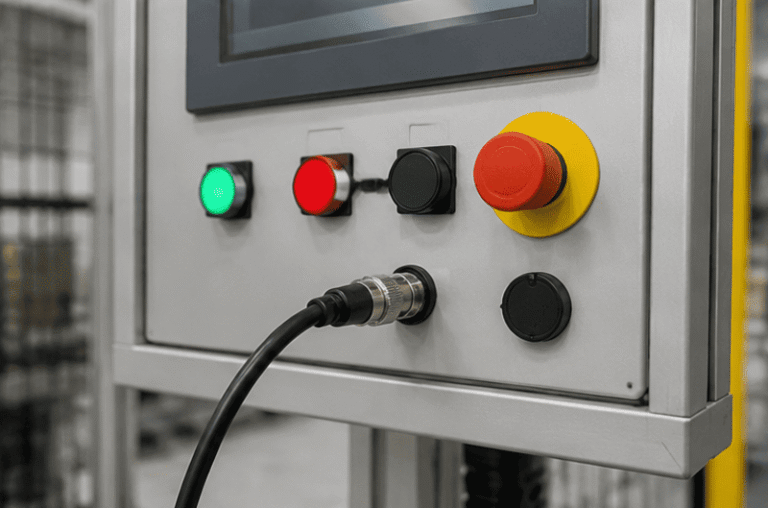
An M12 male connector 5-pin B-coded may look like a straightforward line item, but its name does not…
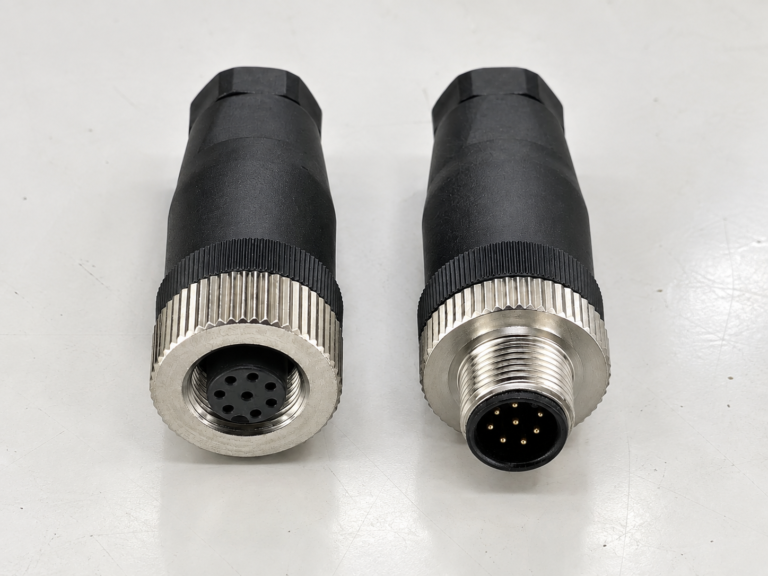
M12 connectors can carry different voltage ratings, so a buyer cannot choose one safely from the connector size…
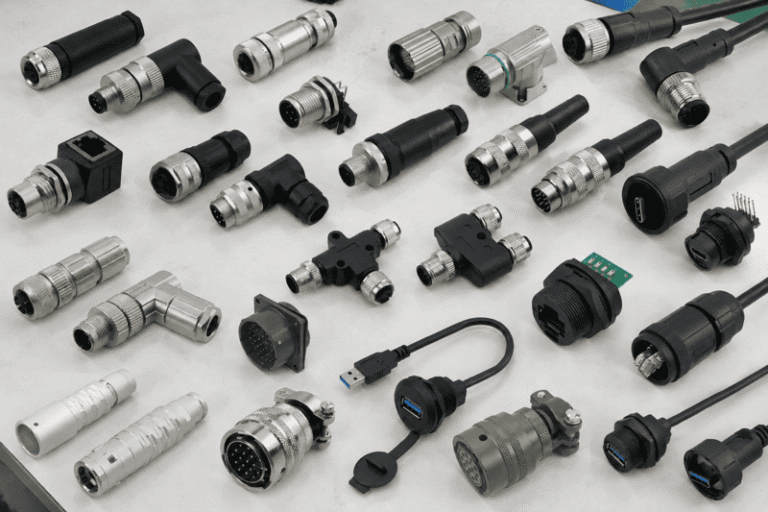
Connector types can look interchangeable in a catalog, but a familiar shape does not tell me whether two…
NITAI manufactures terminal blocks, M8/M12 waterproof connectors and industrial distribution modules for global OEMs, distributors and automation customers.
Leave a Reply