Sep 10, 2026
Top M12 Connector Manufacturers: 10 Global Brands Compared
Choosing an M12 connector manufacturer is not simply a matter of selecting the best-known name. The right supplier…

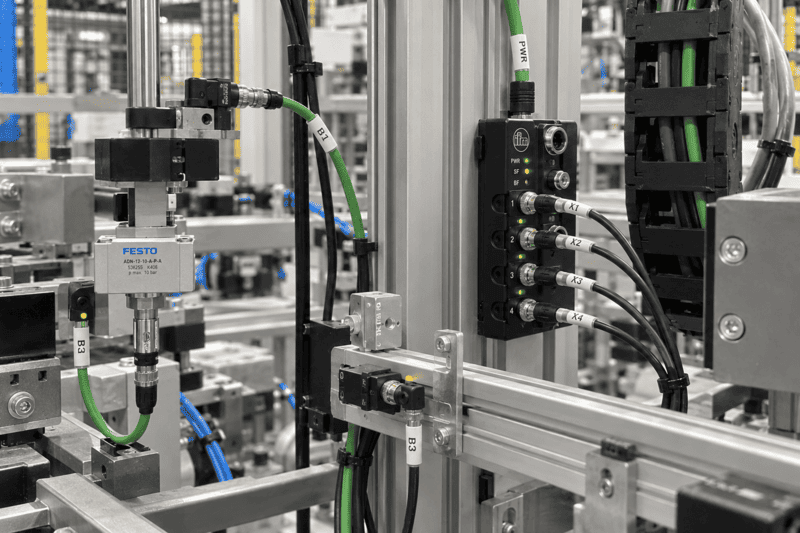
An M8 connector is used when industrial equipment needs reliable signal, power, or data connections in a compact space. Its small threaded interface is well suited to dense sensor and actuator layouts where panel area, cable routing, and moving weight are limited.
M8 connectors are mainly used for proximity sensors, photoelectric sensors, small actuators, solenoid valves, robot grippers, end effectors, compact I/O modules, and test equipment. They save panel space, increase port density, and reduce cable weight on moving machine parts.
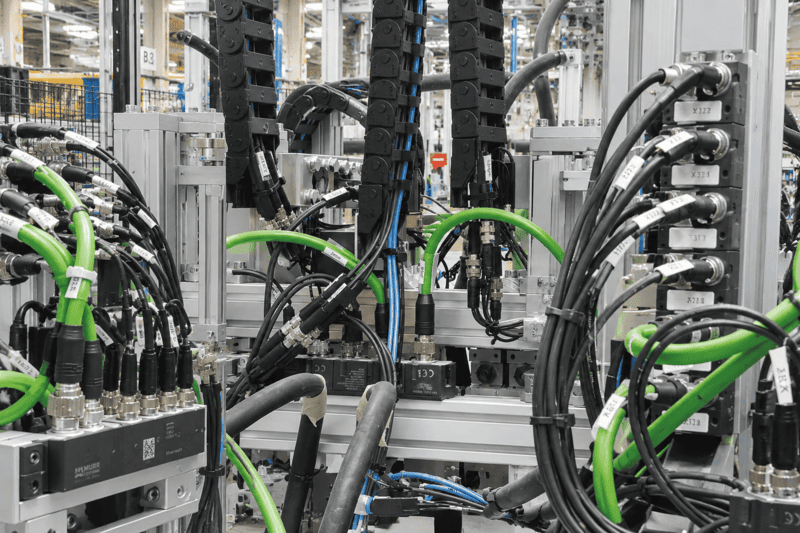
I do not see M8 as only a smaller version of M12. It is a different design choice for applications where compact size and wiring density must be balanced with electrical and mechanical requirements.
An M8 connector is used for space-saving industrial connections, particularly on compact sensors, actuators, robotic end tools, valve terminals, miniature I/O modules, and measurement devices. Its threaded circular interface provides a stable connection in environments where vibration, dust, moisture, or movement may be present.
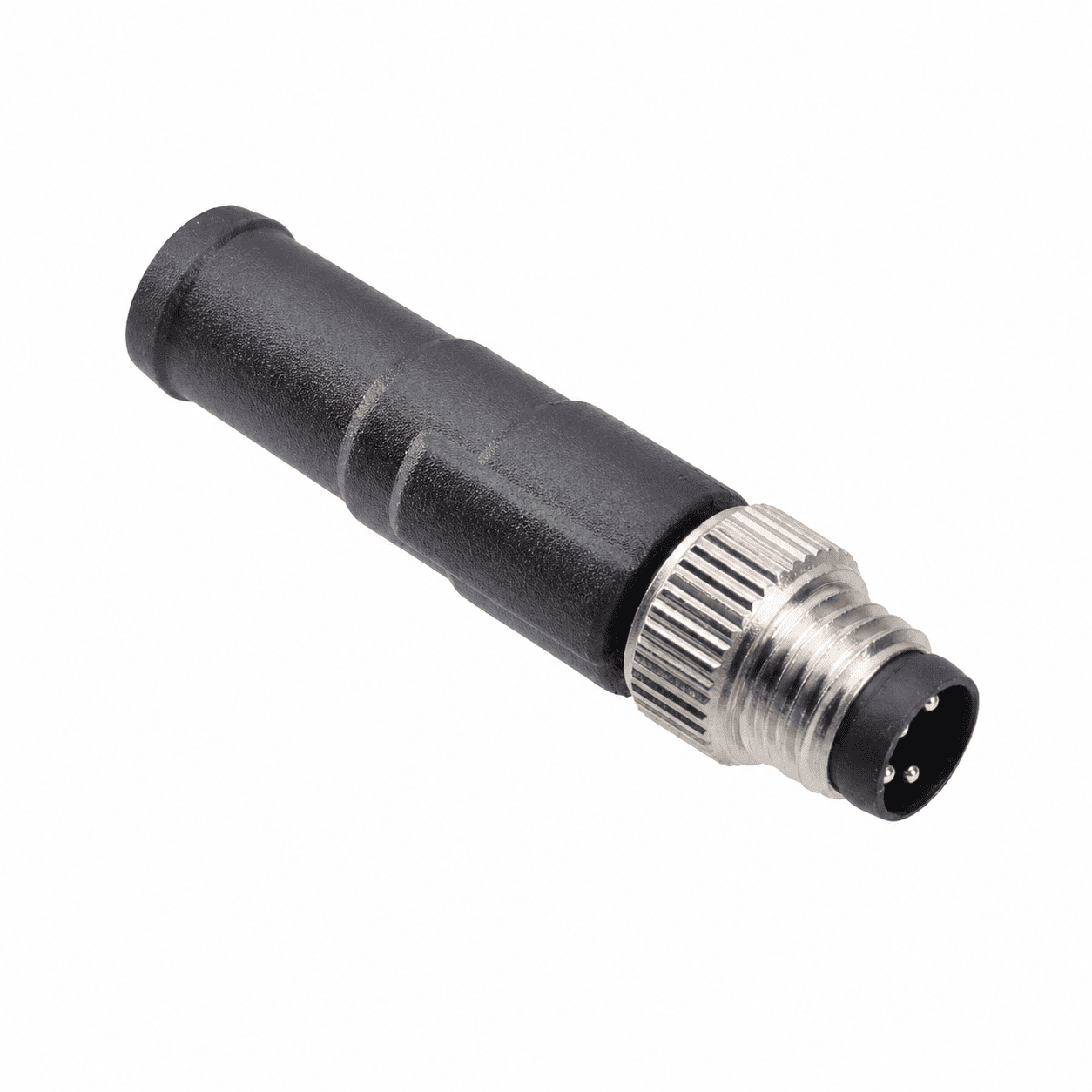
M8 connections are commonly selected when the device body is too small for a larger interface or when several ports must fit into a limited area. Typical applications include:
Industrial manufacturers such as Phoenix Contact and binder also position M8 connectivity for compact sensors, actuators, robotics, and machinery.1 The exact suitability must still be confirmed from the product datasheet.
The main advantage of M8 appears when several interfaces must be installed close together. A compact sensor block may require four, six, or eight ports. Using smaller interfaces reduces the required housing area and allows a higher port density.2
| Application | Why M8 is useful |
|---|---|
| Compact sensor arrays | More sensor ports fit in less space |
| Robot end tooling | Smaller cables reduce weight and bending space |
| Mini I/O modules | High port density supports compact designs |
| Small valve islands | Compact connections simplify wiring |
| Test fixtures | Smaller interfaces suit dense measurement points |
Before selecting an M8 connector, I recommend confirming:
M8 can solve space problems, but the wrong pinout, coding, cable, or environmental rating can create compatibility and reliability issues.
An M8 connector is chosen instead of M12 when installation space is limited, port density is important, or cable weight must be reduced. M12 is often more suitable when the project requires higher current, thicker cables, easier field assembly, or more handling space.
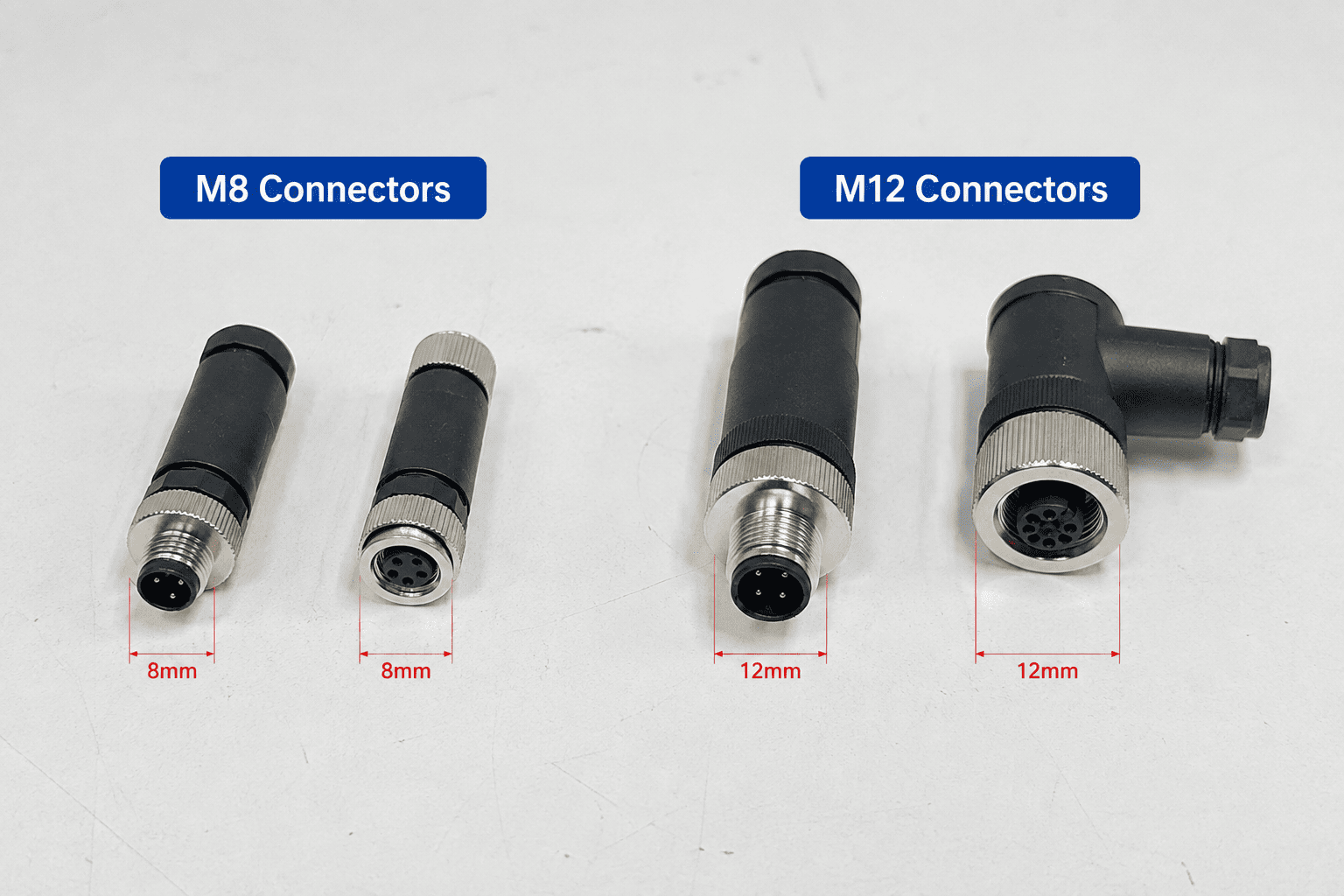
M8 and M12 overlap in automation wiring, but they are not interchangeable choices. M8 prioritizes compactness, while M12 generally provides more installation space and broader options for power and field wiring.3
| Factor | M8 connector | M12 connector |
|---|---|---|
| Physical size | Smaller | Larger |
| Panel space | Requires less space | Requires more space |
| Port density | Better for compact layouts | Lower density |
| Cable weight | Usually lighter | Usually heavier |
| Installation handling | Less room for fingers and tools | Easier to handle |
| Common use | Sensors, small actuators, compact I/O | Sensors, actuators, power, Ethernet, field devices |
| Mechanical margin | More limited | Usually greater |
| Field wiring | More demanding | Often easier |
I usually consider M8 when:
I usually consider M12 when the design needs:
M12 is not automatically better; it simply provides more physical room for some higher-load or service-intensive applications.
A robot gripper with four sensors has limited space, and every gram at the end of the arm matters.4 Smaller M8 connectors and cables can reduce drag and simplify routing.
A power connection inside a machine frame may have more space and require easier access with gloves. In that case, M12 may be easier to install and maintain. The final choice should be based on the equipment layout, wiring diagram, and cable route.
An M8 connector can carry automation signals, low-voltage power, and, in some designs, industrial data. IEC 61076-2-104:2026 covers M8 connectors with 3 to 12 contacts for signal and power transmission, with standard-scope ratings up to 50 V AC, 60 V DC, and 4 A.5 The actual rating must always come from the exact product datasheet.
Signal transmission is the most common M8 application. A typical three- or four-pin sensor connection may include:
This arrangement is common for proximity sensors, photoelectric sensors, and actuator feedback. Correct mating and wiring are essential because similar-looking connectors may use different pin assignments.
Some M8 designs also support power within their rated limits. Capacity depends on the connector design, number and size of contacts, conductor size, temperature, and installation conditions. The maximum values in a standard must not be treated as universal ratings for every M8 product.
For procurement, verify:
| Item to verify | Why it matters |
|---|---|
| Rated voltage | Prevents insulation mismatch |
| Current per contact | Prevents overheating |
| Contact resistance | Affects voltage drop and stability |
| Operating temperature | Influences current-carrying performance |
| Conductor size | Must support the required load |
| Mating cycles | Matters for frequent maintenance |
| IP rating when mated | Confirms the sealing condition |
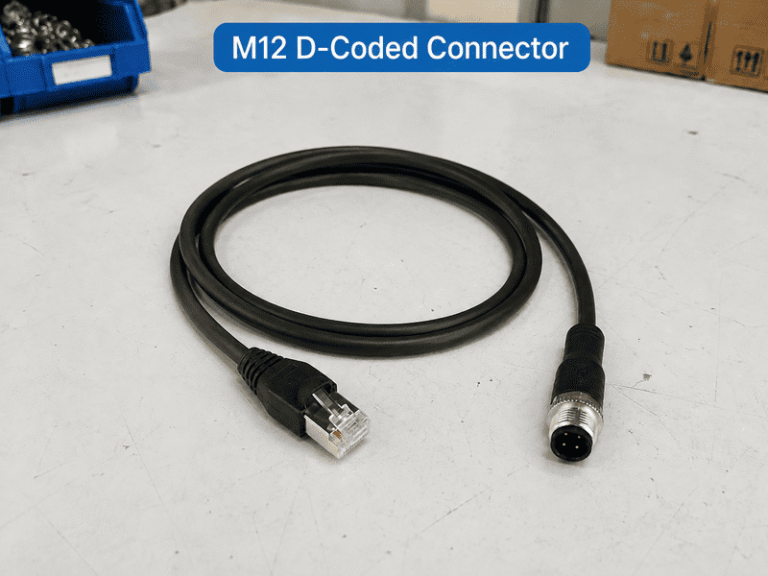
Some M8 connectors support data applications. For example, D-coded M8 products can be used for compact 100 Mbit/s industrial data connections6 where a larger interface will not fit.
For data applications, I check:
Performance depends on the complete link, including the plug, socket, cable, shielding termination, and device design.
M8 connectors are available in different pin counts and coding arrangements.7 Common procurement options include:
The selected connector must match the device interface and wiring diagram exactly. For OEM projects, I recommend providing the device drawing or an old connector sample to reduce pinout and compatibility errors.
To select an M8 connector, I check the original interface, pin count, coding, voltage, current, signal type, shielding, IP rating, cable dimensions, bending space, and mating frequency. Drawings, samples, and datasheets should be reviewed before bulk purchasing.
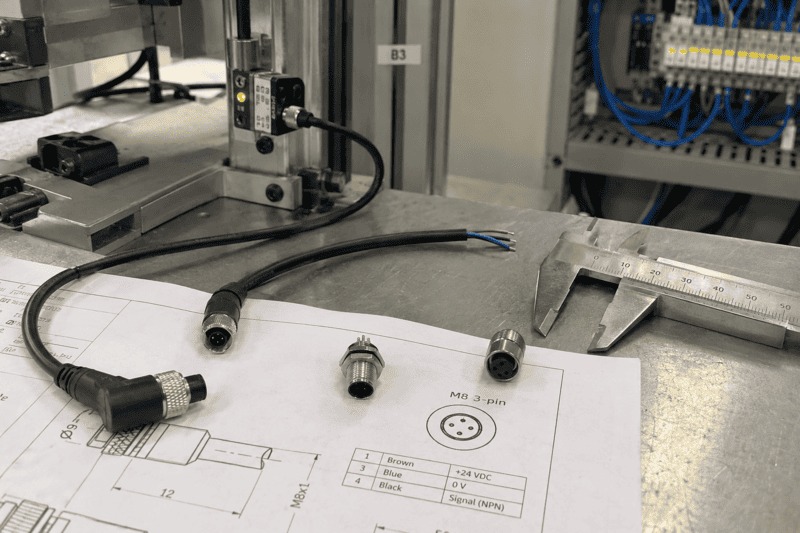
First confirm whether the equipment already uses M8 or M12. Changing the connector family may require housing, PCB, or cable-harness redesign.
For replacement sourcing, collect:
Pin count and coding determine compatibility. A 4-pin connector cannot directly replace a 5-pin version, and incorrect coding may prevent mating or lead to wiring errors.
| Requirement | Selection question |
|---|---|
| Sensor signal | How many conductors are required? |
| Actuator output | What current does the load require? |
| Data communication | Are shielding and data coding required? |
| Compact module | How many ports must fit in the available space? |
| Field replacement | Is a molded or field-wireable connector needed? |
The voltage and current rating must match the actual device requirement. Important values include:
If UL, RoHS, REACH, or other documents are required, confirm that they apply to the exact part number and market rather than only to a general product family.
A dry control cabinet and a machine exposed to coolant, oil mist, washdown, or outdoor weather require different connector and cable designs. Check:
An IP67 or IP68 rating normally applies only when compatible parts are correctly mated and tightened.8 Appearance alone does not confirm waterproof performance.
The cable is as important as the connector. A right-angle M8 cable may solve a routing problem that a straight version cannot.
Review:
For moving robot parts, bending radius and repeated flexing need particular attention. A compact connector cannot compensate for an unsuitable cable.
An M8 connector is not the best choice when the application requires higher current, thicker cables, easier field wiring, frequent manual handling, or greater mechanical margin. M12 or another industrial connector may then provide a more serviceable solution.
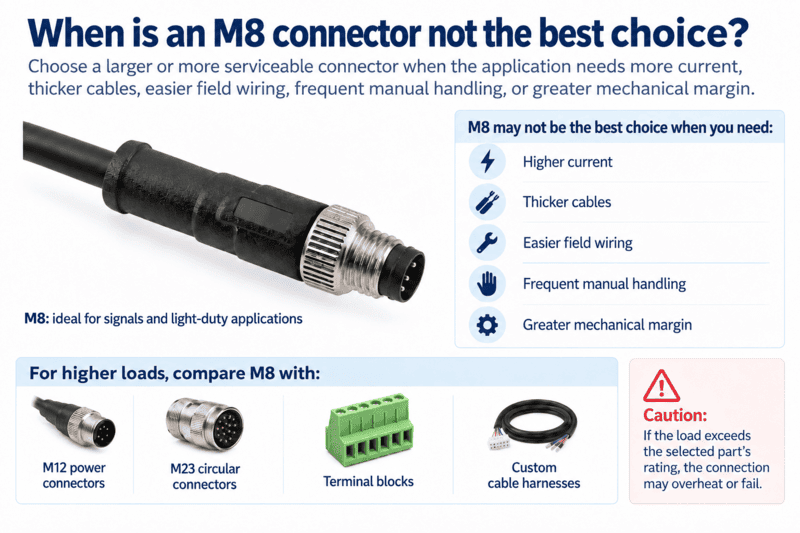
M8 supports signals and some power applications, but it is not a universal power connector. If the load exceeds the selected part's rating, the connection may overheat or fail.
For higher loads, compare M8 with:
The decision depends on current, voltage, environment, and safety requirements.
The compact M8 body provides less gripping area. M12 may be easier when operators wear gloves, connectors are frequently disconnected, the cable is thick or stiff, or the installation is exposed to impact. This does not mean M8 is fragile; it means the connector size must suit the maintenance conditions.
Molded M8 cable assemblies provide consistency when length and wiring are known. Field-wireable M8 connectors offer flexibility but can be harder to assemble because of their small conductors and limited internal space.
Before choosing a field-wireable version, confirm installer training, cable preparation space, strain relief, shielding termination, and assembly repeatability.
Not every M8 connector or cable is suitable for industrial data. A basic unshielded cable may work for a sensor but not for 100 Mbit/s communication or electrically noisy environments.9
| Link element | Why it matters |
|---|---|
| Connector coding | Prevents incorrect mating |
| Shielding | Reduces electromagnetic interference |
| Cable pair structure | Supports data integrity |
| Grounding | Controls electrical noise |
| Device design | Affects complete-link performance |
| Cable length | Influences signal quality |
Some OEM projects require a custom M8 cable assembly rather than a standard catalog part. Options may include:
These projects may also require drawings, sample validation, and production testing before batch manufacturing.
To evaluate an M8 connector supplier, I review its product range, engineering support, drawings, sample quality, batch consistency, customization, lead time, testing, packaging, export experience, and compliance documentation. Certificates should be checked against the exact product and market requirement.
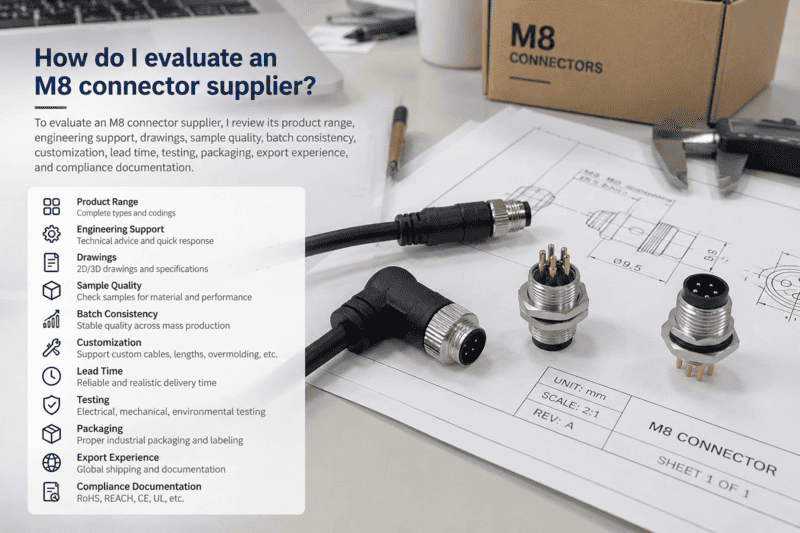
A capable supplier should support related products, such as:
A broader range makes it easier to support future changes without qualifying a new supplier for every variation.
For B2B purchasing, I usually request:
Documentation helps engineering approval and incoming inspection. Confirm that each certificate applies to the exact model, cable, and market.
Small circular connectors require controlled molding, contact alignment, sealing, and overmolding. Relevant inspections may include:
Customized assemblies should also have approved samples and clear work instructions to control batch variation.
| Supplier factor | Why it matters |
|---|---|
| OEM/ODM capability | Supports custom connectors and harnesses |
| Sample development | Reduces risk before batch orders |
| Stable lead time | Supports production planning |
| Engineering support | Speeds up specification confirmation |
| Export experience | Reduces communication and logistics issues |
| Product family range | Supports future project expansion |
| Private-label support | Helps distributors and OEM brands |
| Quality process | Improves batch consistency |
At NITAI, we support industrial connectors, terminal blocks, distribution modules, and custom wiring solutions. We still recommend sample testing and document verification before batch approval.
No. M8 connectors are common on sensors but can also connect small actuators, solenoid valves, compact I/O modules, robot tooling, test equipment, and certain low-voltage power or industrial data applications. Suitability depends on the exact connector and device ratings.
M8 is smaller and better suited to tight spaces and high port density. M12 offers more handling room, broader cable options, and often more margin for power or rugged field installation. The choice depends on space, load, environment, and wiring requirements.
Some M8 connectors, including certain D-coded versions, support compact 100 Mbit/s industrial data connections. Shielding, cable structure, coding, impedance, and the complete link must be verified. Not every M8 connector is suitable for data.
M8 connectors are available with several contact counts, including 3, 4, 5, 8, and 12, depending on the series and standard. Pin count, coding, gender, and wiring must match the equipment interface.
A molded M8 cable is usually better for repeatable production quality and consistent sealing. A field-wireable connector is useful when the cable length must be adjusted on site. For harsh environments or high-volume OEM use, I usually prefer a molded assembly after sample approval.
M8 connectors are used where industrial equipment needs compact, reliable connections for sensors, actuators, low-voltage power, or data. They are particularly useful when panel space, port density, cable routing, and moving weight are limited.
M8 is not automatically better than M12. Buyers should verify the original interface, pin count, coding, electrical ratings, shielding, IP protection, cable design, and installation conditions. If you need an M8 connector or custom cable assembly, NITAI can review your drawings and specifications, prepare samples, and support OEM batch production.
"Signal cables and power cables for reliable sensor ...", https://www.phoenixcontact.com/en-ae/products/cables-and-lines/signal-cables-and-power-cables. Product literature from Phoenix Contact and binder describes M8 connector products for compact automation uses such as sensors, actuators, machinery, and related equipment; this supports the statement about vendor positioning rather than providing independent performance evidence. Evidence role: case_reference; source type: other. Supports: Manufacturer documentation should show that Phoenix Contact and binder describe M8 connector products for sensors, actuators, robotics, machinery, or similar compact automation uses.. Scope note: Vendor documentation is appropriate here because the article directly discusses those vendors, but it is not neutral proof of superiority or suitability. ↩
"IEC metric screw sized connectors", https://en.wikipedia.org/wiki/IEC_metric_screw_sized_connectors. Dimensional standards for M8 and M12 circular connectors show that the M8 interface is physically smaller than the M12 interface, supporting the engineering inference that smaller connector interfaces can reduce required housing area and permit closer port spacing; the standards do not determine the exact port density of a particular device design. Evidence role: mechanism; source type: institution. Supports: Standards or technical dimensional data should show that M8 connectors have smaller mating/thread dimensions than M12 connectors, supporting the port-density mechanism.. Scope note: Contextual support only; actual port spacing also depends on housing geometry, cable outlet direction, sealing hardware, and installation clearance. ↩
"IEC metric screw sized connectors - Wikipedia", https://en.wikipedia.org/wiki/IEC_metric_screw_sized_connectors. IEC standards for M12 circular connectors include variants for industrial signal and power connections, and the M12 interface is physically larger than M8, supporting the statement that M12 offers more room and broader power-oriented options; this does not mean every M12 product has a higher rating than every M8 product. Evidence role: general_support; source type: institution. Supports: IEC standards for M12 connectors should support that M12 includes standardized connector variants for sensors, actuators, and power applications, with a larger interface than M8.. Scope note: Product-specific ratings and wiring features must still be checked in the exact datasheet. ↩
"An Evaluation System of Robotic End-Effectors for Food ... - PMC", https://pmc.ncbi.nlm.nih.gov/articles/PMC10670141/. Robotics dynamics research shows that payload and end-effector mass contribute to manipulator inertia and required actuator torque, explaining why reductions in mass at the arm end can matter for robot performance; the finding supports the general principle rather than quantifying the effect of a specific M8 cable assembly. Evidence role: mechanism; source type: paper. Supports: A robotics dynamics paper should support that payload or end-effector mass affects manipulator inertia, torque demand, energy consumption, or motion performance.. Scope note: Contextual support only; the practical benefit depends on robot size, motion profile, cable length, and payload margin. ↩
"IEC metric screw sized connectors - Wikipedia", https://en.wikipedia.org/wiki/IEC_metric_screw_sized_connectors. IEC 61076-2-104:2026 specifies detail requirements for M8 screw-locking circular connectors with 3 to 12 contacts for signal and power transmission and identifies ratings within the standard scope, including up to 50 V AC, 60 V DC, and 4 A; these values are standard-scope limits and not universal ratings for every product. Evidence role: definition; source type: institution. Supports: The official IEC standard page or standards abstract should confirm the scope, contact counts, and headline ratings of IEC 61076-2-104:2026.. ↩
"IEC metric screw sized connectors", https://en.wikipedia.org/wiki/IEC_metric_screw_sized_connectors. Industrial Ethernet connector specifications and guidance identify D-coded compact circular connector variants, including M8 implementations, for 100 Mbit/s industrial data links; this supports the possibility of such use but not the compliance of every D-coded M8 product or cable assembly. Evidence role: general_support; source type: institution. Supports: An industrial-networking institution or standard should support that D-coded M8 connector variants are used for 100 Mbit/s industrial Ethernet or similar industrial data links.. Scope note: Contextual support only; verified performance requires the complete channel specification, cable construction, shielding, and device implementation. ↩
"IEC metric screw sized connectors", https://en.wikipedia.org/wiki/IEC_metric_screw_sized_connectors. IEC standards for M8 circular connectors specify multiple contact configurations and keyed/coded arrangements, supporting the statement that M8 connectors are available with different pin counts and coding options; the standard does not imply interchangeability among those variants. Evidence role: definition; source type: institution. Supports: A standards source should confirm that M8 connector specifications include multiple contact configurations and coding/keying arrangements.. ↩
"IP code", https://en.wikipedia.org/wiki/IP_code. IEC 60529 defines IP ratings as degrees of ingress protection under specified test conditions, and connector IP claims are therefore applicable only to the tested configuration, typically when compatible mating parts are properly assembled and sealed; the IP code alone does not verify protection for an unmated or incorrectly tightened connector. Evidence role: definition; source type: institution. Supports: IEC 60529 or equivalent standards guidance should support that IP ratings describe protection under defined test conditions, which for connectors is normally the assembled or mated condition.. ↩
"Ethernet over twisted pair", https://en.wikipedia.org/wiki/Ethernet_over_twisted_pair. EMC and industrial networking guidance explains that high-speed 100 Mbit/s links rely on appropriate twisted-pair cabling, impedance control, and noise mitigation, and that shielding or grounding measures may be required in electrically noisy installations; this supports the general caution but does not determine whether a particular unshielded M8 cable will fail. Evidence role: mechanism; source type: research. Supports: A neutral EMC or industrial networking source should explain that high-speed differential data links require appropriate cable structure and may need shielding or EMC controls in noisy environments.. Scope note: Contextual support only; actual performance depends on cable length, transceiver design, installation routing, and the electromagnetic environment. ↩
Choosing an M12 connector manufacturer is not simply a matter of selecting the best-known name. The right supplier…
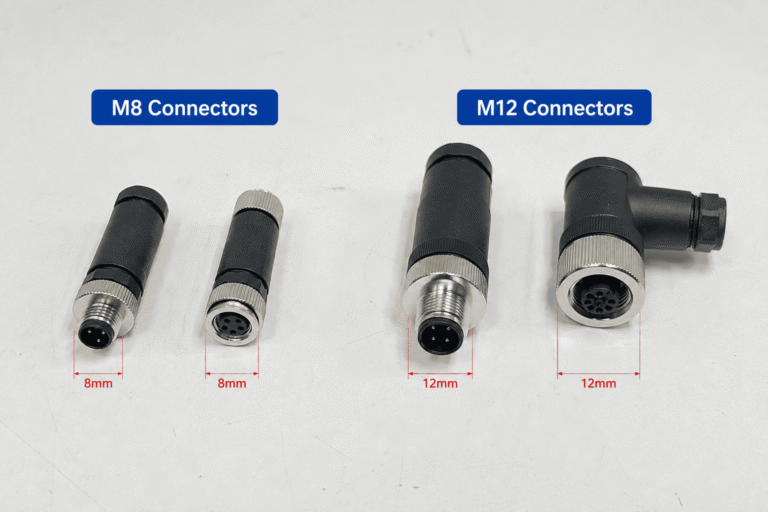
M8 and M12 connectors both appear throughout industrial automation, but they are not interchangeable drop-in options. Choose M8…
A four-pin M12 connector is not automatically a sensor connector. In industrial automation, a visually similar four-contact product…
NITAI manufactures terminal blocks, M8/M12 waterproof connectors and industrial distribution modules for global OEMs, distributors and automation customers.
Leave a Reply