Oct 22, 2026
Industrial Relay Module for PLC Control Panels: What It Is and How to Choose
An industrial relay module can simplify PLC control-panel wiring, but a familiar input voltage or current marking does…

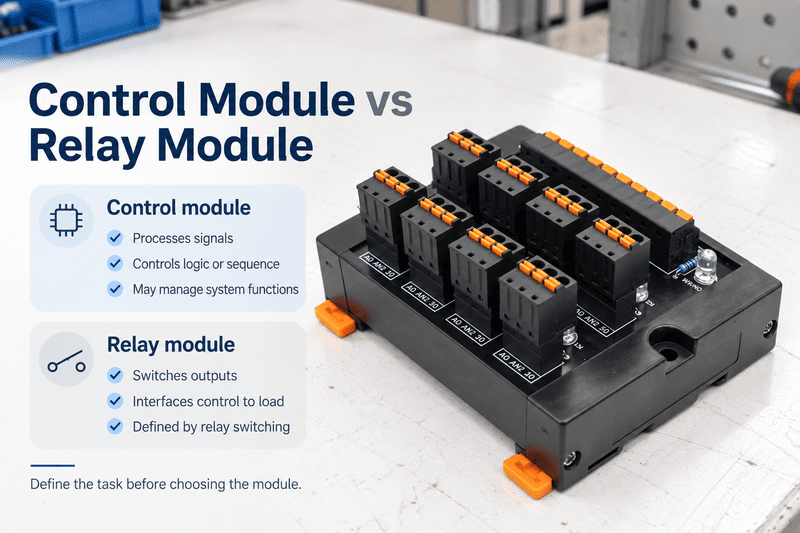
A control module and relay module can look like similar purchases when both appear on a control-panel parts list. That similarity can lead to a costly mismatch: one product may process a signal, while another only switches a circuit.1 I start by asking what the system must decide, what output it already has, and what load it must operate.
The difference between a control module and a relay module is their primary job. In industrial automation, a control module may process inputs, perform logic, or manage an interface, depending on the model. A relay module primarily provides a switching interface. They can work together, and some control modules already have relay outputs. The right choice depends on the actual circuit and datasheets. (siemens.com)
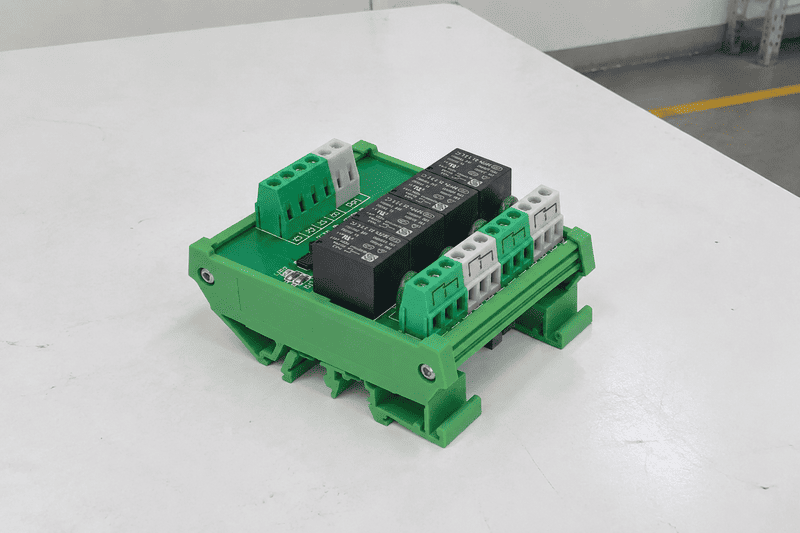
The labels alone do not tell me whether a part will fit a buyer’s application. I need to follow the signal from the controller to the load. That path reveals which device makes a decision, which device switches power, and whether an extra interface serves a useful purpose.
A buyer may ask me for a “control module” without naming the controller, input signal, or required output. That leaves too much room for interpretation. I narrow the term before suggesting a part, because a module that performs logic and a module that adapts an interface can solve different problems.
In this article, I use control module as a broad industrial-control term for a device involved in processing signals or directing an operation. Its functions depend on the product. I use relay module for a device whose defining function is switching through a relay interface. Neither name, on its own, guarantees a particular supply, contact arrangement, or load rating.2 (siemens.com)
When I review a module-selection inquiry, my first question is usually: “What must happen when the input changes?” A buyer might need a timed sequence, a processed sensor signal, a status indication, or an output that opens and closes an external circuit. Those tasks do not necessarily call for the same hardware.
“Control module” is especially broad. A compact logic module, for example, can have inputs, outputs, and control functions. Another product described as a control or interface module may have a narrower role within a larger system. Siemens’ LOGO! range illustrates why I check the specific model: the available functions, supply, and output type vary by configuration. I would not define every product called a control module as a programmable CPU. (siemens.com)
A relay module has a clearer central purpose: it provides a switching interface. Yet its name still does not tell me everything about the circuit. I check whether it uses an electromechanical relay or another switching technology, how its input is driven, and what its output can switch. Phoenix Contact, for instance, publishes separate input and output data for a specific preassembled relay module rather than asking buyers to rely on the category name. (phoenixcontact.com)
I also avoid treating the categories as opposites. A control device can contain relay outputs.3 A system can use a controller and an external relay module. The useful distinction is not “which box wins?” It is which functions the existing system performs, and which functions remain unmet?
Product names often compress several design decisions into two or three words. That makes a quick catalog comparison tempting. I find a function-by-function comparison more reliable, especially when a buyer must match a module to an existing PLC, a defined load, and limited cabinet space.
The table below is a selection framework, not a universal specification. I treat every “model-dependent” entry as a prompt to inspect the manufacturer’s wiring diagram and datasheet. In particular, I never assume that a relay module has dry contacts, accepts a given supply voltage, or can switch a load merely because another model can. (phoenixcontact.com)
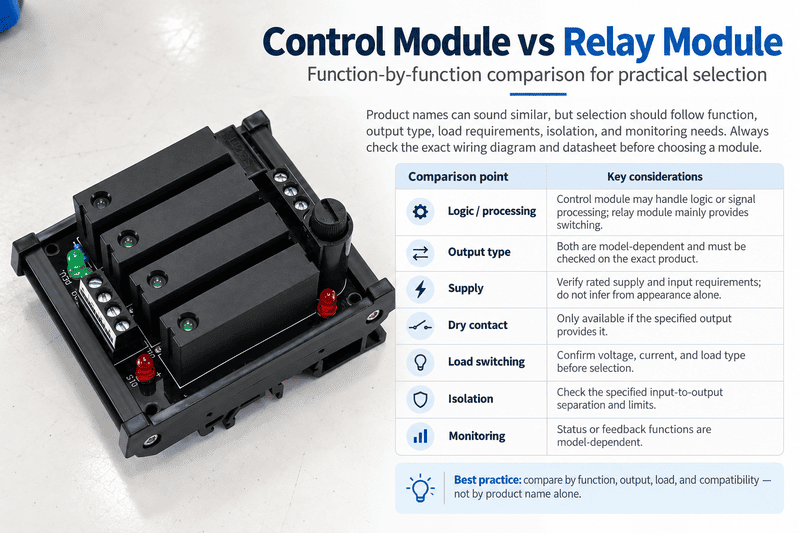
| Question | Control module | Relay module |
|---|---|---|
| Does it perform logic or signal processing? | Model-dependent; this may be a main function. | Not usually its primary switching function; check for added features. |
| What output does it provide? | Model-dependent; outputs may differ across products. | Model-dependent; check the exact relay or switching output. |
| What supply does it need? | Check the rated supply and input requirements. | Check the coil or module input supply; do not infer it from the contact circuit. |
| Does it provide a dry contact? | Only if the specified output provides one. | Only if the specified output provides one. |
| Can it switch the proposed load? | Check the output rating against that load. | Check contact or output ratings against voltage, current, and load type. |
| Does it provide isolation? | Check the specified separation and ratings. | Check the stated input-to-output isolation and its limits. |
| Does it offer monitoring? | Model-dependent; check status and communication functions. | Model-dependent; an indicator or feedback feature must be verified. |
I pay particular attention to the phrase “dry contact.” In a contact-output arrangement, the contact does not generate the switched voltage.4 The external circuit supplies that voltage, and the contact opens or closes its path. That does not mean the relay coil or the rest of the module operates without power.5 A published relay-module datasheet can specify a coil-side input voltage and current separately from its output-contact characteristics. (phoenixcontact.com)
I then check what the contact is expected to switch. A current rating without its corresponding voltage and load conditions is an incomplete basis for selection.6 Resistive and inductive loads can place different demands on contacts; DC switching also deserves particular attention.7 Omron’s relay guidance distinguishes these conditions rather than assigning one switching capability to every load. (ia.omron.com)
Finally, I look beyond electrical ratings. A panel builder needs to know the connection method, mounting format, available width, wire routing, and replacement approach. These details rarely settle the control-versus-relay question by themselves, but they can determine whether an otherwise suitable part belongs in the cabinet.
A frequent question in the inquiries I handle is whether a PLC output can operate an external device through a relay interface. I do not start with a wiring sketch alone. I first identify the PLC’s output type and the proposed relay input, because an attractive-looking connection is not necessarily a compatible one.
In a common arrangement, PLC logic commands an output; that output drives a compatible relay-module input; the relay output switches a separately supplied external circuit. The PLC makes the control decision, while the relay interface performs the specified switching task. The arrangement works only when each connection and load is suitable for the selected models. (literature.rockwellautomation.com)
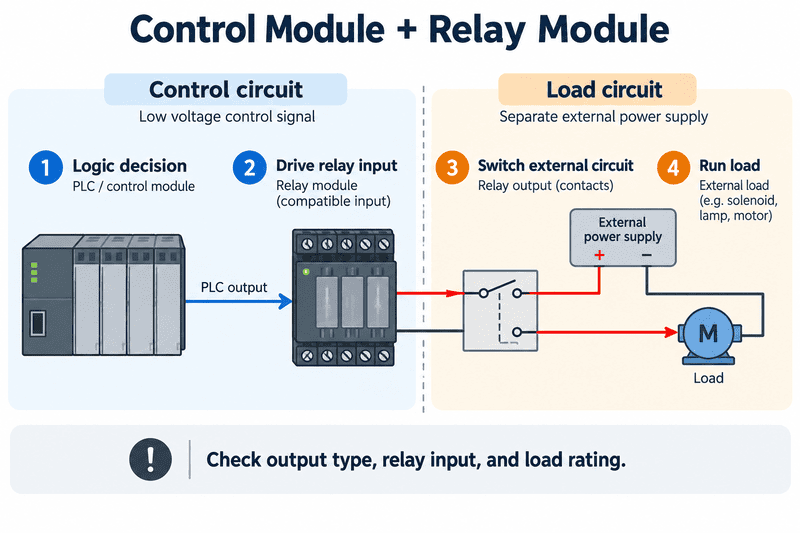
I find it helpful to describe the path as two circuits with a defined connection between them:
That sequence is conceptual, not a wiring instruction for every model. The actual terminals, polarity, shared commons, protective components, and permissible voltages come from the device documentation. Rockwell Automation’s industrial wiring guidance includes an example in which an output drives an interposing relay and the relay contacts control a solenoid. It also shows why the switching arrangement and inductive-load protection need attention. (literature.rockwellautomation.com)
The two sides answer different procurement questions. On the input side, I ask whether the PLC output can drive the relay input as specified. On the output side, I ask whether the relay can make and break the external circuit under its real operating conditions. A match on one side cannot compensate for a mismatch on the other.
I also ask who is responsible for the system’s logic. An external relay interface does not automatically add the timing, sequencing, or signal interpretation that the application needs. Conversely, a controller with the necessary logic may still need a suitable output interface. The system design—not the words printed on the purchase order—determines whether I recommend one device, both devices, or neither as an additional purchase.
An extra module adds parts, wiring, space, and another specification to verify. I therefore do not recommend one automatically. Many buyers already have a PLC or control device with an output that may suit the intended circuit. I compare that existing capability with the load before proposing an interposing relay.
I consider an external relay interface when the existing output and proposed load are not a suitable direct match, or when the design calls for a particular switching interface or documented separation. If the controller’s own output meets the application requirements, an additional relay may offer no necessary function. That conclusion must come from the relevant datasheets and system design. (siemens.com)
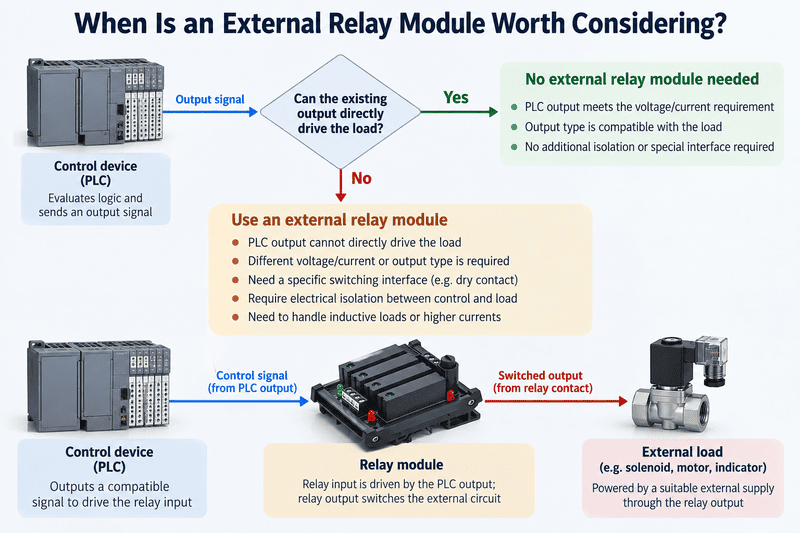
Suppose a panel builder tells me that a PLC must turn on a solenoid. I do not assume that “solenoid” means “buy a relay module.” I ask for the PLC output model, the solenoid’s electrical data, the switching frequency, and the proposed circuit. The PLC may have a suitable output, or the application may justify an external interface. The answer depends on those particulars.
Load type matters as much as a nominal current figure. Inductive devices can produce switching transients, and the appropriate protection depends on the device and circuit.8 Rockwell’s guidance for one of its relay-output modules calls for surge suppression when switching inductive loads; Omron likewise provides application guidance for protecting relay contacts. I use those documents as reasons to investigate the design, not as a substitute for the manuals governing a buyer’s actual components. (rockwellautomation.com)
I also distinguish isolation requirements from the casual request for “a relay.” A relay-module datasheet may state a particular level of separation between its control and contact sides. That is a product-specific claim with defined conditions; I would verify it against the system’s voltage, installation, and applicable requirements. (phoenixcontact.com)
The final question is practical: What problem does the extra interface solve? If the buyer cannot identify a required output, switching, separation, service, or installation benefit, I return to the existing output specification before adding hardware. If the need is clear, I document it so purchasing can compare equivalent proposals rather than similar-sounding names.
A part can look right in a catalog and still fail the application review. The most common gap is missing context: a request names the module but not the signal, load, or mounting constraints. I use a short qualification list so an engineering team and a purchasing team can evaluate the same requirement.
I start with the control task, then verify the existing output and the external load. After that, I check electrical compatibility, isolation, physical installation, and system documentation against the actual model numbers. I ask a qualified controls or electrical professional to approve application-specific wiring, protection, and safety decisions before installation.
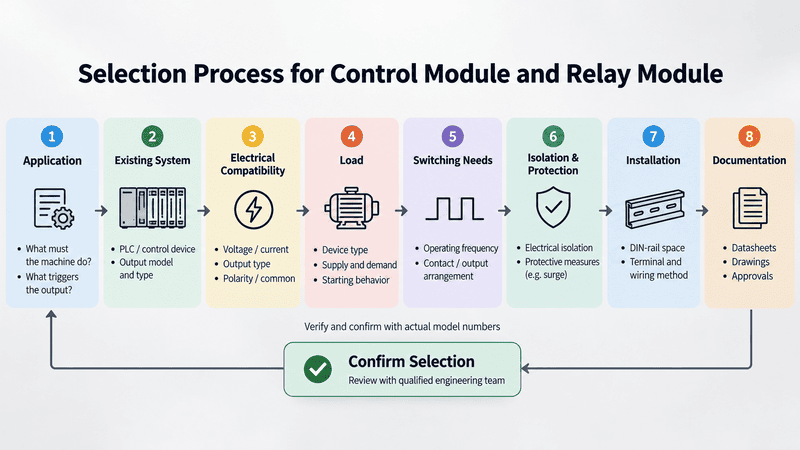
For an inquiry, I ask the buyer or integrator to share:
I ask for model-specific evidence, not a broad promise that a product is “industrial grade.” For example, a buyer should compare the stated input range with the available driving signal and the stated output characteristics with the real load. Relay guidance also warns that switching capability and durability depend on load conditions.9 (phoenixcontact.com)
I apply the same discipline to supplier selection. I ask whether the supplier can provide current datasheets, terminal diagrams, dimensional drawings, sample support, and a clear revision or substitution process. I treat any certification or approval as a document to check for the specific product and intended market, not as a claim I can infer from a product family name.
At NITAI, we support industrial buyers with relay modules, PLC interface modules, terminal blocks, connectors, and custom wiring-related products. Our business context includes OEM/ODM support, engineering materials, samples, and volume production. I would use that support to help narrow a shortlist and clarify documentation requests; I would still have the buyer’s qualified engineering team validate the final circuit and component selection.
I would not classify one by name alone. A relay module’s primary role is its switching interface, while “control module” can describe different functions across products. Some control devices include relay outputs. I compare the actual functions and datasheets before deciding whether the terms overlap in a particular system. (siemens.com)
No. I first check whether the PLC’s existing output is suitable for the proposed circuit and load. If it is, an external interface may be unnecessary. If it is not, I evaluate a compatible relay interface or another appropriate design with the system engineer.
It may. Dry contact describes the switched contact: the contact does not supply the external circuit’s voltage. The relay coil or module input can still require its own specified power or driving signal. I verify both the input requirements and contact characteristics for the exact model. (phoenixcontact.com)
No. I check the rated voltage, whether the load is AC or DC, its resistive or inductive behavior, starting demand, switching frequency, and any required protection. A headline current figure does not establish suitability for every circuit. I have the application engineer confirm the final choice. (ia.omron.com)
The difference between a control module and relay module becomes clearer when I stop comparing names and trace the actual task. I identify who processes the signal, what output already exists, and what the load needs. Then I check both sides of any proposed relay interface against model-specific documentation. If you are evaluating parts for a control panel, send NITAI your application details, existing output model, and load requirements. We can help you review suitable module and connection options for your engineering team’s final assessment.
"Programmable Logic Controllers (PLCs)", http://users.etown.edu/w/wunderjt/PLC_Fundamentals.pdf. Industrial-control references distinguish evaluation of input conditions from the switching of an output circuit; that distinction alone does not identify the functions of a particular module. Evidence role: definition; source type: education. Supports: The functional distinction between processing control inputs and switching an electrical circuit.. Scope note: A functional distinction does not establish the specifications of any named product. ↩
"(PDF) Relay Selection Guide GE Power Management ...", https://www.academia.edu/42077759/Relay_Selection_Guide_GE_Power_Management_Relay_Selection_Guide_g_GET_8048A. Relay selection references treat operating supply, contact arrangement, and switching ratings as distinct specifications; a category label does not establish their values. Evidence role: general_support; source type: education. Supports: Supply requirements, contact configuration, and load ratings are separate specifications that must be identified for a device.. Scope note: The reference would support the selection principle, not verify a particular catalog item. ↩
"Programmable Logic Controllers (PLCs)", http://users.etown.edu/w/wunderjt/PLC_Fundamentals.pdf. Descriptions of programmable-controller output types include relay-contact outputs, showing that control and relay switching functions can coexist in one device; the available outputs remain model-specific. Evidence role: case_reference; source type: education. Supports: Programmable control equipment can include relay-contact outputs.. Scope note: An example of relay outputs does not imply that all control devices include them. ↩
"Glossary of Terms For the Electric Utility Industry", https://lifelonglearning.ncsu.edu/wp-content/uploads/sites/477/2026/04/Glossary2025.pdf. A dry contact is a contact output that opens or closes an externally supplied circuit rather than providing the switched circuit’s voltage; its permissible ratings must still be checked. Evidence role: definition; source type: education. Supports: What a dry contact does, and what it does not supply.. Scope note: The definition does not establish the contact ratings of a specific module. ↩
"RelayPaper", https://web.cecs.pdx.edu/~harry/Relay/RelayPaper.htm. A relay’s coil or module electronics may require an operating supply even when its output is a dry contact; the contact designation describes the switched side, not the power requirements of the entire device. Evidence role: mechanism; source type: education. Supports: The operating input or coil circuit is separate from the circuit switched by the contact.. Scope note: The required supply depends on the particular relay or module. ↩
"Application Note: Relay Selection and Design", https://www.egr.msu.edu/classes/ece480/capstone/fall12/group07/AppRelays.pdf. Relay-contact ratings specify operating conditions alongside current, including voltage and load characteristics; a current figure alone does not establish suitability for another circuit. Evidence role: general_support; source type: education. Supports: Contact suitability depends on specified voltage and load conditions as well as current.. Scope note: A general ratings explanation cannot substitute for the selected device’s datasheet. ↩
"Direct current interruption on small AC relay using IGBT ...", https://ui.adsabs.harvard.edu/abs/2013pest.conf...78S/abstract. Studies of relay-contact interruption describe how load inductance and current type affect arcing and contact stress; the magnitude of those effects depends on the circuit and protective measures. Evidence role: mechanism; source type: paper. Supports: Why inductive loads and DC interruption can produce different contact stresses from resistive or AC switching.. Scope note: Mechanistic evidence does not provide a universal derating factor for every relay. ↩
"24 kA solid state switch for plasma discharge experiments", https://plasma.physics.ucla.edu/papers/Pribyl-Switch.pdf. Interrupting current through an inductive load can produce a voltage transient as stored magnetic energy is released; the protection method depends on the circuit’s voltage, timing, and component requirements. Evidence role: mechanism; source type: education. Supports: Stored energy in an inductive load can create a voltage transient when current is interrupted.. Scope note: The mechanism does not identify a safe protection component or wiring arrangement for a particular installation. ↩
"Change in Electric Contact Resistance of Low-Voltage Relays ...", https://pmc.ncbi.nlm.nih.gov/articles/PMC6650999/. Research on relay contacts associates electrical endurance with switching conditions, including load characteristics and operating frequency; reported lifetimes are not transferable without comparable test conditions. Evidence role: mechanism; source type: paper. Supports: Electrical loading and repeated switching affect relay-contact performance and endurance.. Scope note: General contact-wear findings cannot predict the lifetime of a specific module in a specific circuit. ↩
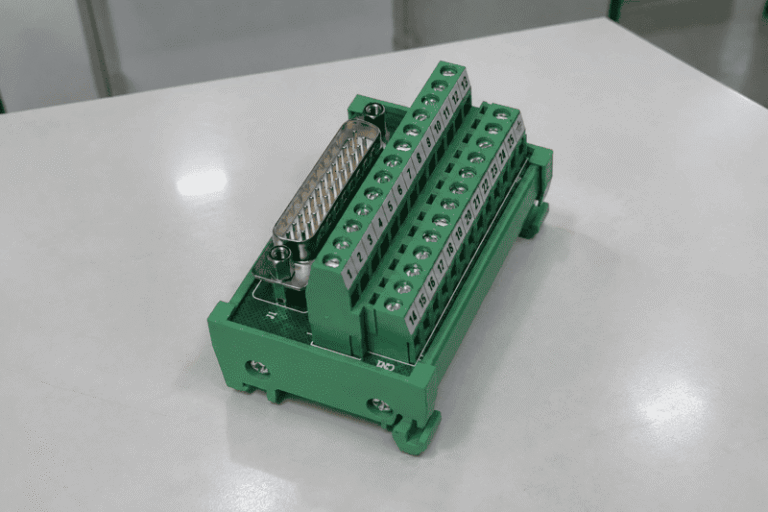
An industrial relay module can simplify PLC control-panel wiring, but a familiar input voltage or current marking does…
An M8 8 pin female connector can look like the right replacement on a purchasing list and still…
Connector types can look interchangeable in a catalog, but a familiar shape does not tell me whether two…
NITAI manufactures terminal blocks, M8/M12 waterproof connectors and industrial distribution modules for global OEMs, distributors and automation customers.
Leave a Reply