Oct 17, 2026
How Do I Choose the Right M8 8 Pin Female Connector for My Equipment?
An M8 8 pin female connector can look like the right replacement on a purchasing list and still…

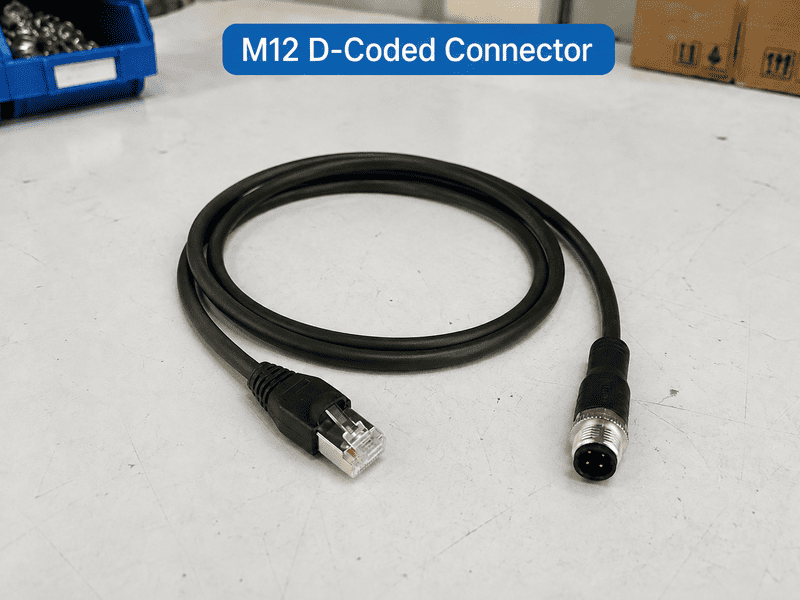
M12 D-coded connectors are commonly used in industrial Ethernet applications to provide reliable 100 Mbps connections between PLCs, sensors, actuators, switches, and field devices. These connectors are specifically designed for compact, rugged environments and are compatible with automation equipment requiring vibration resistance, waterproofing, and stable signal performance.
M12 D-coded connectors support 100 Mbps Ethernet networks and connect devices such as PLCs, sensors, motor controllers, and industrial switches within automated systems. They are ideal for applications in factory automation, robotics, and machinery where durability and shielding are crucial.
Unlike general-purpose connectors, D-coded M12 connectors are optimized for industrial environments, but selecting the right one requires careful consideration of the equipment interface, cable specifications, and installation conditions. Let’s dive into the details below.
When we talk about D-coded connectors, we’re referring to coding specific to Ethernet communication.
D-coded M12 connectors support Fast Ethernet at 100 Mbps, offering four pin contacts1 precisely positioned to maintain stable data transmission within industrial networks. These connectors are differentiated by a specific key shape and coding that prevents mismatched connections.2
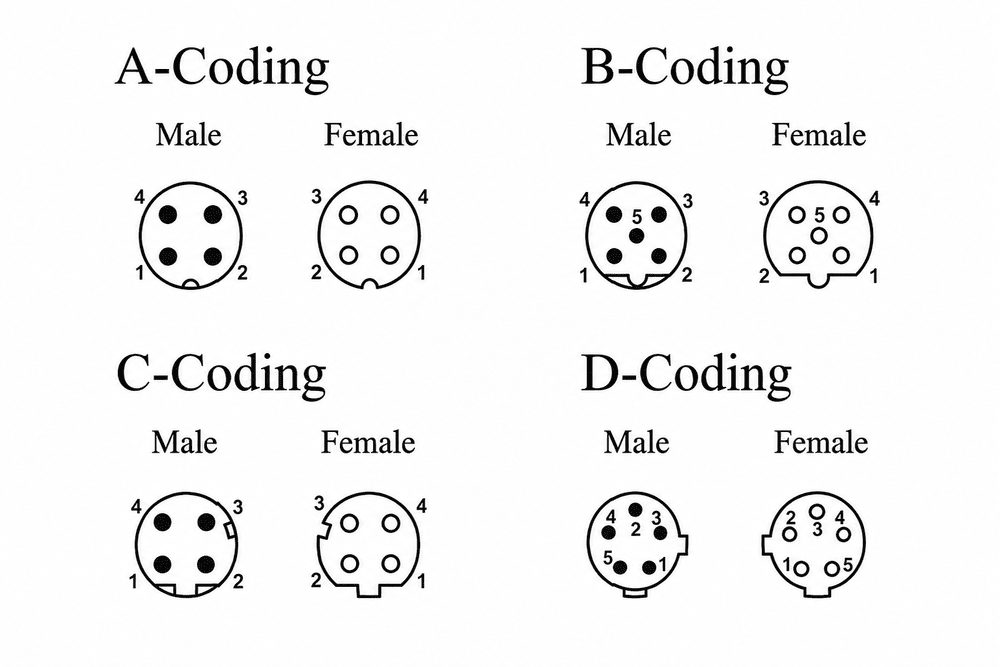
The coding prevents accidental mismating with non-Ethernet connectors. The connector's design complies with automation standards3, ensuring compatibility with Ethernet-enabled devices like programmable logic controllers (PLCs), factory I/O modules, and industrial switches. But it’s not solely about coding—you’ll also need to verify housing type, pin configuration, and cable wiring to ensure compatibility.
These checkpoints are vital because not every four-contact M12 connector is D-coded4. Misidentifying connectors can lead to errors in network installation or communication performance.
D-coded connectors excel in environments where industrial Ethernet data must flow reliably under rugged conditions.
D-coded M12 connectors are used in sectors like factory automation, robotics, machinery, and PLC-controlled systems5 requiring 100 Mbps Ethernet connectivity between sensors, motors, switches, and controllers. They ensure stable performance despite water exposure, vibrations, or electromagnetic interference.
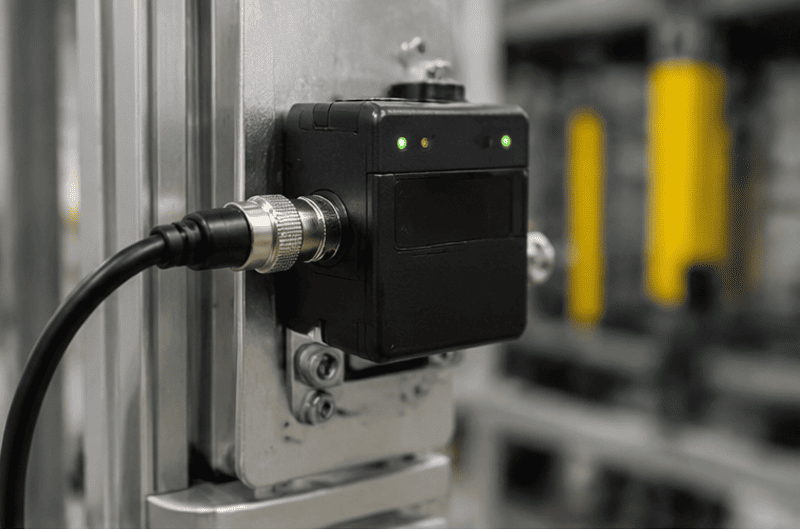
They’re particularly suited for:
In short, if your application integrates Ethernet communication within exposed or confined industrial environments, D-coded connectors are likely the right choice.
The coding marks distinct usage categories within M12 connectors. Here’s a quick comparison:
| Coding Type | Data Rate / Signal Type | Application Focus |
|---|---|---|
| D-coded | 100 Mbps Ethernet | Factory automation, PLC networks |
| A-coded | Analog or low-speed digital signals8 | General signal transmission |
| X-coded | Up to 10 Gbps Ethernet9 | High-speed data applications |
While it may sound tempting to switch from D-coded to X-coded for higher speed, compatibility depends on your equipment interface. Mating a connector to an incompatible port risks damaging hardware or interrupting communication.
D-coded connectors occupy the middle ground—offering a balance of industrial durability and Ethernet functionality. They are ideal for standard automation systems where 100 Mbps data rates suffice, without the need for ultra-high-speed transmission.
Connecting M12 D-coded connectors isn’t just about matching the coding. Several factors influence the final purchase:
Before connecting a D-coded M12 connector, confirm device compatibility, interface type, cable wiring, shielding, cable length10, connector gender, installation conditions, and environmental resistance. M12-to-RJ45 adapters should also be checked for wiring consistency and port compatibility.
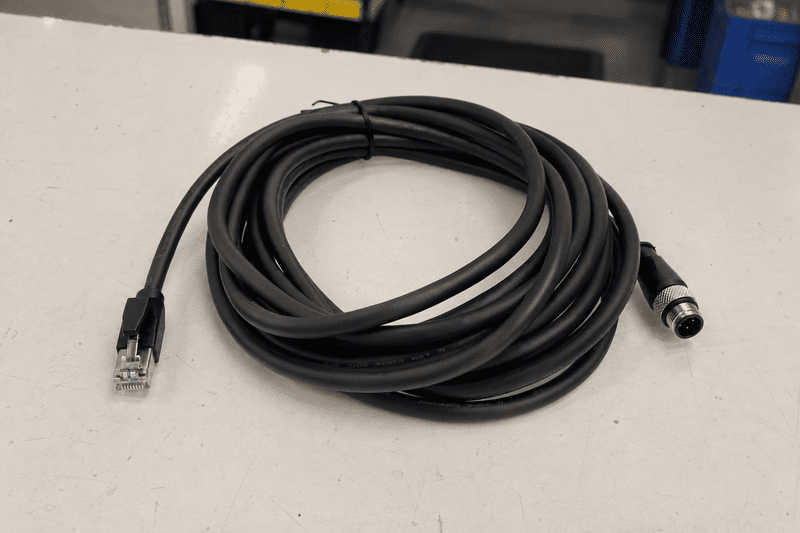
Missteps such as mismating connectors or ignoring shielding details can lead to system downtime or degradation of Ethernet data quality.
While D-coded M12 connectors are versatile, they’re not universally applicable.
Choose an alternate coding (A-coded, X-coded, etc.) or another interface like RJ45 if your application requires higher data rates (10 Gbps), analog signals, low-speed digital signals, or compatibility beyond M12 connector types. Always rely on equipment specifications to guide your choice.
Here’s a decision tree for connector selection:
Remember, the equipment port specification is the final authority. Review technical documentation before making your decision.
D-coded connectors support 100 Mbps Ethernet, while X-coded connectors handle up to 10 Gbps Ethernet speeds. X-coded connectors have more contact pins and are built for high-speed data applications, whereas D-coded ones serve standard industrial Ethernet systems.
No, D-coded connectors are specifically designed for Ethernet communication. For analog signals, A-coded M12 connectors are better suited due to their pin configuration.
An IP67 rating ensures waterproofing but doesn’t address shielding, cable construction, or vibration tolerance. For robust industrial Ethernet performance, confirm cable shielding, connector mount compatibility, and cable quality alongside the ingress protection rating.
M12 D-coded connectors are essential for 100 Mbps industrial Ethernet networks in automation environments like PLC cabinets, robotics systems, and factory equipment. While their coding ensures proper Ethernet routing, compatibility with equipment ports, cables, and environmental conditions must be verified. Whether you’re connecting sensors or establishing backbone PLC networks, proper evaluation and specification reviews will ensure you choose the right connector for your setup.
Browse our catalog for custom D-coded connectors and industrial cable solutions, or contact us for personalized recommendations tailored to your automation system.
"Ethernet over twisted pair", https://en.wikipedia.org/wiki/Ethernet_over_twisted_pair. The relevant M12 interface specification identifies the D-coded contact arrangement; industrial Ethernet guidance associates that arrangement with 100 Mbps links. The connector alone does not determine the speed of a complete link. Evidence role: definition; source type: institution. Supports: The specified D-coded interface has four contacts and is used for 100 Mbps Ethernet.. Scope note: Actual operation also depends on the devices, cable, and wiring. ↩
"IEC metric screw sized connectors", https://en.wikipedia.org/wiki/IEC_metric_screw_sized_connectors. M12 coding specifies distinct mating geometries that discourage connection to differently coded interfaces. This protection concerns normal mating, not damage from forced insertion or incorrect wiring within a compatible interface. Evidence role: mechanism; source type: institution. Supports: M12 coding specifies mechanical keying intended to prevent mating between incompatible codings.. Scope note: Mechanical keying does not establish electrical compatibility. ↩
"IEC metric screw sized connectors", https://en.wikipedia.org/wiki/IEC_metric_screw_sized_connectors. The applicable IEC connector specification defines interface requirements for M12 connectors, including coding. The existence of a specification does not establish that any particular connector has been tested or certified as compliant. Evidence role: definition; source type: institution. Supports: An applicable IEC specification defines requirements for the M12 interface and coding.. Scope note: Product-level compliance requires evidence for the specific connector. ↩
"IEC metric screw sized connectors", https://en.wikipedia.org/wiki/IEC_metric_screw_sized_connectors. M12 connector classifications include four-contact arrangements under more than one coding; identifying D-coding therefore requires checking the mating geometry as well as the contact count. Evidence role: general_support; source type: institution. Supports: M12 coding and contact count are separate characteristics, and other codings can have four contacts.. ↩
"PROFINET Installation Guideline", https://www.profibus.com/fileadmin/media/downloadsection/installation_guide/PROFINET_Assembling_8072_V212_Sept22.pdf. Industrial Ethernet installation guidance describes D-coded M12 connections for equipment-level network links in automation. Such guidance establishes an applicable use, not how frequently the connectors appear in every sector listed. Evidence role: general_support; source type: institution. Supports: Industrial Ethernet installation guidance or documented applications place D-coded M12 connections in automated equipment networks.. Scope note: Application guidance is not evidence of prevalence across all listed sectors. ↩
"EN 60512-2-5:2003 - Electrical Continuity and Contact ...", https://standards.iteh.ai/catalog/standards/clc/10d8a3c1-8a2c-4ef5-adf4-6a43c49ca2bd/en-60512-2-5-2003?srsltid=AU7gw4XW1b_GgO23qnaz5m8s1nYV_y9FSCsxTpOM3fSp__rtc0bo5vtq. Connector vibration testing evaluates whether contacts maintain continuity under defined mechanical stress. Passing a specified test does not guarantee stable signals under every installation or pattern of motion. Evidence role: mechanism; source type: research. Supports: Vibration can affect contact integrity, and connector vibration tests assess continuity under specified conditions.. Scope note: Performance depends on the tested connector assembly, cable support, and vibration profile. ↩
"IP67 Testing: Dust Test and Temporary Immersion IEC 60529", https://www.ingressprotectiontest.com/?l=test-ip67-protection-against-dust-ip6x-immersion-ipx7-cei-en-iec-60529. Under IEC 60529, IP67 denotes dust-tight protection and protection against temporary immersion under specified test conditions. It does not by itself establish suitability for continuous submersion or every outdoor exposure. Evidence role: definition; source type: institution. Supports: IEC 60529 defines the dust and temporary-immersion protections represented by IP67.. Scope note: The rating must apply to the connector in its specified installed or mated condition. ↩
"IEC metric screw sized connectors", https://en.wikipedia.org/wiki/IEC_metric_screw_sized_connectors. Automation interface guidance identifies A-coded M12 connectors for sensor and actuator connections, including analog or digital signals. Coding describes the mating interface rather than imposing a universal signal type or speed limit. Evidence role: general_support; source type: institution. Supports: A-coded M12 interfaces are used for sensor, actuator, and other signal connections that can include analog or digital I/O.. Scope note: Permitted signals depend on the equipment pinout and electrical specification. ↩
"10 Gigabit Ethernet", https://en.wikipedia.org/wiki/10_Gigabit_Ethernet. The X-coded M12 interface is used for Ethernet applications reaching 10 Gbps. That rate describes a properly specified link, not a capability conferred by the connector regardless of cable or equipment. Evidence role: general_support; source type: institution. Supports: The X-coded M12 interface is specified for high-speed Ethernet applications, including 10 Gbps implementations.. Scope note: Achievable speed depends on the complete channel and both connected devices. ↩
"Fast Ethernet", https://en.wikipedia.org/wiki/Fast_Ethernet. 100BASE-TX channel specifications impose a maximum length for a compliant copper link, making cable length a necessary installation check. The applicable limit must be assessed for the complete channel rather than an isolated connector. Evidence role: general_support; source type: education. Supports: 100BASE-TX copper Ethernet specifies channel-length constraints relevant to cable selection.. Scope note: Other Ethernet variants or installation specifications may have different limits. ↩
"Performance Assessment of Different Cable Shield ...", https://ui.adsabs.harvard.edu/abs/2023emct.confR...5D/abstract. Studies of cable shielding show that suitable shielding and termination can reduce interference coupling. Shielding alone does not prevent all signal degradation, particularly when grounding or installation is inadequate. Evidence role: mechanism; source type: research. Supports: Appropriately implemented shielding can reduce electromagnetic coupling into signal cables.. Scope note: The degree of protection is installation- and interference-dependent. ↩
"M12 D-code Cordsets and M12 D-code to RJ45 Cordsets", https://www.mouser.com/pdfDocs/ENG_DS_m12-d-code-cordsets-DS_2107.pdf?srsltid=AU7gw4XnexLaicUcbV33oagHCkAtO7se2lj8MAbkDC9nFmS9RVQNLs-2. Industrial Ethernet wiring guidance specifies contact and pair assignments for M12 D-coded and RJ45 interfaces. An adapter must preserve the assignments required by the connected equipment; matching connector shapes alone does not verify the wiring. Evidence role: mechanism; source type: institution. Supports: Industrial Ethernet wiring guidance specifies how D-coded M12 contacts map to RJ45 contacts and twisted pairs.. Scope note: The correct mapping should be checked against the applicable network and device documentation. ↩
An M8 8 pin female connector can look like the right replacement on a purchasing list and still…
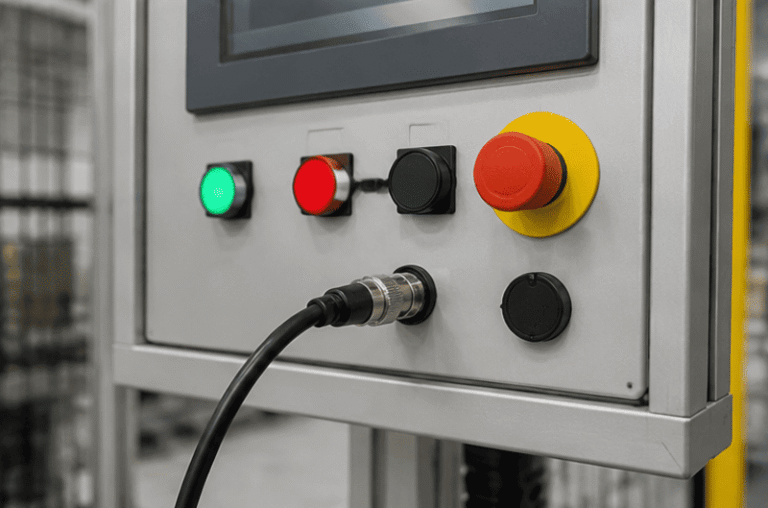
An M12 male connector 5-pin B-coded may look like a straightforward line item, but its name does not…
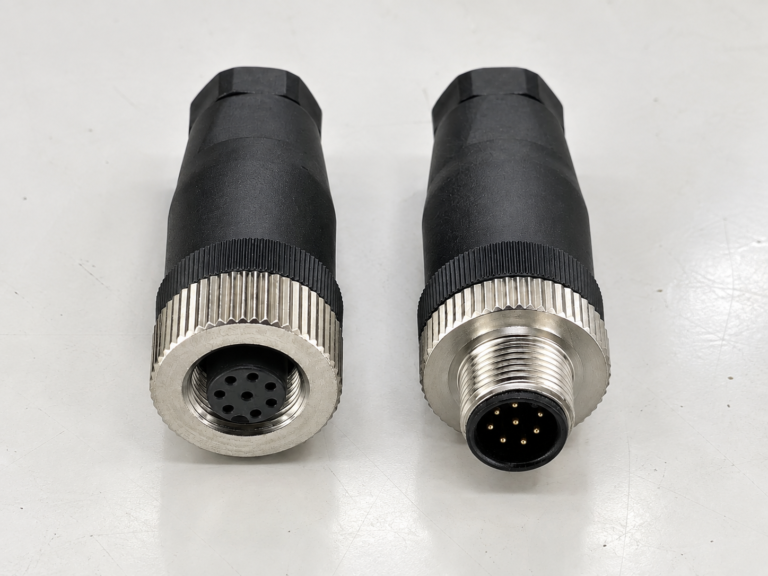
M12 connectors can carry different voltage ratings, so a buyer cannot choose one safely from the connector size…
NITAI manufactures terminal blocks, M8/M12 waterproof connectors and industrial distribution modules for global OEMs, distributors and automation customers.
Leave a Reply