Oct 17, 2026
How Do I Choose the Right M8 8 Pin Female Connector for My Equipment?
An M8 8 pin female connector can look like the right replacement on a purchasing list and still…

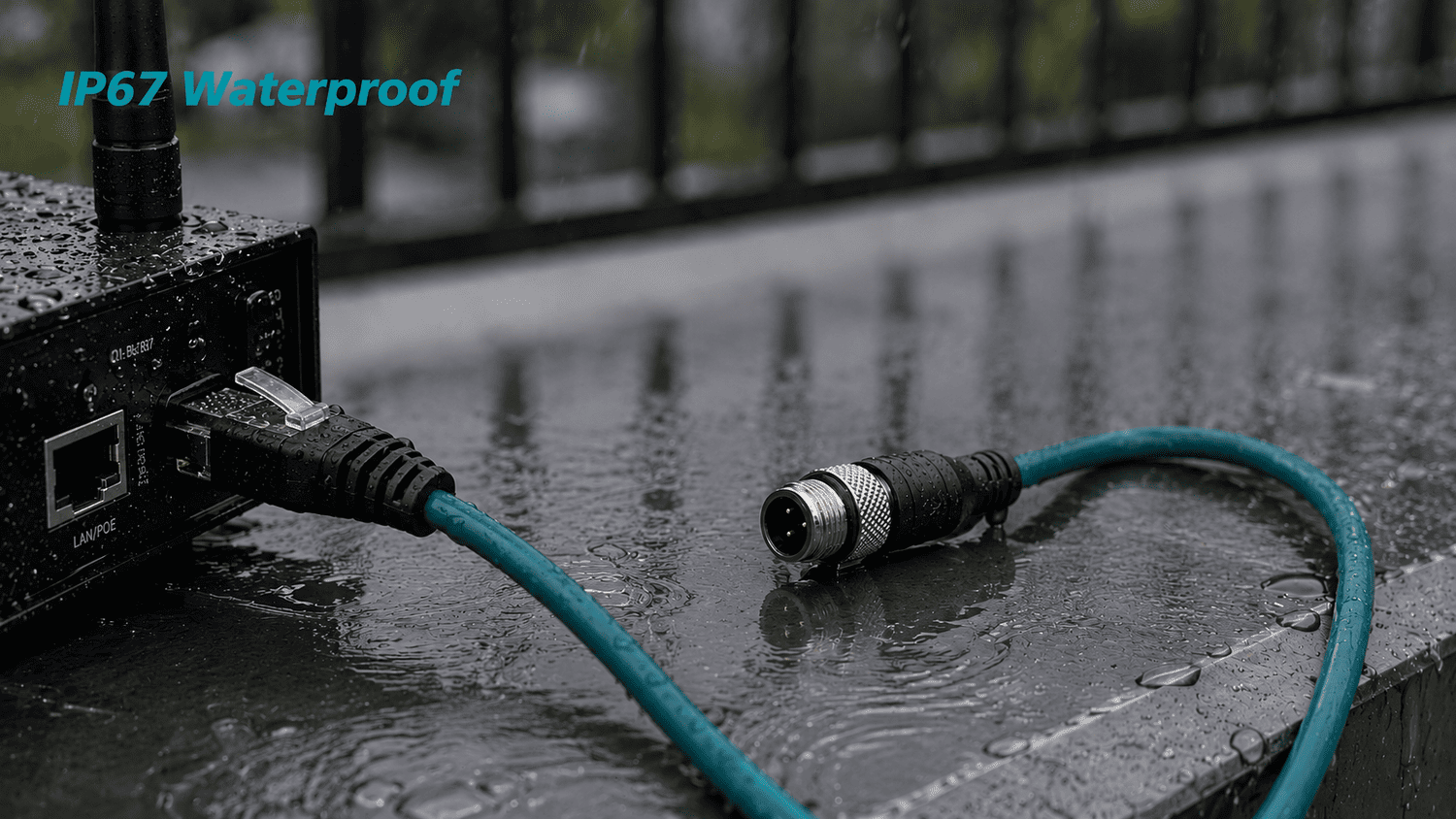
M12 connectors can be waterproof, but M12 does not automatically mean waterproof. M12 identifies a connector interface family. The actual IP67 or IP68 protection depends on the complete connection: the plug and socket, face seal, O-ring, cable entry, overmolding or gland, panel gasket, assembly quality, and installation condition.
This is why I do not answer “Is this M12 connector waterproof?” with a simple yes or no. Before confirming a protection level, I need to know the exact product structure, whether it will be mated or unmated, how it will be installed, and what kind of water exposure it must survive.
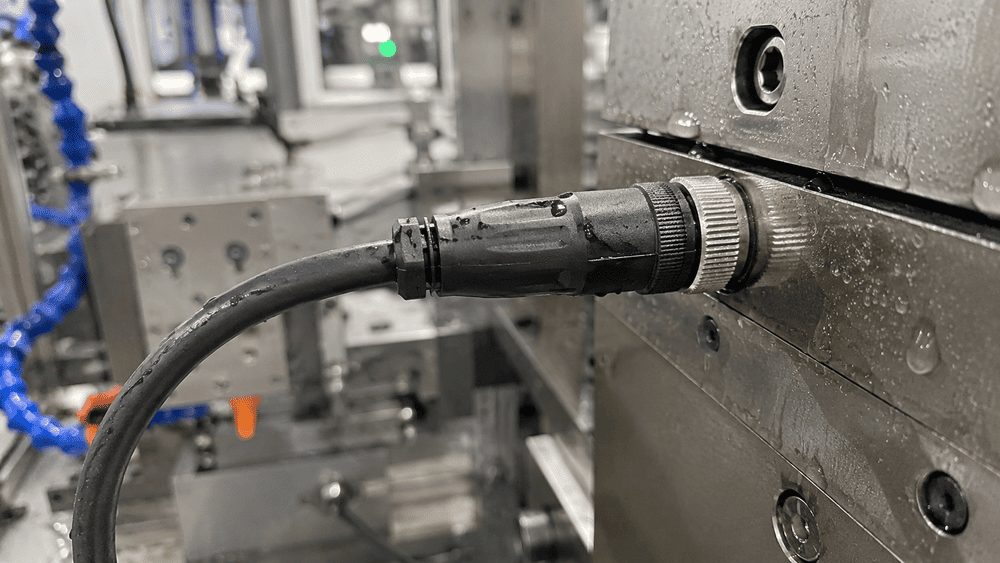
An M12 connector is waterproof only when the specific product and complete installed connection have an appropriate ingress-protection rating.
A properly designed and assembled M12 cable connection may achieve IP67 or IP68. However, the same connector can lose that protection if:
IEC 61076-2-101 describes the standardized M12 screw-locking circular connector interface used for industrial process measurement and control applications.1 The interface standard helps define mating compatibility, but it does not make every M12 product identical or give every assembly the same IP rating.
IP ratings classify how an enclosure protects against access, solid foreign objects, dust, and water.
ANSI/IEC 60529 applies to the classification of degrees of protection provided by enclosures for electrical equipment.2
An IP code normally contains two digits:
| IP Position | What It Describes | Example in IP67 |
|---|---|---|
| First digit | Protection against access and solid foreign objects | 6 = dust-tight |
| Second digit | Protection against water ingress | 7 = protected under the specified temporary-immersion test |
The IEC explains that the first IP digit grades resistance to solid-particle intrusion, while the second digit grades resistance to liquid intrusion.3
The IP code is more useful than a vague statement such as “waterproof” because it points to a defined test category. It is still necessary to read the conditions attached to the rating.
Both IP67 and IP68 begin with the number 6, so both indicate the highest solid-ingress category in the basic two-digit IP system: dust-tight protection.
The difference is the water test.
| Rating | Dust Protection | Water Protection | What You Must Confirm |
|---|---|---|---|
| IP67 | Dust-tight | Temporary immersion under the specified test conditions | Mated condition, immersion depth, duration, installation, temperature |
| IP68 | Dust-tight | Continuous immersion under conditions more severe than IPX7 and specified for the product | Manufacturer's stated depth, duration, pressure, installation, and product configuration |
An IEC technical explainer describes IP67 as dust-tight protection with resistance to temporary immersion, while IP68 covers dust-tight protection with resistance to continuous immersion.4
IP67 is commonly associated with temporary immersion in fresh water at a depth of up to 1 meter for 30 minutes under the standard test arrangement.
That does not mean every IP67 connector can be left underwater indefinitely. It also does not guarantee resistance to coolant, salt water, oil, solvents, detergents, steam, or high-pressure washing.
IP68 is often misunderstood as “better waterproofing with one fixed test.” In reality, the conditions for IPX8 must be stated for the product and are established beyond the IPX7 immersion conditions.
One IP68 product may be tested at a different depth, pressure, or duration from another IP68 product. Therefore, an IP68 claim without the accompanying test conditions is incomplete for engineering selection.
The IP Code reference explains that IPX8 covers continuous immersion under conditions specified for the product and that fresh-water IP testing does not automatically establish resistance to salt water, oil, or solvents.5
When a customer asks us for IP68, I normally continue with these questions:
Without these details, “IP68” may sound precise while still leaving the actual application undefined.
No. Water-ingress tests address different exposure methods.
Immersion, water jets, and high-temperature high-pressure washdown are not the same test. A product rated for immersion should not automatically be assumed to withstand high-pressure jets unless the relevant jet rating is also stated.
For example:
This matters in food equipment, vehicle cleaning, packaging machinery, and washdown production lines. A connector that survives immersion may still be unsuitable for a close-range high-pressure cleaning nozzle.
If both immersion and washdown resistance are required, the product documentation should show the applicable ratings rather than relying on the assumption that one rating automatically includes all others.
No. IP ratings and NEMA enclosure types are related classification systems, but they are not directly interchangeable.
NEMA explains that IEC 60529 IP ratings and NEMA 250 enclosure types use different requirements, so a simple one-to-one conversion should not be treated as exact equivalence.6
For an M12 cable assembly, the project specification may request an IP rating. For a complete electrical enclosure, a North American customer may also specify a NEMA type. These requirements should be checked separately against the relevant product documentation.
Not necessarily.
Many connector IP ratings apply when the plug and socket are correctly mated and tightened. Once disconnected, the exposed contacts and sealing face may no longer have the same protection.
This is one of the most common misunderstandings I see in customer inquiries. A customer may order an IP67 M12 panel receptacle and assume that the open equipment port can remain outdoors without a mating plug or cap.
For an unused or temporarily disconnected port, we check whether the product requires:
A dust cap and a waterproof sealing cap are not always the same product. The cap must match the connector gender, thread, sealing face, and required environment.
Water protection comes from a sealing system, not from the M12 thread alone.
| Part of the Connection | Its Waterproofing Role | Typical Risk |
|---|---|---|
| Face seal or O-ring | Seals the mating interface between plug and socket | Missing, cut, twisted, contaminated, or compressed incorrectly |
| Coupling nut and thread | Maintains mechanical engagement and seal compression | Loose connection, cross-threading, or incorrect torque |
| Overmolded cable entry | Seals and supports the cable-to-connector transition | Cracks, poor molding, unsuitable material, or severe bending at the exit |
| Cable gland | Compresses a seal around the cable jacket | Cable outside diameter outside the permitted range |
| Panel gasket | Seals between the receptacle and equipment wall | Wrong cutout, uneven panel, missing gasket, or loose mounting nut |
| Connector housing | Provides the mechanical enclosure | Damage, incorrect assembly, or unsuitable chemical resistance |
| Protective cap | Seals an unused or unmated port | Wrong cap, missing seal, or cap not tightened |
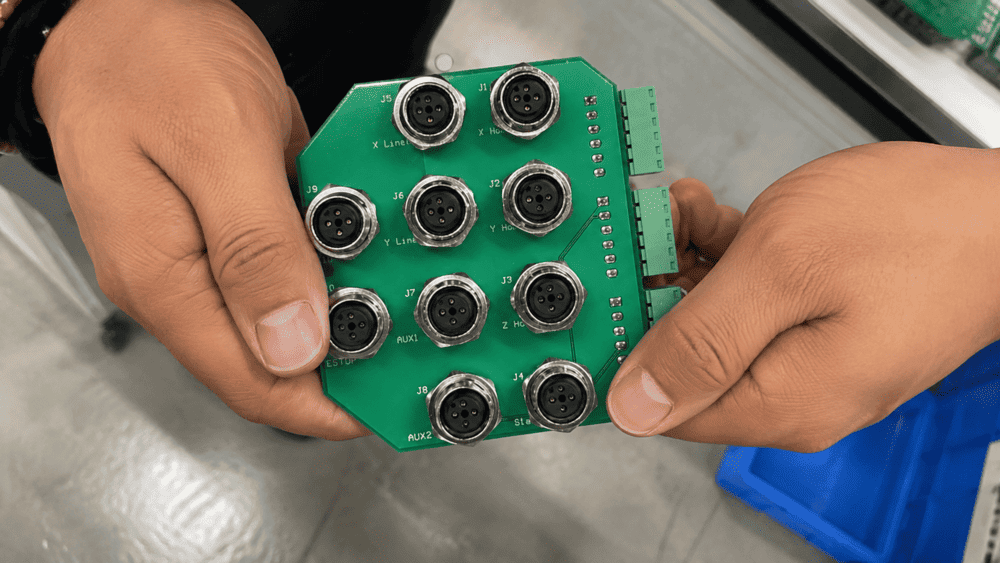
The seal between the male and female connector faces is one of the most important parts of the system. The connector must be fully engaged so that the sealing surfaces compress as designed.
More force is not always better. Overtightening can damage threads, distort sealing parts, or make later maintenance difficult. Undertightening may leave insufficient seal compression. The installation torque should follow the selected product specification.
For a molded cable assembly, the connector body, cable jacket, and overmold form one finished structure. A well-controlled molding process helps seal the conductor entry and provides strain relief.
For a field-wireable connector, the gland and cable jacket create the rear seal. If the cable is too small, the gland may not compress enough. If it is too large, assembly may damage the seal or prevent the connector from closing correctly.
A panel receptacle needs protection at two different areas:
Even if the external plug is correctly mated, water can enter the enclosure around the panel cutout if the panel gasket is missing, the surface is uneven, the cutout is oversized, or the mounting hardware is loose.
For panel projects, we therefore ask for:
An IP67 label does not prevent installation errors, mechanical damage, or use outside the rated conditions.
The most common causes we investigate are:
The electrical contacts may already work even though the sealing faces are not fully compressed. This creates a dangerous impression that the installation is complete.
O-rings can be lost during handling, cut by a sharp edge, contaminated with metal chips, or displaced during assembly.
This is especially important for field-wireable connectors. Cable conductor count alone is not enough. We need the actual outside diameter of the finished cable jacket.
An oversized hole, rough panel surface, thin panel, loose nut, or unsuitable gasket can create a leak path behind the receptacle.
An IP67 rating in the mated condition does not automatically protect open contacts. A suitable sealing cap may be required.
Repeated bending at the cable exit can fatigue the jacket, strain relief, or internal termination. A right-angle connector, longer strain relief, or dynamic-rated cable may be more suitable.
Coolant, cutting oil, detergent, salt water, and solvents can affect seals, plastics, metals, and cable jackets differently from fresh water. Chemical compatibility must be evaluated separately.
Immersion protection is not the same as protection from a high-pressure or high-temperature jet. The required washdown rating and test conditions must be specified.
Yes. M12 is commonly used as a field connection on sensors, actuators, I/O modules, and automation equipment designed for protected installation outside a control cabinet.
The IO-Link System Description identifies the M12 plug connector as a defined connection option for IP65/IP67 field technology, with typical 4-pin sensor plugs, 5-pin actuator plugs, and 5-pin master sockets.7
This does not mean that every M12 connector is automatically IP67. It means the M12 format is used in systems where appropriately rated connector products are selected and installed.
The IO-Link Design Guideline specifically tells planners to determine which connector type is used on an IP67 device and to verify the device information during system design.8
This matches how we handle customer projects: we do not select from the word “M12” alone. We compare the device interface, connector structure, cable, IP requirement, and installation condition.
No. PUR does not automatically produce a higher IP rating.
PVC and PUR describe cable-jacket materials. IP67 and IP68 describe the ingress protection of the complete product under stated conditions. They answer different questions.
| Selection Factor | PVC Cable | PUR Cable |
|---|---|---|
| Typical cost | More economical | Usually more expensive |
| Fixed installation | Often a practical choice | Can be used, but may be unnecessary |
| Frequent flexing | Standard PVC is usually not the first choice | Suitable dynamic-rated PUR constructions are often preferred |
| Abrasion resistance | Depends on compound; generally suited to normal use | Commonly selected for higher mechanical wear |
| Oil and demanding industrial exposure | Must check the exact compound | Often selected when stronger oil and abrasion resistance is required |
| Ability to form an IP67 assembly | Yes, with the correct connector and sealing design | Yes, with the correct connector and sealing design |
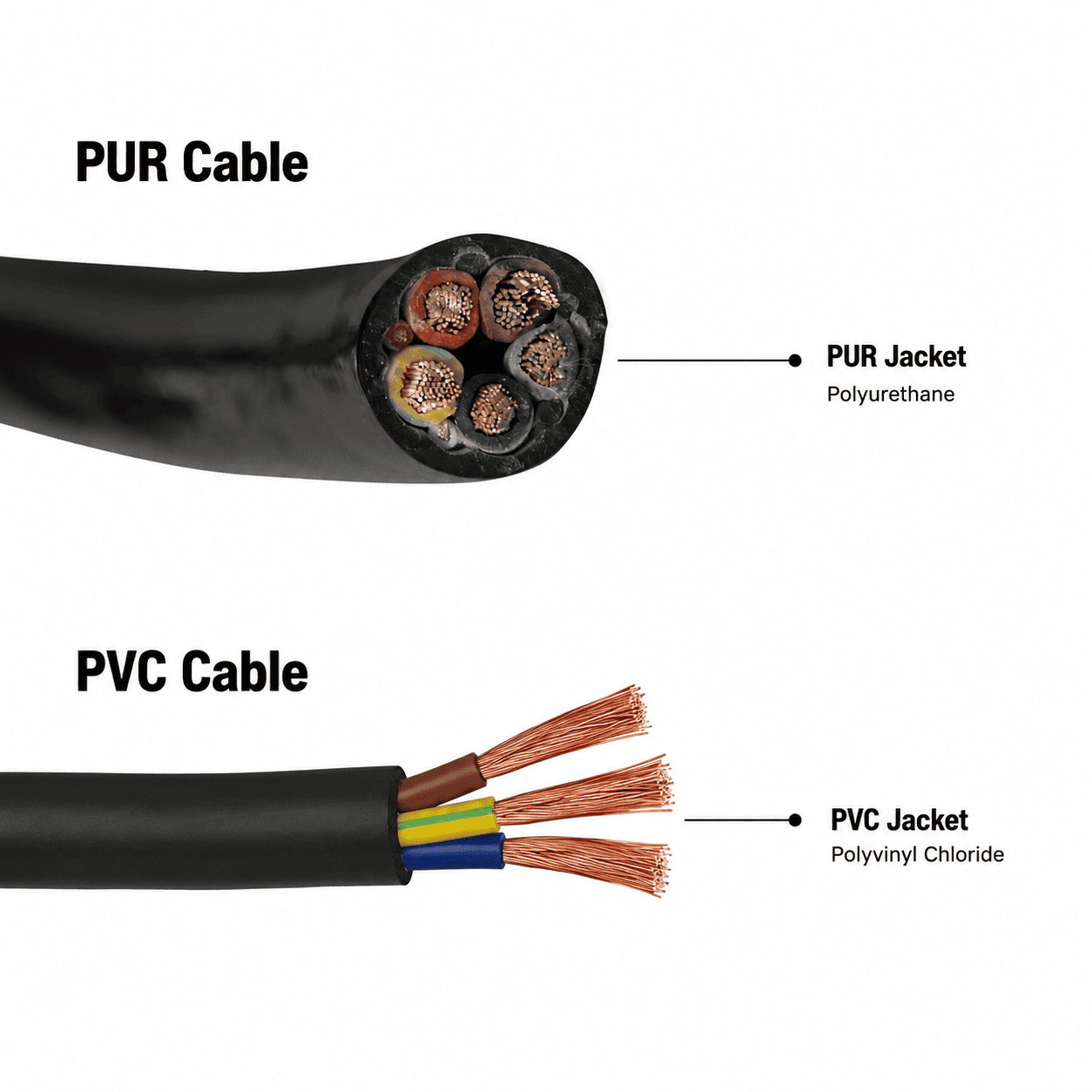
In ordinary fixed equipment, a PVC cable assembly can be the more economical option. If the connector, overmolding, seals, and assembly meet the required design, PVC can be used in an IP67 M12 cable assembly.
We are more likely to recommend PUR when the application includes:
The more expensive material should solve a real operating problem. We do not recommend PUR only because the customer asks for waterproofing, and we do not recommend PVC when the dynamic or chemical environment clearly requires a more suitable cable.
For a detailed material comparison, read our PUR vs PVC cable selection guide.
Each structure can provide environmental protection, but the risk points are different.
A molded cable is normally the most straightforward option when the customer wants a finished, repeatable assembly.
We confirm:
The controlled overmolding process reduces the number of field-assembly steps, but the product still needs correct mating and installation.
A field-wireable connector is useful for on-site installation, repair, or custom cable length. Its sealing performance depends more heavily on the installer.
Before supplying one, we ask for:
The gland, rear seal, conductor preparation, shield termination, and housing assembly must all be correct.
A panel receptacle creates an equipment interface and must seal both the mating face and the panel opening.
We normally request a drawing or panel information because the M12 mating interface can be standard while the mounting thread, gasket location, thread length, and rear termination vary.
When a customer asks us for a waterproof M12 connector, our usual confirmation process is:
This process is more reliable than selecting a connector only from a product photo or an “IP68” label.
Before ordering, send as much of the following information as possible:
| Required Information | Example |
|---|---|
| Application | Sensor, robot, outdoor machine, control cabinet, or industrial camera |
| M12 coding | A, B, D, X, S, T, K, or L |
| Contact count | 3-pin, 4-pin, 5-pin, or 8-pin |
| Gender | Male pins or female sockets |
| Product structure | Molded cable, field-wireable connector, or panel receptacle |
| Required protection | IP67, IP68, washdown, or project-specific |
| Exposure | Rain, splash, immersion, coolant, oil, detergent, or salt water |
| Immersion details | Depth, duration, frequency, and temperature |
| Connection state | Mated, unmated, or both |
| Cable requirement | Length, outside diameter, wire gauge, PVC/PUR, and shielding |
| Panel requirement | Cutout, thickness, mounting direction, gasket, and rear space |
| Reference | Device model, drawing, photo, old sample, or part number |
If the full specification is not available, start with a clear mating-face photo, the equipment model, the application, and the expected water exposure. We can then identify the missing questions.
No. M12 describes the connector family, not one universal protection rating. Check the exact product specification and the conditions under which the rating applies.
IP68 addresses continuous immersion under product-specific conditions, while IP67 addresses temporary immersion. “Better” depends on the actual exposure. A washdown application may require a water-jet rating rather than relying only on an immersion rating.
IP67 is not intended as a general statement of permanent-submersion suitability. For longer or deeper immersion, request an appropriately specified IP68 product and verify its stated depth, duration, pressure, and installation conditions.
No. The IPX8 conditions must be specified for the product. Always request the applicable depth, duration, pressure, configuration, and test information.
Not automatically. Many ratings apply to a correctly mated connection. An unmated plug or receptacle may require a compatible sealing cap with its own stated protection.
Yes. PVC can be used in an IP67 cable assembly when the connector, seals, overmolding or gland, and assembly meet the required design. PUR is selected mainly for mechanical movement, abrasion, oil exposure, and other demanding conditions—not simply to create an IP rating.
Yes, if the selected connector is rated for the required protection and is assembled correctly with a cable diameter inside the gland's specified sealing range. Incorrect stripping, gland assembly, shield termination, or tightening can compromise the seal.
Usually, yes, when the open port must maintain environmental protection. Use a cap designed for the exact connector interface and required IP condition, not only a loose dust cover.
Not by itself. The IP test addresses water ingress under defined conditions. Chemical compatibility of the sealing materials, housing, overmolding, and cable jacket must be checked separately.
M12 connectors can achieve IP67 or IP68, but M12 itself is not a waterproof rating.
Reliable protection depends on the complete connection:
IP67 is generally used for temporary-immersion protection, while IP68 covers continuous immersion under conditions specified for the product. Neither rating should be used as a substitute for checking pressure washdown, chemical exposure, salt water, temperature, cable movement, or unmated protection.
At NITAI, we do not automatically recommend the most expensive cable or the highest number on a datasheet. We review the equipment, water exposure, movement, cable material, installation structure, and budget, then match a complete M12 solution that is both reliable and economical.
You can review our M12 connector and cable assembly range or read our broader guide to M12 connector types, codes, pins, and uses.
If you have a device model, drawing, panel cutout, cable specification, or old sample, send it to us for product matching and quotation.
[IEC 61076-2-101:2024](https://webstore.iec.ch/en/publication/77773), International Electrotechnical Commission. The standard provides detail specifications for M12 screw-locking circular connectors used in industrial process measurement and control applications. It supports the distinction between the standardized M12 interface and the environmental rating of a specific connector product. ↩
[ANSI/IEC 60529-2020: Degrees of Protection Provided by Enclosures](https://www.nema.org/docs/default-source/about-us-document-library/ansi-iec_60529-2020-contents-and-scopef0908377-f8db-4395-8aaa-97331d276fef.pdf), National Electrical Manufacturers Association. The published scope states that IEC 60529 classifies degrees of protection provided by electrical-equipment enclosures. ↩
[Ingress Protection Ratings](https://iec.ch/ip-ratings), International Electrotechnical Commission. The IEC explains the two-digit IP classification, with the first digit addressing solid-particle intrusion and the second digit addressing liquid intrusion. ↩
[The Secret to Waterproof Phones](https://www.iec.ch/blog/secret-waterproof-phones), International Electrotechnical Commission. This IEC explainer distinguishes IP67 temporary-immersion protection from IP68 continuous-immersion protection while illustrating how IP ratings should be interpreted. ↩
[IP Code](https://en.wikipedia.org/wiki/IP_code), Wikipedia. This encyclopedic overview summarizes IEC 60529, including the purpose of replacing vague “waterproof” claims with defined protection categories, the distinction between IPX7 and IPX8, and the limitation of fresh-water tests for other liquids. ↩
[NEMA and IP Ratings](https://www.nema.org/docs/default-source/technical-document-library/eng-buletin-no.-123-nema-and-ip-ratings-liquidtight-flexible-metal-conduit_final.pdf?sfvrsn=5e5309d1_3), National Electrical Manufacturers Association. The bulletin explains that IEC IP codes and NEMA enclosure types are based on different requirements and should not be treated as exact equivalents. ↩
[IO-Link System Description](https://io-link.com/fileadmin/user_upload/Downloads/About_IO-Link/IO-Link_System_Description_eng_2018.pdf), IO-Link Community. The document identifies M12 plug connectors as a defined connection option for IP65/IP67 field technology and gives typical sensor, actuator, and master contact configurations. ↩
[IO-Link Design Guideline](https://io-link.com/fileadmin/user_upload/Downloads/About_IO-Link/IO-Link_Design_Guideline_eng_2018.pdf), IO-Link Community. The planning guideline instructs system designers to determine the connector type used on an IP67 device and verify device-specific technical data during engineering. ↩
An M8 8 pin female connector can look like the right replacement on a purchasing list and still…
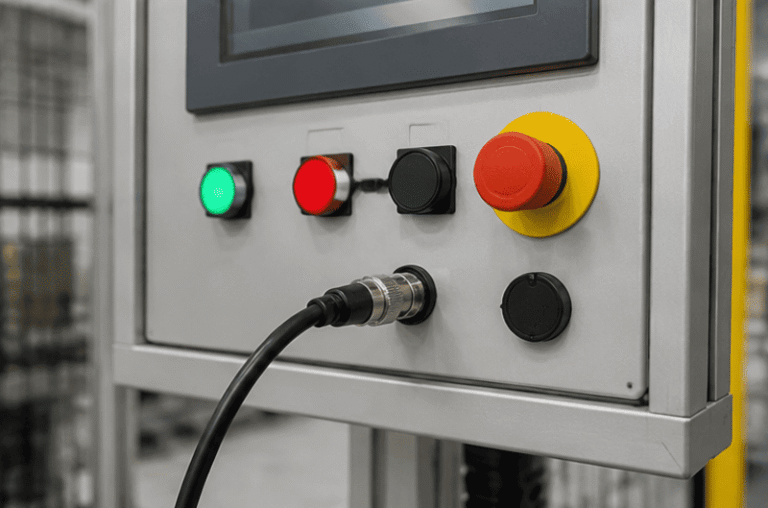
An M12 male connector 5-pin B-coded may look like a straightforward line item, but its name does not…
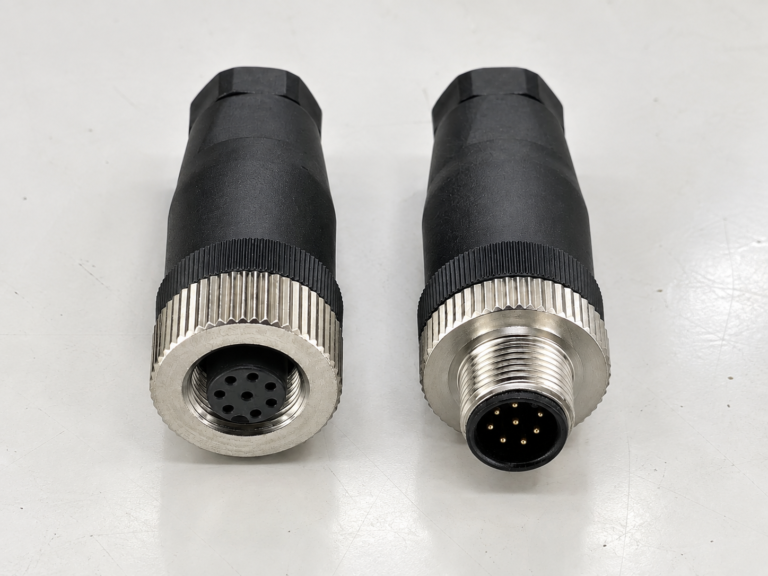
M12 connectors can carry different voltage ratings, so a buyer cannot choose one safely from the connector size…
NITAI manufactures terminal blocks, M8/M12 waterproof connectors and industrial distribution modules for global OEMs, distributors and automation customers.
Leave a Reply