Oct 17, 2026
How Do I Choose the Right M8 8 Pin Female Connector for My Equipment?
An M8 8 pin female connector can look like the right replacement on a purchasing list and still…

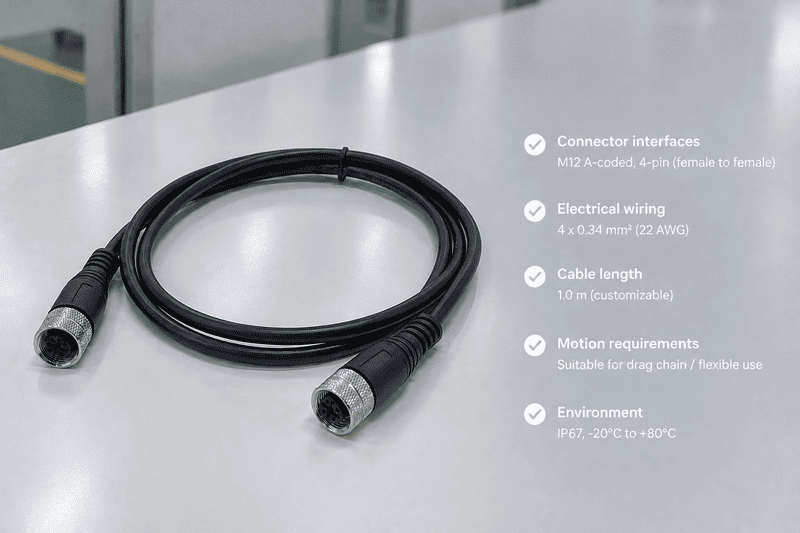
An M12 cable can look correct on a drawing and still be wrong for the machine. I see this risk when buyers confirm the connector but overlook the cable’s operating conditions. A clear selection process helps me match both the equipment interface and the cable’s actual working environment before samples are approved.
An M12 cable is a cable assembly with an M12 connector interface, commonly using a threaded coupling with a nominal 12 mm thread diameter.1 I select its function and suitability through the connector coding, contact count, pinout, cable construction, and operating requirements. M12 assemblies can carry signals, data, or power.2
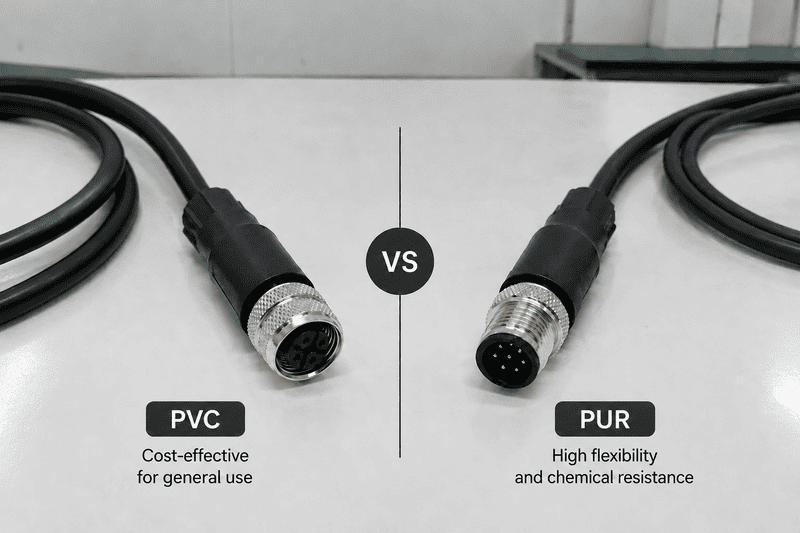
I start with two questions: what must the assembly connect, and what will happen to it during operation? These questions help me separate electrical compatibility from mechanical suitability. The distinction becomes especially important when a cable moves with the machine.
I often receive inquiries that specify only “M12, four pins, two meters.” That description gives me a starting point, but it leaves important details unresolved. Without coding, wiring, and cable specifications, I cannot treat two assemblies with the same contact count as interchangeable.
I distinguish M12 cable types by connector coding, contact count, male or female contacts, connector orientation, end configuration, and cable construction. The M12 designation identifies the connector interface family, not one electrical function. I confirm the equipment documentation before selecting an assembly for signals, industrial networking, or power.
I do not define M12 as an Ethernet cable category. Industrial Ethernet is one important application, but the same interface family also appears in sensor connections, actuator wiring, and power connections.
For procurement, I use the following distinctions:
| Selection factor | What I ask the buyer to confirm | Why I check it |
|---|---|---|
| Coding | A, B, D, X, or the specified power coding | Coding helps define compatible mating interfaces |
| Contact count | The exact number of contacts | The circuit needs the correct contact arrangement |
| Pinout | The function assigned to each contact | Contact count alone does not establish wiring compatibility3 |
| Contact gender | Male or female at each end | Both ends must match their mating components |
| Orientation | Straight or angled connectors | Cabinet clearance and routing can limit access |
| End configuration | M12-to-M12, open wires, or another interface | The assembly must match both connection points |
| Cable construction | Conductors, shielding, jacket, and motion specification | The cable must support its electrical and mechanical duties |
I commonly discuss A-coded assemblies for sensors and actuators, D-coded assemblies for suitable industrial Ethernet connections, and X-coded assemblies for higher-bandwidth industrial networking.4 I also encounter power-coded interfaces where the exact coding and electrical ratings need separate confirmation. These are common application patterns, not substitutes for the equipment specification.
When a buyer needs a closer comparison, I point them to our M12 connector coding guide. I use coding as an early screening step, then check the complete wiring requirements.
I never assume that both ends have identical interfaces or that every assembly uses straight-through wiring. An M12-to-open-wire cable requires a clear conductor-to-contact assignment. An M12-to-another-interface assembly needs documentation for both ends.
I also ask for a drawing when connector orientation matters. A right-angle connector may solve one clearance problem while creating another if its cable exit points toward a nearby panel or moving component. I therefore treat mating compatibility, wiring compatibility, and physical fit as separate approval items.
I see M12 assemblies requested across industrial automation, but a general application name rarely gives me enough information to select one. “Robot cable” or “sensor cable” can describe very different electrical and mechanical requirements. I ask buyers to explain the actual connection and routing before recommending a configuration.
I commonly evaluate M12 cable assemblies for sensors, actuators, industrial networks, machinery, and equipment power connections. Their suitability depends on the specific interface and documented ratings. I also check whether the installation involves moisture, oil, abrasion, electrical interference, fixed routing, or movement, because these conditions affect cable and connector selection.
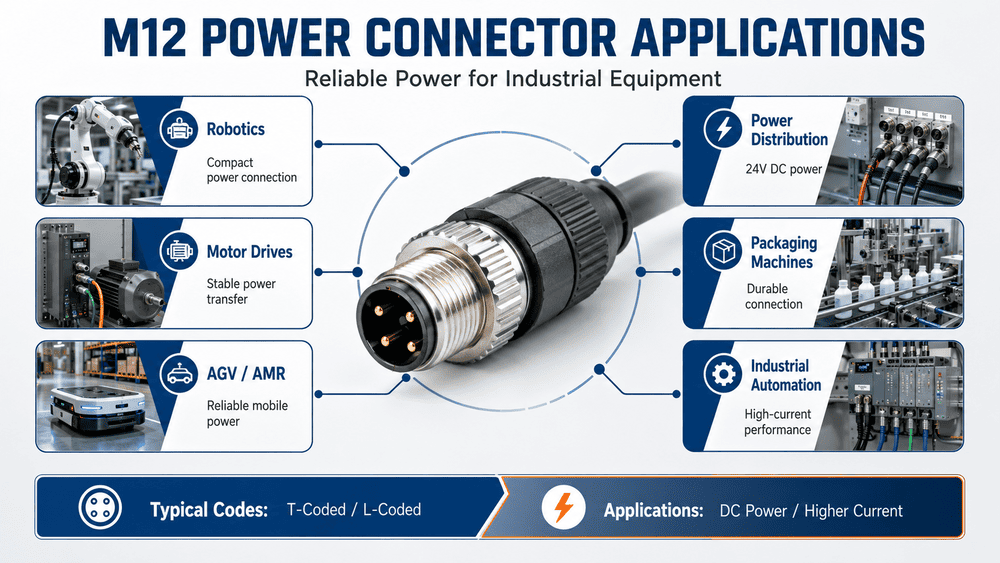
At NITAI, our supplied business context covers industrial connection solutions for automation equipment, robots, sensors, actuators, industrial Ethernet, AGVs, and machinery. In my selection conversations, I turn those broad categories into requirements that purchasing and engineering teams can verify.
| Application | What I check first | What I also ask about |
|---|---|---|
| Sensor or actuator connection | Coding, contacts, and pin assignment | Cable route, contamination, and movement |
| Industrial network connection | Protocol requirements and specified interface | Shielding, cable category, and termination |
| Equipment power connection | Coding and documented electrical ratings | Conductor requirements and installation conditions |
| Moving machine assembly | End interfaces and wiring | Movement type, bend radius, and cable support |
| Wet or exposed installation | Required ingress protection | Mating conditions and environmental compatibility |
For broader application context, I refer buyers to what an M12 connector is used for. I then bring the discussion back to the exact assembly, because a general connector application does not establish the suitability of a particular cable.
I do not rely on the word “waterproof” alone. I ask for the relevant ingress-protection documentation and check whether the stated protection depends on correct mating, sealing components, or other assembly conditions. An unmated connector may not provide the same protection as a properly mated assembly.5
I take the same approach with shielding. A shielded cable can be important for the specified network or installation, but I also need to understand how the shield is terminated and how the equipment expects it to be connected.6 The jacket description does not answer those questions.
Finally, I ask buyers to distinguish a cable mounted on moving equipment from a cable that actually flexes during operation. A cable attached to a moving structure may experience little local bending, while another cable on the same machine may bend at every cycle. I recommend that the buyer’s qualified engineer confirm the application-specific electrical, environmental, and mechanical requirements before final approval.
I pay close attention when an inquiry mentions moving machinery because a connector-compatible sample can still have an unsuitable cable construction. The problem becomes harder to correct after the sample specification has already been accepted. I therefore ask about movement before choosing the jacket material or confirming the quotation.
For moving machinery, I consider a suitable flexible PUR cable a practical option for repeated bending, drag-chain travel, or machine swinging movement. I select it against the complete cable’s documented motion capability and bend-radius requirements. I do not treat PUR jacket material alone as proof of suitability for every movement type.
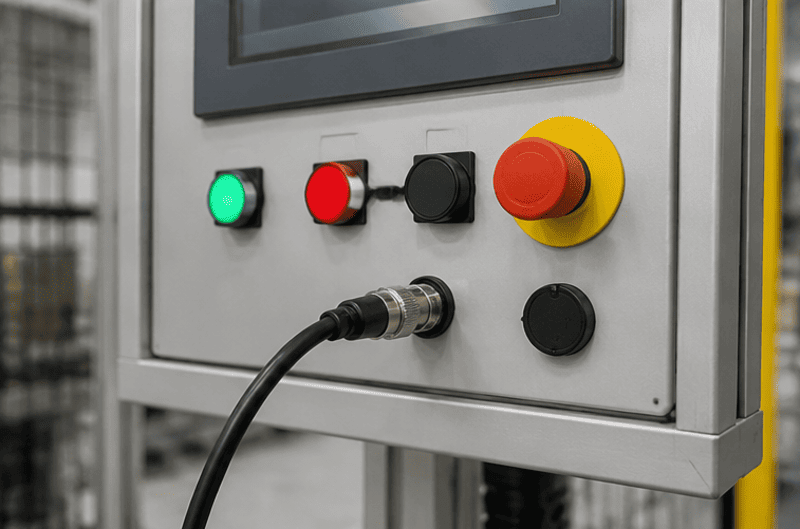
In one customer inquiry I handled at NITAI, the customer initially accepted PVC cable. The customer had not disclosed that the machine required swinging movement. The sample exposed the mismatch between the accepted cable choice and the actual operating conditions.
My lesson was straightforward: movement must be discussed before material selection and sample approval. The early specification conversation had not established whether the cable would remain stationary or move with the machine.
I now make that distinction explicit. I ask whether the cable:
I do not describe these conditions as interchangeable. Drag-chain travel involves guided movement with a defined routing arrangement. Swinging movement can change the cable’s curvature, support, and loading. Torsion introduces twisting and needs its own documented capability.7
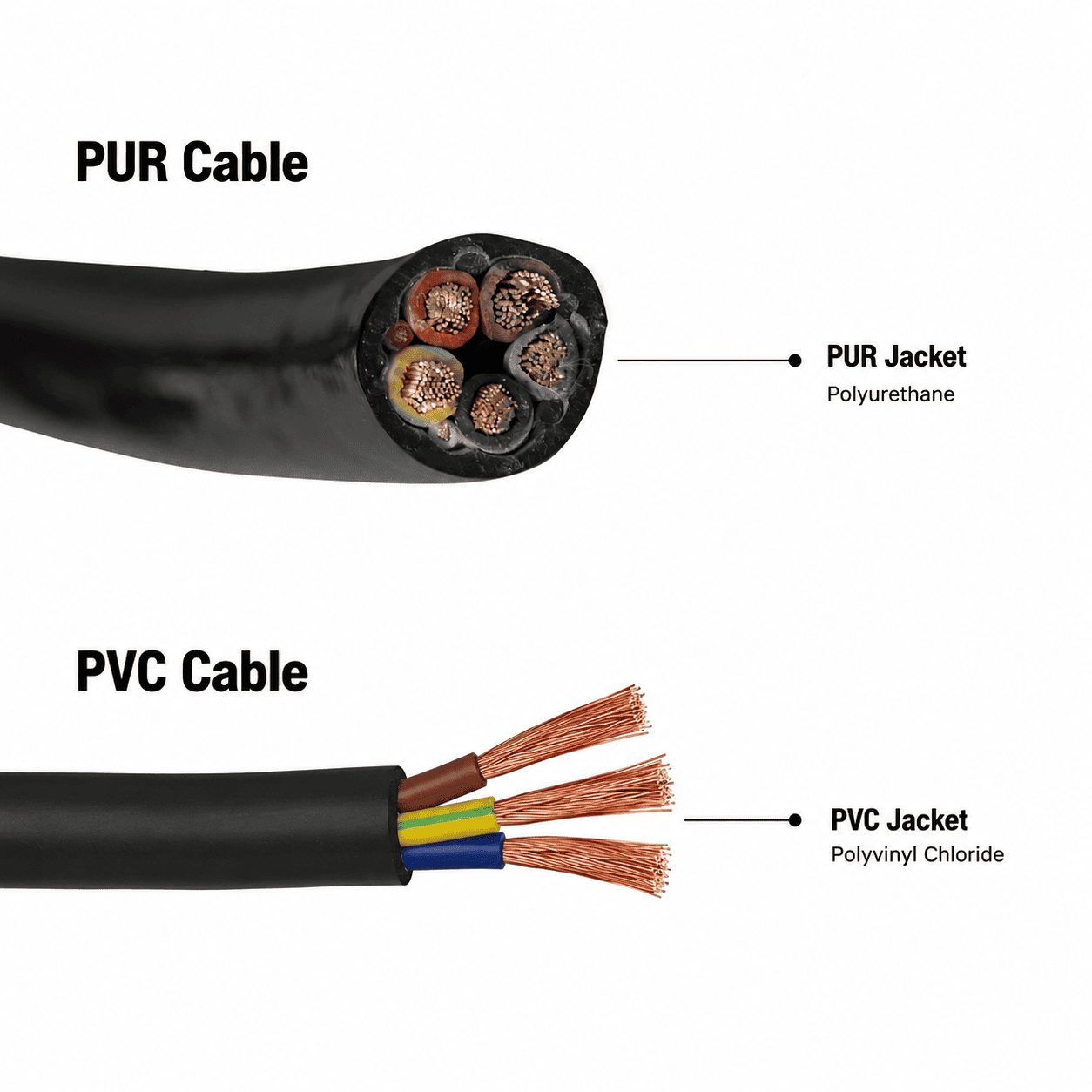
I consider suitable flexible PUR constructions valuable for demanding moving applications. Depending on the specific formulation and cable design, PUR jackets can offer useful flexibility, abrasion resistance, and resistance to certain oils.8 Those properties can make them a practical choice for machinery where routing and repeated motion matter.
However, I evaluate more than the jacket. The complete cable includes conductor stranding, insulation, shielding where applicable, and the internal arrangement of those components. Each contributes to how the assembly behaves during motion.9
| Operating condition | My selection approach |
|---|---|
| Stationary routing | I consider a suitable PVC or PUR construction against the environment |
| Repeated bending | I request documented flex capability and dynamic bend-radius requirements10 |
| Drag-chain travel | I request a specifically suitable drag-chain cable and its operating limits |
| Swinging movement | I clarify the motion path, supports, bending, and any associated twisting |
| Torsion | I request a cable with documented torsional capability |
I do not reject PVC as a category. A suitable PVC cable may be sufficient for stationary routing, and individual PVC constructions can differ in flexibility and capability. My recommendation is to select an appropriate flexible PUR or high-flex cable based on the confirmed application and available specifications, not simply to change the material name.
I can prepare a more useful quotation when the inquiry describes both the connection and the operating conditions. Missing details create assumptions that may survive into sample production. I use a written checklist so the buyer, supplier, and engineering team can review the same specification before approval.
For an M12 cable quotation, I request coding, contact count, pinout, both end interfaces, length, shielding, quantity, and drawings. I also request movement type, applicable bend-radius requirements, and environmental conditions. For moving applications, I ask for documented cable capability before confirming a flexible PUR or other high-flex construction.
I recommend the following inquiry format because it exposes gaps before the quotation becomes a purchasing reference:
| RFQ item | Information I request |
|---|---|
| Connector interfaces | Coding, contact count, contact gender, and orientation at both ends |
| Electrical wiring | Pinout, conductor assignments, and any special wiring |
| Cable length | Nominal length, measurement reference, and required tolerance |
| Electrical requirements | Intended signal, network, or power duty and relevant ratings |
| Cable construction | Required jacket material, shielding, and available cable specification |
| Motion | Stationary use, repeated bending, drag-chain travel, swinging movement, or torsion |
| Bending requirements | Required static or dynamic bend radius and how it is defined |
| Environment | Temperature, oil exposure, moisture, abrasion, and other relevant conditions |
| Commercial requirements | Sample quantity, production quantity, delivery schedule, and packaging |
| Technical references | Equipment drawings, mating-part details, and acceptance requirements |
Where movement is involved, I also request the available travel, motion frequency, installation layout, and support arrangement. I do not fill missing values with assumed operating limits. The buyer’s engineering team should identify the requirements, and the supplier should explain what the proposed construction supports.
I compare quotations against the same approved specification. Otherwise, a lower price may reflect a different cable construction, omitted shielding, a different connector arrangement, or a stationary-use assembly where a moving-use cable was intended.
For supplier evaluation, I ask about:
I treat certifications as documents to verify, not as automatic proof that every quoted configuration meets the requirement.11 I check the named product, scope, issuer, and relevance to the buyer’s intended market.
NITAI’s supplied business context includes OEM/ODM support, cable customization, engineering documentation, sample development, and batch production. I use those services to help buyers establish a reviewable specification, while confirming the feasibility of each requested configuration individually.
For sample approval, I recommend checking interface fit, wiring, dimensions, routing, and the stated operating conditions. An initial fit check does not establish repeated-motion capability.12 I ask the buyer’s qualified engineering team to define appropriate application-specific evaluation before releasing the assembly for production use.
I do not use “M12” as a synonym for Ethernet. It describes the connector interface family. An assembly may serve sensors, actuators, industrial networks, or power connections. I confirm its function through coding, contact count, pinout, cable construction, and the connected equipment’s specification.
I often consider suitable flexible PUR a practical choice for moving machinery because appropriate constructions can support repeated bending and demanding routing conditions. I still compare the complete cable specifications. A suitable PVC cable may be sufficient for stationary installations, and jacket material alone does not establish motion capability.
I do not assume that every PUR cable is drag-chain rated. I request documentation for the exact cable construction, including applicable bending and operating limits. The PUR jacket can provide useful properties, but the conductors, insulation, shielding, and internal construction also affect motion suitability.
I would not approve a replacement on pin count alone. I also check coding, contact gender, pinout, orientation, electrical requirements, shielding, and cable construction. For moving equipment, I include motion capability and routing requirements so the replacement matches more than the visible connector.
I can assess an inquiry more effectively when it includes drawings, coding, contact count, pinout, end interfaces, length, shielding, quantity, and operating conditions. For moving machinery, I also need the movement type and bending requirements. These details help me discuss a suitable configuration without relying on assumptions.
I select an M12 cable by matching both the equipment interface and the operating conditions. Coding and pinout establish compatibility, while cable construction, environment, and movement determine whether the assembly suits the installation. My customer sample experience reinforced the importance of discussing movement early. Suitable flexible PUR is a valuable option for demanding motion when its documented capability matches the application. Contact NITAI with your drawings, connection details, quantities, and motion requirements so I can help review the assembly specification before quotation and sample approval.
"M12", https://en.wikipedia.org/wiki/M12. IEC 61076-2-101 specifies circular M12 connectors with screw locking, supporting the threaded-interface description; its scope does not encompass every alternative M12 locking mechanism. Evidence role: definition; source type: institution. Supports: The standardized M12 screw-locking connector interface and its nominal coupling-thread size.. Scope note: The cited standard describes screw-locking connectors, not all connector variants marketed as M12. ↩
"IEC metric screw sized connectors", https://en.wikipedia.org/wiki/IEC_metric_screw_sized_connectors. The IEC 61076-2 series includes M12 connector specifications for signal, data, and power applications, establishing the range of functions within the interface family rather than the capabilities of any single assembly. Evidence role: general_support; source type: institution. Supports: The existence of distinct M12 connector specifications for signal, data, and power applications.. Scope note: Family-level coverage does not establish the electrical suitability of a particular cable assembly. ↩
"IEC metric screw sized connectors", https://en.wikipedia.org/wiki/IEC_metric_screw_sized_connectors. Standardized connector arrangements and application-specific pin assignments distinguish physical contact count from the electrical function assigned to each contact, supporting separate verification of the wiring map. Evidence role: mechanism; source type: institution. Supports: Compatibility depends on specified contact assignments as well as the number of contacts.. ↩
"IEC metric screw sized connectors", https://en.wikipedia.org/wiki/IEC_metric_screw_sized_connectors. M12 connector specifications and industrial-network installation guidance associate A-coding with sensor and actuator interfaces and D- and X-coding with Ethernet interfaces, with X-coded designs supporting higher-frequency data transmission; achieved link performance also depends on the cable and connected equipment. Evidence role: general_support; source type: institution. Supports: Common applications of A-, D-, and X-coded M12 connectors and the data-interface distinctions between D and X coding.. Scope note: Coding identifies interface characteristics but does not independently guarantee a protocol or data rate. ↩
"IEC metric screw sized connectors", https://en.wikipedia.org/wiki/IEC_metric_screw_sized_connectors. IEC 60529 defines enclosure ingress-protection classifications, while connector specifications identify the assembly conditions to which protection applies; a rating established for a mated connector does not by itself establish equivalent protection when unmated. Evidence role: general_support; source type: institution. Supports: Ingress protection applies to specified test and assembly conditions, including the connector's mating state where relevant.. Scope note: The protection of an individual connector must be determined from its applicable specification and stated test conditions. ↩
"Effectiveness of Shield Termination Techniques Tested ...", https://ntrs.nasa.gov/api/citations/20090033805/downloads/20090033805.pdf. Electromagnetic-compatibility guidance identifies shield termination and bonding as contributors to interference control, supporting evaluation of the complete shielding path rather than the cable shield alone; appropriate arrangements depend on frequency and system grounding. Evidence role: mechanism; source type: government. Supports: Shield continuity, termination geometry, and bonding influence electromagnetic interference control.. Scope note: General EMC guidance does not establish the required termination for a particular industrial network or machine. ↩
"Determination of Tensile Characteristics and Electrical ... - PMC", https://pmc.ncbi.nlm.nih.gov/articles/PMC12114882/. Cable mechanics and fatigue studies treat bending and torsion as distinct loading modes, supporting separate assessment of twisting capability; results remain specific to the tested cable construction and loading conditions. Evidence role: mechanism; source type: paper. Supports: Bending and torsion produce different cable deformation and fatigue conditions and require relevant testing.. Scope note: Mechanical studies do not qualify an untested M12 assembly or establish universal torsion limits. ↩
"Study on Mechanical Properties of Polyurethane Cross-Linked ...", https://pmc.ncbi.nlm.nih.gov/articles/PMC9785859/. Research on polyurethane elastomers relates flexibility, abrasion performance, and chemical resistance to polymer composition and structure, providing material-level context for these jacket properties rather than proof of performance for a particular cable. Evidence role: general_support; source type: paper. Supports: Polyurethane elastomers can exhibit useful flexibility, abrasion resistance, and oil resistance, with substantial formulation-dependent variation.. Scope note: Bulk-material findings do not establish the durability or oil compatibility of a finished cable jacket under specific service conditions. ↩
"Mechanical Properties and Fatigue Life Analysis of Motion ...", https://pmc.ncbi.nlm.nih.gov/articles/PMC10893113/. Mechanical studies of flexible cables show that conductor geometry and interactions among internal components influence strain and fatigue under cyclic loading, supporting assessment of the complete construction rather than jacket material alone. Evidence role: mechanism; source type: paper. Supports: Conductor geometry, component materials, and internal cable arrangement influence strain distribution and fatigue during motion.. Scope note: The magnitude of each contribution and the resulting service life depend on the tested construction and motion profile. ↩
"Discard fatigue life of stranded steel wire rope subjected to ...", https://www.academia.edu/118580097/Discard_fatigue_life_of_stranded_steel_wire_rope_subjected_to_bending_over_sheave_fatigue. Cyclic-bending research links cable curvature to strain and fatigue behavior, supporting the use of documented dynamic bending limits rather than treating an installation bend radius as evidence of repeated-motion endurance. Evidence role: mechanism; source type: paper. Supports: Bend radius affects cyclic strain and fatigue, so repeated-motion limits need application-relevant qualification.. Scope note: Research findings do not provide a universal minimum bend radius or cycle-life rating for all cable constructions. ↩
"Conformity Assessment Basics | NIST", https://www.nist.gov/standardsgov/conformity-assessment-basics. Conformity-assessment frameworks distinguish product certification from management-system certification and define the scope of the attestation, supporting verification that the certificate covers the relevant product and requirements. Evidence role: general_support; source type: institution. Supports: Certification has a defined subject and scope, and management-system certification is distinct from product conformity.. Scope note: General certification frameworks do not establish the validity or applicability of any particular supplier certificate. ↩
"Evaluation of cyclic fatigue and bending test for different ...", https://pmc.ncbi.nlm.nih.gov/articles/PMC10456180/. Cable test standards include repeated-flexing procedures distinct from initial dimensional and electrical checks, supporting the distinction between installation fit and motion endurance; the applicable procedure must match the cable and intended service. Evidence role: general_support; source type: institution. Supports: Repeated-motion endurance is evaluated through cyclic testing rather than initial dimensional or mating checks.. Scope note: General flexible-cable test methods do not automatically qualify an M12 assembly for a particular drag-chain, swinging, or torsional application. ↩
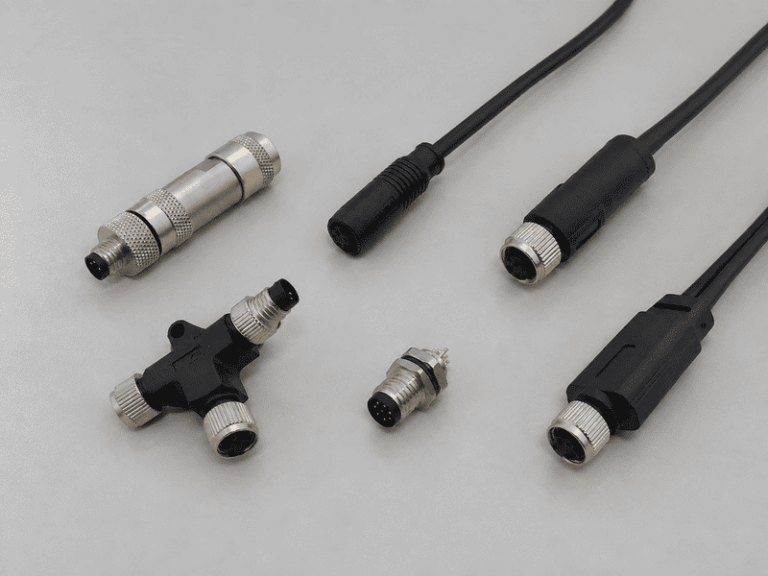
An M8 8 pin female connector can look like the right replacement on a purchasing list and still…
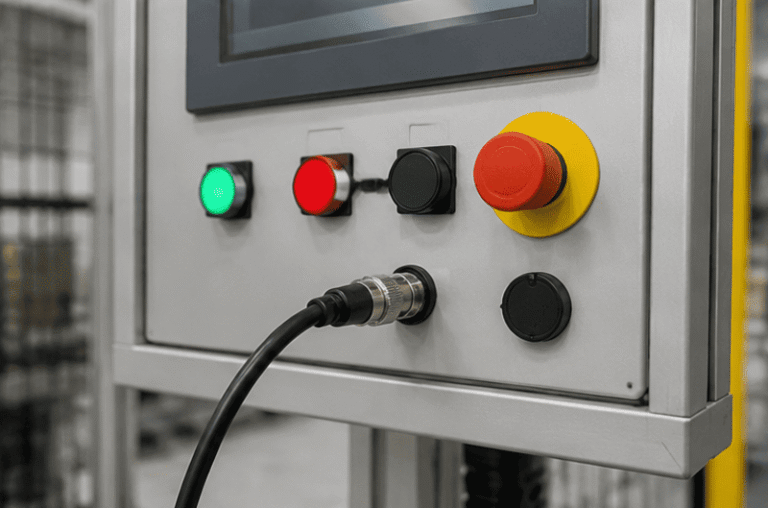
An M12 male connector 5-pin B-coded may look like a straightforward line item, but its name does not…
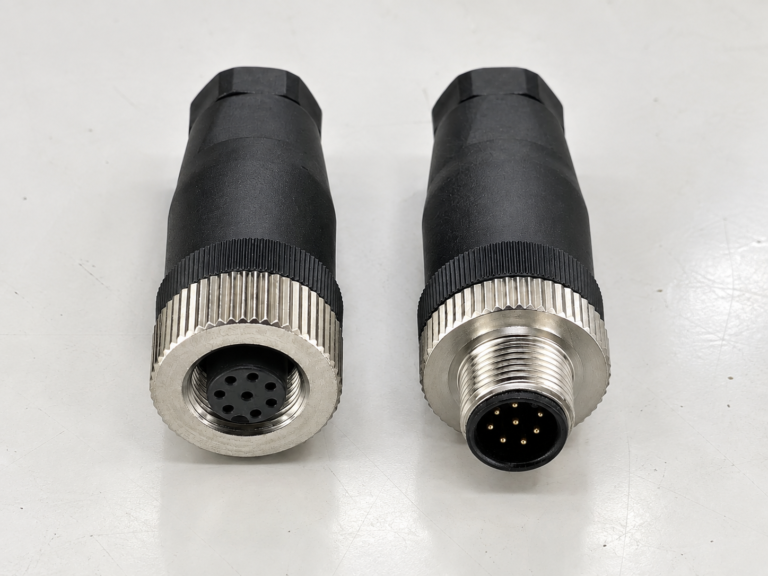
M12 connectors can carry different voltage ratings, so a buyer cannot choose one safely from the connector size…
NITAI manufactures terminal blocks, M8/M12 waterproof connectors and industrial distribution modules for global OEMs, distributors and automation customers.
Leave a Reply